
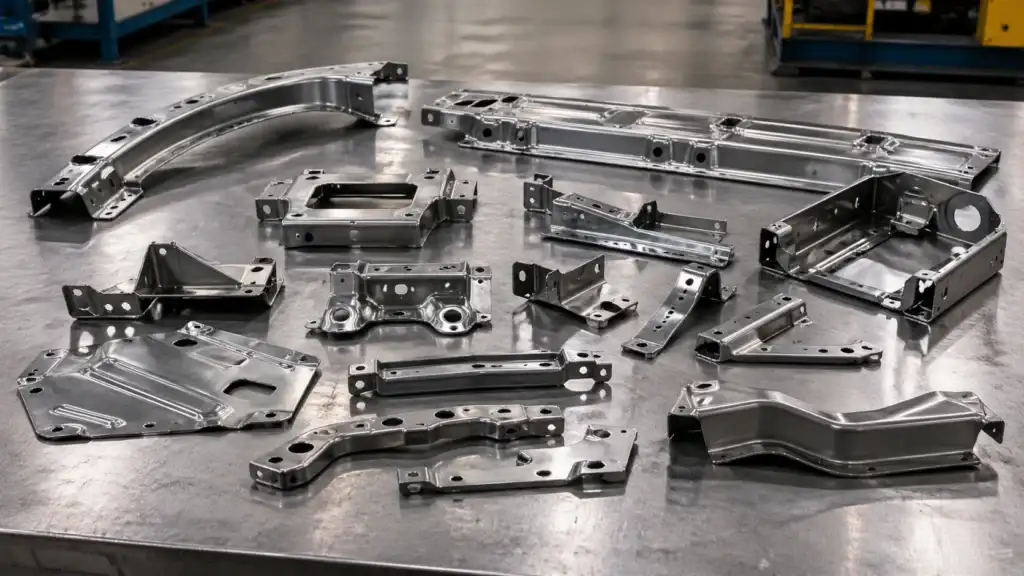
Das Stanzen von Stahl ist das am weitesten verbreitete und kostengünstigste Metallumformverfahren zur Herstellung hochfester struktureller und mechanischer Komponenten. Wir stanzen Kohlenstoffstahl, legierten Stahl, verzinkten Stahl, hochfesten niedriglegierten Stahl (HSLA) und Federstahl in Stärken von 0,004 Zoll bis 0,500 Zoll Baumetallstanzen, Haushaltsgeräte, Landwirtschaft, HVAC, Möbel und allgemeine Industrieanwendungen.
Stahl bietet eine unübertroffene Kombination aus Festigkeit, Formbarkeit, Schweißbarkeit und Erschwinglichkeit, die ihn zum Material der Wahl für die meisten gestanzten Metallteile macht. Unser Fachwissen im Stahlstanzen reicht von dünnwandigen Präzisionselektronikkomponenten bis hin zu schweren Strukturhalterungen und Verstärkungen.
Von uns gestanzte Stahlsorten
| Typ | Gängigen Sorten | Schlüsseleigenschaften | Anwendungen |
|---|---|---|---|
| Kaltgewalzt (CRS) | 1008, 1010, 1018 | Glatte Oberfläche, enge Toleranzen, gute Formbarkeit | Präzisionsteile, Halterungen, elektronische Fahrwerke |
| Warmgewalzt (HRS) | 1020, 1045, A36 | Kostengünstig, in dickeren Stärken erhältlich | Strukturhalterungen, Hochleistungshardware |
| Verzinkt | G60, G90 (HDG, EG) | Zum Korrosionsschutz verzinkt | Outdoor-Hardware, HVAC, Automobil-Unterboden |
| HSLA | HSLA 50, 80 | Höhere Festigkeit bei geringerem Gewicht | Kfz-Struktur- und Anhängerrahmen |
| AHSS | DP590, DP780, TRIP | Ultrahohe Festigkeit für Crash-Performance | Sicherheitskomponenten für Kraftfahrzeuge |
| Federstahl | 1074, 1095, SK5 | Hohe Belastbarkeit und Ermüdungsbeständigkeit | Federn, Clips, Halterungen, Schlosskomponenten |
| Legierter Stahl | 4130, 4140, 8620 | Wärmebehandelbar, hohe Zähigkeit | Zahnräder, Wellen, Strukturbauteile |
Stanzteile aus Kohlenstoffstahl für eine kostengünstige Produktion
Stanzteile aus Kohlenstoffstahl werden häufig für Halterungen, Clips, Platten, Rahmen, Unterlegscheiben und Strukturkomponenten ausgewählt, die Festigkeit zu wettbewerbsfähigen Stückkosten benötigen. Wir stanzen Stähle mit niedrigem und mittlerem Kohlenstoffgehalt durch Plattieren, Pulverbeschichten, Wärmebehandlung oder Entgraten nach Bedarf und helfen Käufern dabei, Werkzeugkosten, Materialkosten, Festigkeit und Oberflächenschutz für die Massenproduktion in Einklang zu bringen.
Vorteile des Stahlstanzens
- Niedrigste Materialkosten — Kohlenstoffstahl ist das wirtschaftlichste stanzbare Metall und bietet ein hervorragendes Preis-Leistungs-Verhältnis für die Massenproduktion
- Hervorragende Formbarkeit — Sorten mit niedrigem Kohlenstoffgehalt (1008, 1010) bieten hervorragende Duktilität für komplexe Formen und Tiefziehen
- Hohe Festigkeit — HSLA- und AHSS-Typen bieten ein hervorragendes Verhältnis von Festigkeit zu Gewicht für Strukturanwendungen
- Schweißbarkeit — Kohlenstoffstahlteile lassen sich für Montagearbeiten leicht schweißen
- Große Verfügbarkeit — Stahl ist in den unterschiedlichsten Stärken, Breiten und Güten erhältlich
- Magnetische Eigenschaften – wichtig für Motorbleche, Magnetteile und Magnetanwendungen
Anwendungen für gestanzte Stahlteile
- Automobilindustrie – Strukturverstärkungen, Halterungen, Sitzrahmen, Türscharniere, Bremsträgerplatten
- Baugewerbe – Balkenaufhänger, Verbinder, Ankerplatten, Rahmenbeschläge
- Geräte – Motorbleche, Gehäuse, Halterungen und interne Strukturrahmen
- Landwirtschaft – Geräteschutz, Halterungen, Verbindungskomponenten und Verschleißteile
- HVAC – Kanalhalterungen, Montageplatten, Klappenblätter und Strukturstützen
- Möbel – Halterungen, Scharniere, Schienen und Strukturrahmenkomponenten
Oberflächenveredelungsoptionen
Wir koordinieren alle zu liefernden Oberflächenveredelungsvorgänge montagefertige gestanzte Stahlteile:
- Verzinkung – Trommel- oder Gestellbeschichtung gemäß ASTM B633 für Korrosionsschutz (klares, gelbes, schwarzes Zink)
- Vernickelung – dekorative und verschleißfeste Oberfläche für sichtbare Komponenten
- Pulverbeschichtung – dauerhafte, dicke Beschichtung in jeder Farbe für Außen- und stark beanspruchte Anwendungen
- E-Beschichtung (Elektroabscheidung) – gleichmäßige Abdeckung komplexer Geometrien für den Korrosionsschutz im Automobilbereich
- Phosphatierung – Zink- oder Manganphosphat für Farbhaftung und leichten Korrosionsschutz
- Schwarzoxid – kostengünstige schwarze Oberfläche mit minimalem Korrosionsschutz und Dimensionsstabilität
- Lackierung – Nassspritzen oder Elektrostatik für kundenspezifische Farben und Spezifikationen
Angebot anfordern
Kontaktieren Sie uns unter [email protected] oder rufen Sie +86 152-5047-1868.
Verwandte Ressourcen
- Gestanzter Stahl: Sorten, Eigenschaften und Anwendungen
- Was bestimmt die Preise für Metallstanzen
- Stanzdienstleistungen für Edelstahl
- Sheet Metal Stamping Services
Häufig gestellte Fragen
Welche Stahlsorten werden beim Stanzen verwendet?
Zu den gängigen Stanzstählen gehören Stahl mit niedrigem Kohlenstoffgehalt (SPCC/1008/1010) für den allgemeinen Gebrauch, Stahl mit mittlerem Kohlenstoffgehalt (1045) für Festigkeit, hochfester niedriglegierter Stahl (HSLA) für die Automobilindustrie und Federstahl (SK5/1095) für elastische Teile.
Was ist der Unterschied zwischen Warm- und Kaltprägestahl?
Das Kaltprägen wird bei Raumtemperatur durchgeführt und sorgt für eine bessere Oberflächengüte und engere Toleranzen. Beim Heißprägen wird Stahl vor dem Umformen auf über 900 °C erhitzt und wird für ultrahochfeste Automobilstrukturteile (1500+ MPa) verwendet.
Verwandte Ressourcen
- Baumetall-Stanzen – Gestanzte Hardware und Befestigungselemente für Bauanwendungen.
Häufig gestellte Fragen
Welche Stahlsorten stanzen Sie?
Wir stanzen kaltgewalzten Stahl (CRS, SPCC, DC01-DC06), warmgewalzten Stahl (HRS), verzinkten Stahl (G60, G90), hochfesten niedriglegierten Stahl (HSLA) und Federstahl. Jede Sorte wird basierend auf den Anforderungen Ihres Teils an Festigkeit, Formbarkeit und Korrosionsbeständigkeit ausgewählt.
Welche Toleranzen können Sie beim Stahlstanzen erreichen?
Die handelsübliche Toleranz beträgt ±0,10 mm. Das Präzisionsstanzen erreicht ±0,05 mm. Bei kritischen Abmessungen können wir mit Feinstanzen ±0,025 mm halten. Alle Toleranzen werden durch CMM-Inspektion und statistische Prozesskontrolle (SPC) überprüft.
Was ist die Mindestbestellmenge für das Stanzen von Stahl?
Unser MOQ beginnt bei 500 Stück für Prototypenläufe. Beim progressiven Stanzen in der Produktion liegt der wirtschaftliche Break-Even aufgrund der Werkzeugamortisation in der Regel bei 5.000–10.000 Stück. Wir geben ehrliche Empfehlungen basierend auf Ihrem Volumen.
Wie lange dauert die Herstellung von Stahlstanzwerkzeugen?
Die Vorlaufzeit für die Werkzeugbestückung beträgt je nach Komplexität 3–8 Wochen. Eine einfache zusammengesetzte Matrize benötigt 3–4 Wochen, während eine komplexe progressive Matrize mit 20 Stationen 6–8 Wochen benötigt. Wir bieten beschleunigte Werkzeugprogramme für dringende Projekte an.
Bieten Sie Materialzertifizierungen an?
Ja. Jeder Lieferung liegen Mühlentestzertifikate (MTC) mit Schmelznummern bei, die auf die Rohmaterialcharge rückverfolgbar sind. Bei Automobilprojekten (IATF 16949) gewährleisten wir eine vollständige Chargenrückverfolgbarkeit vom eingehenden Material bis zum fertigen Teil.