

Metal Stamping Supplier for Precision Parts and Production Programs
Choosing the right metal stamping supplier is one of the most consequential sourcing decisions a manufacturer makes. The wrong choice creates a chain of problems: dimensional variation at volume, tooling disputes, documentation gaps during qualification audits, and supply interruptions when your production line cannot afford to stop. The right supplier becomes invisible — parts arrive on time, within tolerance, with the paperwork your quality team needs, every batch.

Ready to evaluate us as your supplier? Submit your drawing or RFQ via our contact page — we return a structured quotation with tooling cost, unit price, and lead time within 2 business days.
What to Look for in a Metal Stamping Supplier
Not all stamping suppliers are equivalent. Evaluating a supplier before you place a production order — not after the first quality escape — is how procurement teams protect their supply chains. Here are the criteria that distinguish a capable stamping supplier from a commodity price-cutter:
- In-house tooling design and manufacture — a supplier who builds their own dies controls lead times, die modifications, and tool maintenance. A supplier who outsources tooling has a dependency you inherit.
- Process range and press capacity — progressive die, compound die, transfer die, deep draw, and fine blanking serve different part geometries. A supplier with only one process will force your parts into it regardless of fit.
- Documented quality system — ISO 9001 certification is a baseline. For automotive and medical supply chains, IATF 16949 or equivalent quality management is expected. Ask to see the quality manual and recent audit results.
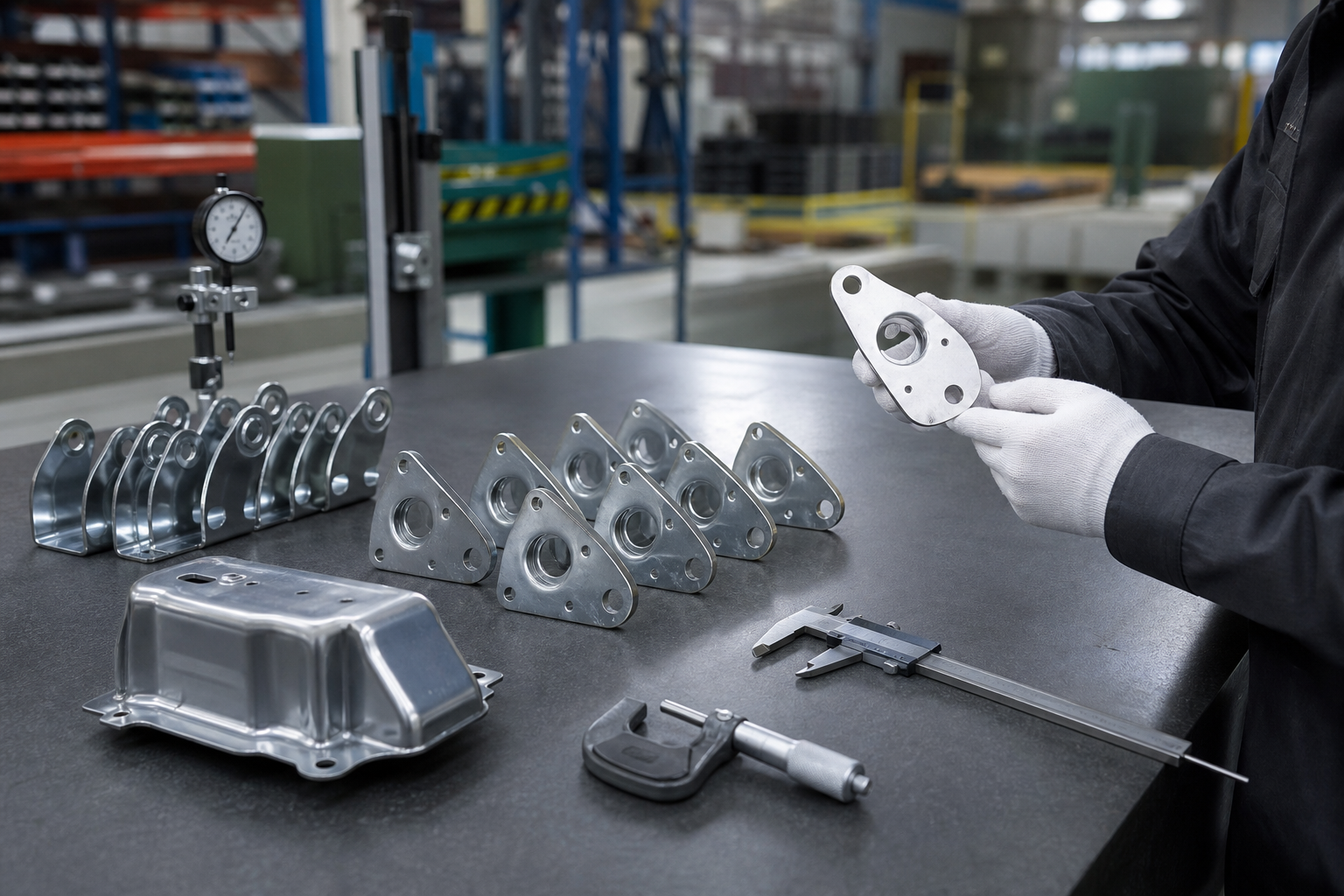
- First Article Inspection (FAI) capability — your supplier should produce a full dimensional FAI report using calibrated measurement equipment (CMM, optical comparator, or vision system) before releasing production.
- Material traceability — certified material test reports (MTRs), heat number traceability, and incoming material inspection records protect you during audits and field failures.
- Production capacity and scheduling discipline — a supplier who is always “running behind” on other customers will eventually run behind on yours. Ask about current capacity utilization and how they handle competing priorities.
- Communication and responsiveness — how fast does the supplier respond to an RFQ? How clearly do they communicate lead time, tooling status, and shipment schedules? These indicators predict how they will behave when something goes wrong.
ISO and IATF-Aligned Supplier Trust for Global Buyers
As a metal stamping supplier serving OEM and industrial buyers, we support ISO-based quality management, documented inspection records, material traceability, corrective action workflow, and automotive IATF-aligned production controls when required by the program. Certification documents, audit evidence, PPAP-style records, and measurement reports can be shared with qualified customers during supplier evaluation.
Before shortlisting a supplier, procurement teams often need to verify the operating company behind the quote. Our metal stamping company page provides that factory-level view, including tooling, inspection, certifications, production capacity, and export support.
Our Metal Stamping Supplier Capabilities
We operate as a full-service metal stamping supplier with in-house tooling, multi-process stamping, and integrated quality systems. The following summarizes what we bring to a supplier relationship:
| Capability | Specification |
|---|---|
| Stamping processes | Progressive die, compound die, transfer die, deep draw, fine blanking, bending & forming |
| Press capacity | 25–800 ton; mechanical and servo presses |
| Material thickness | 0.1 mm – 12 mm |
| Tolerance capability | ±0.01 mm on critical features; ±0.05 mm general |
| Materials | Cold rolled steel, stainless steel (304/316/430), aluminum (5052/6061), copper, brass, HSLA, pre-coated |
| Annual volume range | Prototype to 10M+ pcs/year |
| Tooling | Full in-house die design, CNC machining, EDM, wire cutting, and tryout |
| Quality documentation | FAI, PPAP, dimensional report, material certification, process FMEA, control plan |
| Surface treatment | Zinc plating, nickel plating, anodizing, powder coat, passivation (subcontracted, coordinated) |
| Certifications | ISO 9001:2015 |
Supplier Qualification: How We Support Your Approval Process
Qualified manufacturers typically require new suppliers to complete an approval process before entering production supply. We are structured to support that process efficiently:
- Supplier questionnaire and audit preparation — we maintain a current supplier self-assessment covering process controls, equipment calibration, corrective action history, and quality certifications. We can return a completed questionnaire within 5 business days.
- First Article Inspection (FAI) — we produce a full FAI report including dimensional balloon drawings, measurement data by feature, material certification, and process summary. Reports are issued in your preferred format or AS9102 / PPAP format on request.
- Sample submission — initial samples are produced from production tooling, not prototype tooling. What you approve in the sample phase is what you receive in production.
- PPAP documentation (Level 1–5) — for automotive and industrial OEM customers who require PPAP, we can provide Part Submission Warrant (PSW), dimensional results, material certifications, and process flow.
- On-site audit support — we welcome customer quality audits at our facility. Remote video audits are also available.
Industries We Supply
We currently supply stamped metal components to manufacturers in the following end markets. Each industry has specific documentation, material, and quality requirements that our production teams are trained to meet:
- Automotive Tier 1 and Tier 2 suppliers — structural brackets, body clips, spring contacts, motor laminations, and safety-critical assemblies. IATF-aligned quality practices.
- Electronics and electrical equipment — EMI shields, terminal contacts, connector housings, busbars, and lead frames. Tight flatness and burr control requirements.
- Medical device components — surgical instrument parts, implant hardware, and medical housing components. Biocompatible material selection and lot traceability.
- Construction and building hardware — structural brackets, joist hangers, anchor plates, and fastener components. High-volume production from galvanized and structural steel.
- Appliance and HVAC — motor components, control brackets, housing panels, and assembly hardware. Stable volume programs with consistent dimensional requirements.
How We Handle the Supplier Relationship
Supplier relationships in manufacturing work best when expectations are clear before the first order. Here is how we structure the working relationship with production customers:
- Dedicated account contact — you will have a named contact who knows your programs, your quality requirements, and your scheduling preferences. Not a rotating support queue.
- Engineering change notice (ECN) management — when your design changes, we update tooling, re-validate affected dimensions, and issue revised documentation. ECN impact is assessed within 5 business days of receipt.
- Tooling ownership and records — customer-owned tooling is catalogued, maintained on a scheduled basis, and tracked against shot count and resharpen history. You always know the condition of your dies.
- Blanket order and release scheduling — for stable-volume programs, we support blanket POs with scheduled releases. Inventory buffer agreements can be arranged for critical components.
- Non-conformance resolution — if a quality issue occurs, we issue an 8D report or SCAR response within your required timeline, with root cause analysis and corrective action evidence.
Related Services and Resources
- Custom metal stamping — DFM review, prototype tooling, and first-production runs for new part programs
- OEM metal stamping — structured supply programs for brand manufacturers with PPAP, ECN management, and long-term tooling support
- Metal stamping manufacturer overview — facility, equipment, and quality system details
- Progressive die stamping — high-volume process detail
- Deep draw stamping — housings, shells, and drawn part capability
- Metal stamping parts — product range and materials
Metal Stamping Supplier — Frequently Asked Questions
What is the minimum order quantity for a new supplier relationship?
We do not impose a minimum order quantity as a policy. Practical minimums depend on the process: progressive die tooling investment typically requires annual volumes above 50,000 pieces to justify cost per part; compound die and bending operations can be cost-effective at lower volumes. For prototype and first-article runs, we support quantities as low as 50–200 pieces from production tooling.
How long does supplier qualification typically take?
Qualification timelines depend on your process. For customers with a structured supplier approval process, the typical sequence is: RFQ and quotation (1–2 weeks), tooling design and build (4–12 weeks depending on die complexity), first article production and inspection (1–2 weeks), and customer approval (your internal process). Total time from RFQ to approved production release is typically 8–16 weeks for tooled parts.
Do you support PPAP submission for automotive customers?
Yes. We can produce PPAP documentation at Level 1 through Level 5 as required by your customer. Standard deliverables include Part Submission Warrant (PSW), dimensional results, material certifications, process flow diagram, FMEA, and control plan. We are familiar with the AIAG PPAP manual requirements and align our FAI documentation to PPAP Level 3 as a default for automotive customers.
What quality certifications do you hold?
We are certified to ISO 9001:2015. Our quality management system covers design control, production process control, calibrated measurement equipment, non-conformance management, corrective action, and supplier management. Audit reports and certification documents are available to qualified customers upon request.
Can you stamp materials we supply or consign?
Yes, we can process customer-supplied material under a consignment arrangement. We will inspect incoming material against the agreed specification and issue a receiving inspection report. Material rejection and handling procedures will be agreed in advance. Note that we cannot provide material certifications for consigned material we did not source.
How do you handle capacity for new customers when existing programs are running?
We maintain capacity planning across our press lines and schedule new program launches around existing commitments. When you request a quotation, we will confirm current capacity availability and an honest production start date. We do not overpromise lead times to win business and then deliver late — that is not how long-term supplier relationships work.
Request a Supplier Quotation
If you are evaluating metal stamping suppliers for a current or upcoming program, the fastest path forward is to share your drawing and annual volume estimate. We will review the part, confirm process fit, and return a structured quotation — tooling cost, unit price at your volume, lead time, and quality documentation plan — within 2 business days.
Related Stamping Services
Full-service OEM stamping with PPAP and global delivery.
State-of-the-art press shop with in-house tooling.
Short-run and prototype stamping from 100 pcs.
Mass production stamping with JIT delivery.
Precision electronic and mechanical components.
Contacts, busbars, and terminals for electrical OEMs.
Stamped parts plus welding, riveting, and kitting.
Large complex parts up to 800×600 mm.
Up to 1,500 SPM for connectors and terminals.