
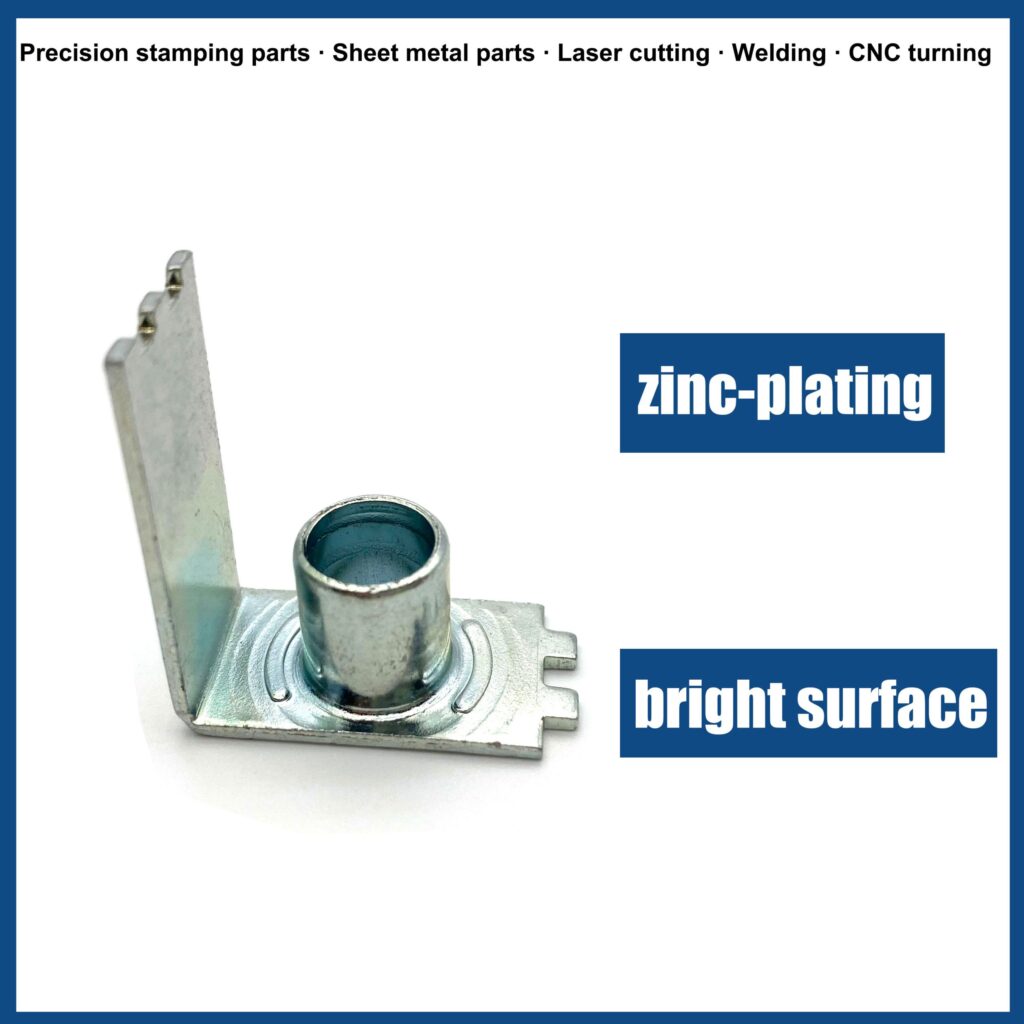
Deep draw stamping is a specialized sheet metal forming process that transforms flat metal blanks into deep, hollow, three-dimensional shapes — cups, cans, enclosures, housings, and cylindrical components — through a series of controlled drawing operations. Unlike conventional stamping that produces flat or shallow-formed parts, deep drawing creates seamless parts where the depth exceeds the distamping manufacturererior structural integrity, leak-proof performance, and smooth surface finish without welded joints.
As an experienced deep draw stamping manufacturer, we produce precision deep drawn parts for automotive, aerospace, electronics, medical, defense, and industrial applications. Our capabilities include single-stage and multi-stage deep drawing, transfer press deep draw, and progressive deep draw in aluminum, steel, stainless steel, copper, and brass.
The Deep Drawing Process Explained
The deep draw metal stamping process involves several key steps:
- Blank preparation — a flat metal disc or shaped blank is cut from sheet stock. Blank size and shape are calculated based on the finished part geometry to ensure adequate material for the full draw.
- First draw — a punch forces the blank into a die cavity while a blank holder controls material flow. The metal flows over the die radius and into the cavity, forming the initial cup shape.
- Redrawing — for deeper parts, additional draw stages progressively reduce the diameter and increase the depth. Each redraw stage typically reduces diameter by 20-30%.
- Ironing (optional) — the wall thickness is reduced and uniformed by forcing the cup through an ironing ring, producing precise wall thickness control.
- Trimming — excess material at the rim (draw ears) is removed to achieve the final height and edge quality.
- Secondary operations — piercing, beading, threading, flanging, or other features are added as needed.
Why Choose Deep Draw Stamping
- Seamless construction — no welds, joints, or seams means no weak points, no leak paths, and no stress concentrators. Parts have uniform strength throughout.
- Superior structural integrity — cold working during the drawing process increases material hardness and tensile strength by 10-30%, producing parts that are stronger than the original sheet material.
- Smooth surface finish — deep drawn parts have excellent surface quality requiring minimal secondary finishing. Interior and exterior surfaces are smooth and consistent.
- Cost effective at volume — deep draw tooling produces parts rapidly with minimal material waste. Per-part costs are significantly lower than machining, spinning, or fabrication at production volumes.
- Design flexibility — cylindrical, oval, rectangular, square, and complex asymmetric shapes are all achievable through deep drawing.
- Tight tolerances — dimensional accuracy of ±0.001 inches on diameter and ±0.003 inches on depth is routinely achievable.
- Material efficiency — over 85% material utilization is typical, with scrap limited to trim rings and minimal offal.
Material Options for Deep Drawing
The best materials for deep drawing have high ductility and uniform grain structure. Our most commonly drawn materials include:
- Aluminum 1100, 3003 — excellent drawability, lightweight, corrosion resistant. Ideal for consumer products, food containers, and electronic enclosures.
- Aluminum 5052 — higher strength with good drawability. Used for marine and aerospace applications.
- Cold Rolled Steel 1008, 1010 — the most commonly deep drawn material. Excellent formability, low cost, good for automotive and industrial applications.
- Stainless Steel 304 — corrosion resistant with good drawability. Used for medical, food processing, and marine applications. Requires careful process control due to work hardening.
- Stainless Steel 316 — superior corrosion resistance for chemical and marine environments.
- Copper C110 — excellent for electrical and thermal applications. Highly ductile and easy to draw.
- Brass C260 — good drawability with attractive appearance. Used for decorative and electrical components.
Deep Drawn Enclosures and Shells for OEM Assemblies
For procurement teams sourcing deep drawn enclosures, shells, cups, and housings, we support round, rectangular, and custom profiles with controlled wall thickness, smooth radii, and repeatable sealing surfaces. Typical applications include sensor shells, battery cans, electronic enclosures, shielding covers, and protective metal housings where a seamless stamped body reduces welding and leakage risk.
Deep Drawn Parts Applications
Deep draw stamping serves diverse industries and applications:
- Automotive — sensor housings, fuel system components, airbag canisters, exhaust components, and fluid reservoirs
- Aerospace — aircraft fittings, satellite component housings, hydraulic cylinders, and pressure vessels
- Electronics — RF shielding cans, battery cans, capacitor cases, and connector housings
- Medical — surgical instrument handles, device housings, implant components, and sterilization containers
- Defense — ammunition casings, ordnance components, communication equipment housings
- Consumer Products — cookware, beverage cans, aerosol containers, and fire extinguisher bodies
- Industrial — pressure vessels, filters, hydraulic cylinders, and industrial containers
Our Deep Draw Capabilities
| Capability | Specification |
|---|---|
| Maximum draw depth | 12 inches |
| Diameter range | 0.25 inches to 12 inches |
| Material thickness | 0.005 inches to 0.125 inches |
| Depth-to-diameter ratio | Up to 2:1 single draw, higher with redraws |
| Wall tolerance | ±0.001 inches |
| Draw methods | Single stage, multi-stage, transfer press, progressive |
| Press capacity | 25 to 400 tons |
Learn morSheet Metal Stamping Services in our guide: Deep Draw Metal Stamping: Process, Benefits, and Applications.
Frequently Asked Questions
What is deep draw stamping?
Deep draw stamping is a metal forming process that transforms flat sheet metal blanks into deep, hollow, three-dimensional shapes such as cups, cans, enclosures, and housings. The process produces seamless parts without welded joints, providing superior structural integrity.
What is the maximum draw depth?
We can achieve draw depths up to 12 inches, with depth-to-diameter ratios of 2:1 or greater depending on the material and part design. Multiple redraw stages allow deeper parts to be produced progressively.
What materials are best for deep drawing?
The best materials for deep drawing are those with high ductility: aluminum 1100 and 3003, cold rolled steel 1008 and 1010, stainless steel 304, copper, and brass. Material selection depends on your application requirements for strength, corrosion resistance, and conductivity.
Request a Quote
Send your part drawings to [email protected] or call +86 152-5047-1868.
Related Resources
- Deep Drawing: Process Mechanics and Defect Prevention
- Aluminum Stamping: Alloy Selection Guide
- Sheet Metal Stamping Services
Related Resources
- Deep Draw Stamping Guide — Process, materials, and design guidelines for deep draw stamping.