
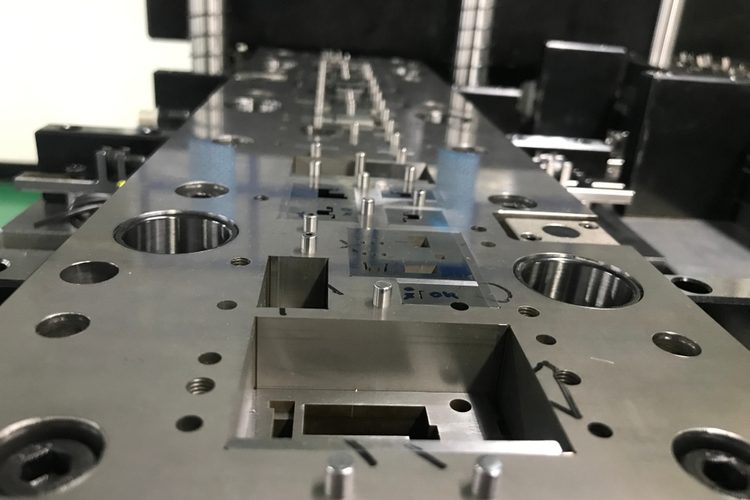
High volume metal stamping is where the economics of the process deliver maximum value. When annual volumes reach 100,000 parts per year and beyond, progressive die stamping transforms raw coil stock into finished parts at rates of 100 to 400 strokes per minute — producing millions of dimensionally consistent parts at the lowest achievable per-piece cost. We operate high-speed progressive die stamping lines as our primary production method for volume OEM supply programs.
Planning a high-volume stamping program? Send your drawing and annual volume to our contact page — we will return a structured quotation with tooling investment, unit price, and production capacity within 2 business days.
Why Progressive Die Stamping Dominates High Volume Production
At high volumes, the choice of process is almost always progressive die stamping. Here is why it dominates volume production economics:
- Single-setup, multi-operation production — a progressive die performs blanking, piercing, forming, bending, and trimming in a single pass through the press. Once set up, the die runs continuously with no operator intervention between strokes.
- High production rate — our high-speed presses run at 100–400 strokes per minute depending on part complexity and material. At 200 spm for a single-part-per-stroke die, that is 12,000 parts per hour — 96,000 parts per 8-hour shift.
- Consistent dimensional repeatability — the die controls part geometry every stroke. Dimensional variation comes from tool wear, not operator variability. Tool wear is managed through scheduled maintenance intervals and in-process dimensional monitoring.
- Low labor content per part — coil loading, press operation, and parts collection require minimal operator time per part at volume. Labor cost per piece approaches negligible at high run rates.
- Coil-fed efficiency — running from coil rather than blanks eliminates blank handling operations and reduces material waste through optimized strip layout design.
High Volume Stamping Capabilities
| Capability | Specification |
|---|---|
| Primary process | Progressive die stamping (coil-fed, high-speed) |
| Press speed | Up to 400 spm on high-speed mechanical presses |
| Press tonnage | 25–800 ton; matched to part size and forming load |
| Strip width | Up to 600 mm coil width |
| Material thickness | 0.1 mm – 6 mm for high-speed progressive production |
| Typical volume range | 100K – 10M+ parts per year per die |
| Tolerance (production) | ±0.05 mm general; ±0.02 mm on critical features with controlled tooling |
| Secondary in-die operations | Tapping, insert pressing, coining, staking, thread forming in-die |
| Parts per stroke | 1–4 parts per stroke depending on strip layout |
| Annual output capacity | 500M+ parts across all production lines |
Tooling Investment for High Volume Programs
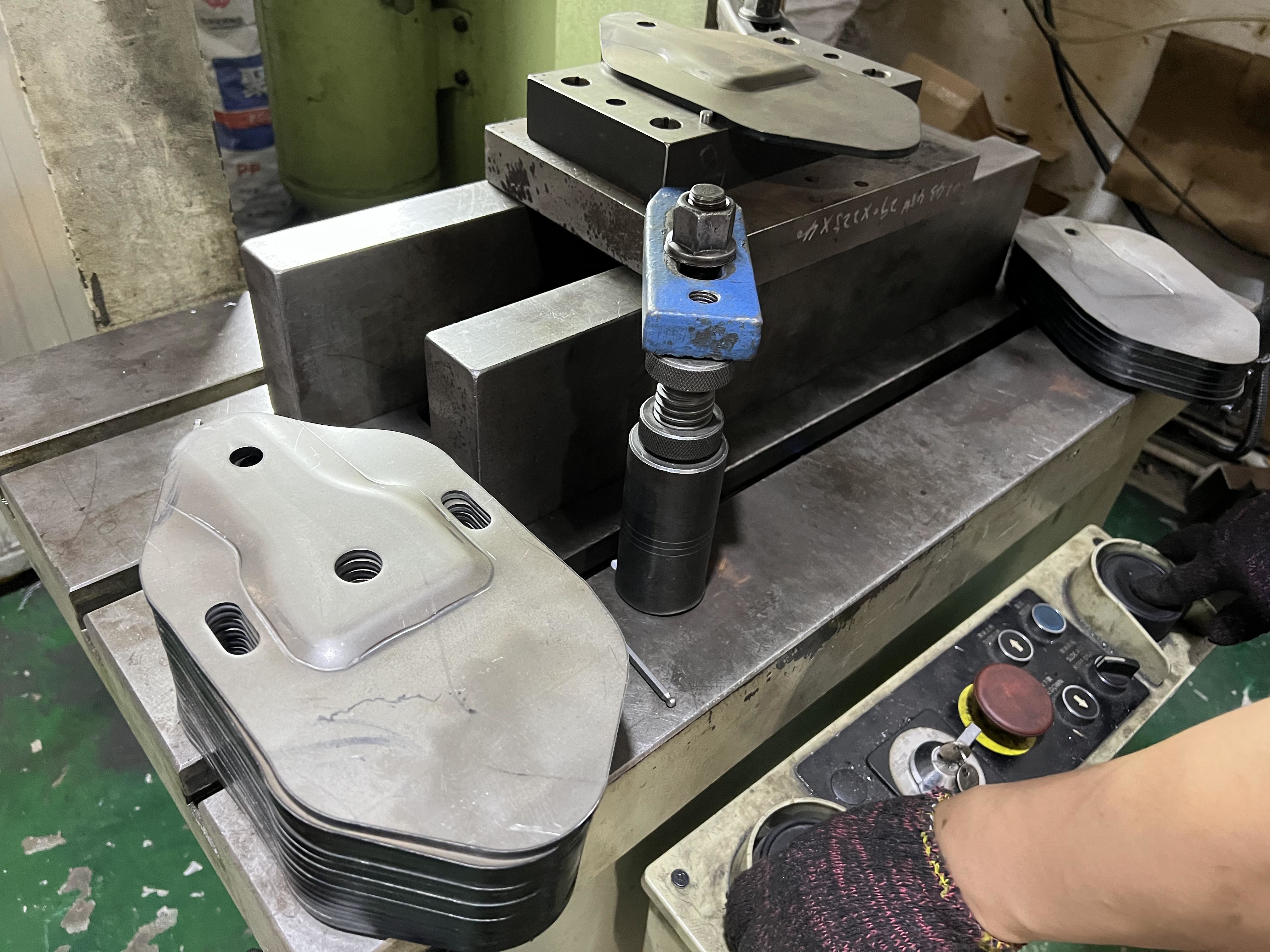
High volume progressive dies represent a larger upfront investment than simple tooling — and that investment is what generates the low unit cost at production volumes. Understanding the tooling economics helps you make the right program decision:
- Die design and simulation — high volume dies are designed with CAD/CAE simulation to optimize strip layout (material utilization), station sequencing (forming sequence to control springback), and die component life. Front-end engineering investment reduces the risk of costly rework after tryout.
- Die construction — high volume progressive dies are built from hardened tool steel with carbide inserts on high-wear punch and die sections. Die life at production volumes is typically 500,000 to 5,000,000+ strokes between major maintenance events, depending on material hardness and part geometry.
- Tooling amortization — tooling cost is typically amortized over the first year of production or a defined quantity in the quotation. Once tooling is paid down, the unit cost drops to material, labor, and overhead only.
- Tooling ownership — customer-owned tooling is catalogued in our system with full maintenance records: shot count, resharpen history, die component replacement log. You always know the condition of your production tooling.
Quality Control at Production Volume
High volume production creates quality risks that are different from low volume — small dimensional trends that are acceptable at low frequency can cause field problems at millions of parts per year. Our production quality system addresses this:
- Statistical Process Control (SPC) — critical dimensions are monitored with control charts across the production run. Out-of-control signals trigger immediate press stop, investigation, and disposition before the problem reaches shipping volume.
- In-die sensing — for high-precision volume programs, we integrate die-mounted sensors that detect misfeed, part presence, and breakage in real time. The press stops on a fault signal — not after a failed part leaves the die.
- Tooling maintenance scheduling — punch and die sharpening intervals are established at FAI based on material hardness and part geometry. Scheduled maintenance is planned into the production calendar to prevent uncontrolled wear from affecting part dimensions.
- AQL sampling per shipment — final inspection before each shipment follows ANSI/ASQ Z1.4 sampling plans at AQL 1.0 or 0.65 as specified by the customer program.
Materials for High Volume Production
We run the following materials in high volume progressive die programs:
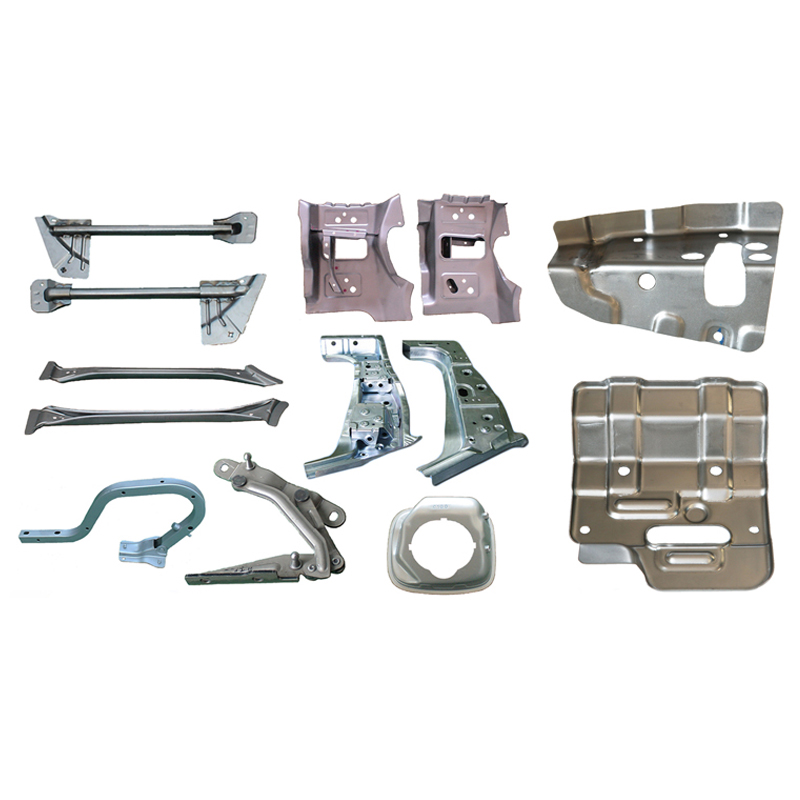
- Cold rolled steel (SPCC, DC01, DC04, ST12) — most common high-volume material; brackets, clips, enclosures, hardware
- HSLA and AHSS (DP600, DP800, TRIP780) — automotive structural parts requiring high strength with reduced thickness
- Electrogalvanized and hot-dip galvanized steel — HVAC, construction, and outdoor hardware at volume
- Stainless steel (304, 430) — volume production of appliance components, food equipment hardware, and corrosion-resistant brackets
- Aluminum (3003, 5052) — lightweight components, EV battery hardware, electronics enclosures
- Copper (C11000, C26000) — electrical contacts, terminals, bus bar blanks at high volume
For high volume programs, we purchase material in full coil quantities from certified mill sources. Material test reports are filed by heat number for traceability across production runs.
High Volume Supply Program Management
High volume programs require supply chain management beyond just production. We support the following for volume OEM customers:
- Blanket purchase orders — agree annual volume upfront, schedule releases monthly or quarterly to match your production consumption.
- Kanban and JIT delivery — for customers with pull-based production scheduling, we can align shipment triggers to your inventory signal rather than fixed release dates.
- Finished goods buffer stock — we maintain agreed safety stock at our facility to absorb volume spikes and protect against short-notice demand increases.
- Engineering change notice (ECN) management — at high volume, ECNs must be managed carefully to avoid mixed parts in the supply chain. We maintain strict part revision control with documented ECN effectivity dates and part numbering.
- Long-term pricing agreements — for multi-year programs, we offer annual pricing agreements with defined escalation terms tied to material indices.
Related Services
- Low volume metal stamping — short run and bridge production before high volume program launch
- OEM metal stamping programs — full supply program management with PPAP and ECN support
- Progressive die stamping — detailed process overview and capability specifications
- Custom metal stamping — DFM review for new part programs entering production
- Our manufacturing facility — press equipment list, certifications, and capacity overview
- Metal stamping parts — product range and industry applications
High Volume Metal Stamping — Frequently Asked Questions
What annual volume is required for high volume progressive die stamping to be cost-effective?
The break-even point depends on part complexity and tooling investment. For simple flat parts, progressive die tooling often becomes cost-effective at 50,000–100,000 parts per year. For complex multi-station dies, the volume threshold is typically 200,000–500,000 parts per year. Below those thresholds, compound die or bending operations are usually more economical. We will do an honest tooling vs. volume analysis as part of your quotation — we will not recommend a more expensive die than your volume justifies.
How long does it take to develop tooling for a high volume progressive die program?
High volume progressive dies typically take 6–12 weeks from drawing approval to first article tryout, depending on die complexity and station count. The sequence is: DFM review and strip layout design (1–2 weeks), die design approval (1 week), CNC machining and EDM of die components (3–6 weeks), die assembly and tryout (1–2 weeks), first article inspection and FAI report (1 week). We will provide a specific lead time commitment in your quotation.
What is the production rate for high volume stamping?
Production rate depends on press speed, parts per stroke, and cycle time. On high-speed mechanical presses at 200 spm with one part per stroke, the gross rate is 12,000 parts per hour. Net production efficiency (accounting for setup, material changes, and maintenance) typically runs at 80–90% of gross rate for well-established programs. For multi-part-per-stroke dies, net output scales proportionally. We will provide a production rate estimate and annual capacity calculation in your quotation.
How do you manage quality at millions of parts per year?
At production volume, quality is managed through process control rather than inspection. We use Statistical Process Control (SPC) to monitor critical dimensions in real time, scheduled tooling maintenance intervals to prevent wear-driven drift, in-die sensing on high-precision programs, and AQL sampling inspection before every shipment. The goal is to catch dimensional trends before they produce non-conforming parts — not to sort them out after the fact.
Can you handle volume spikes or accelerated delivery for established programs?
Yes, with advance planning. For programs where we maintain finished goods buffer stock, we can absorb short-notice volume increases up to the buffer level. For larger spikes, we need 4–6 weeks notice to schedule additional press time and material procurement. We recommend discussing expected peak demand during program setup so we can build buffer and capacity agreements that match your actual demand profile.
Who owns the tooling, and what happens to it at end of program?
Customer-funded tooling is owned by the customer. We maintain it during the program and return it or transfer it at program end on your instruction. We keep full tooling records including die drawings, component specifications, shot count history, and maintenance log. If you want to qualify a second supplier or move production, your tooling records transfer with the die. Tooling transfer can be arranged after program transition planning is complete.
Plan Your High Volume Stamping Program
If you are planning a high volume stamped part program — whether a new product launch, a supply transfer from another manufacturer, or an OEM supply consolidation — the first step is a structured quotation. Share your drawing, annual volume, and quality requirements and we will return tooling cost, unit price at your volume, production rate, and quality documentation plan within 2 business days.
Related Stamping Services
Full-service OEM stamping with PPAP and global delivery.
ISO-certified China supplier with low MOQ.
State-of-the-art press shop with in-house tooling.
Short-run and prototype stamping from 100 pcs.
Precision electronic and mechanical components.
Contacts, busbars, and terminals for electrical OEMs.
Stamped parts plus welding, riveting, and kitting.
Large complex parts up to 800×600 mm.
Up to 1,500 SPM for connectors and terminals.