
Most buyers do not fail in China because the supplier is in China. They fail because they treat sourcing like price shopping.
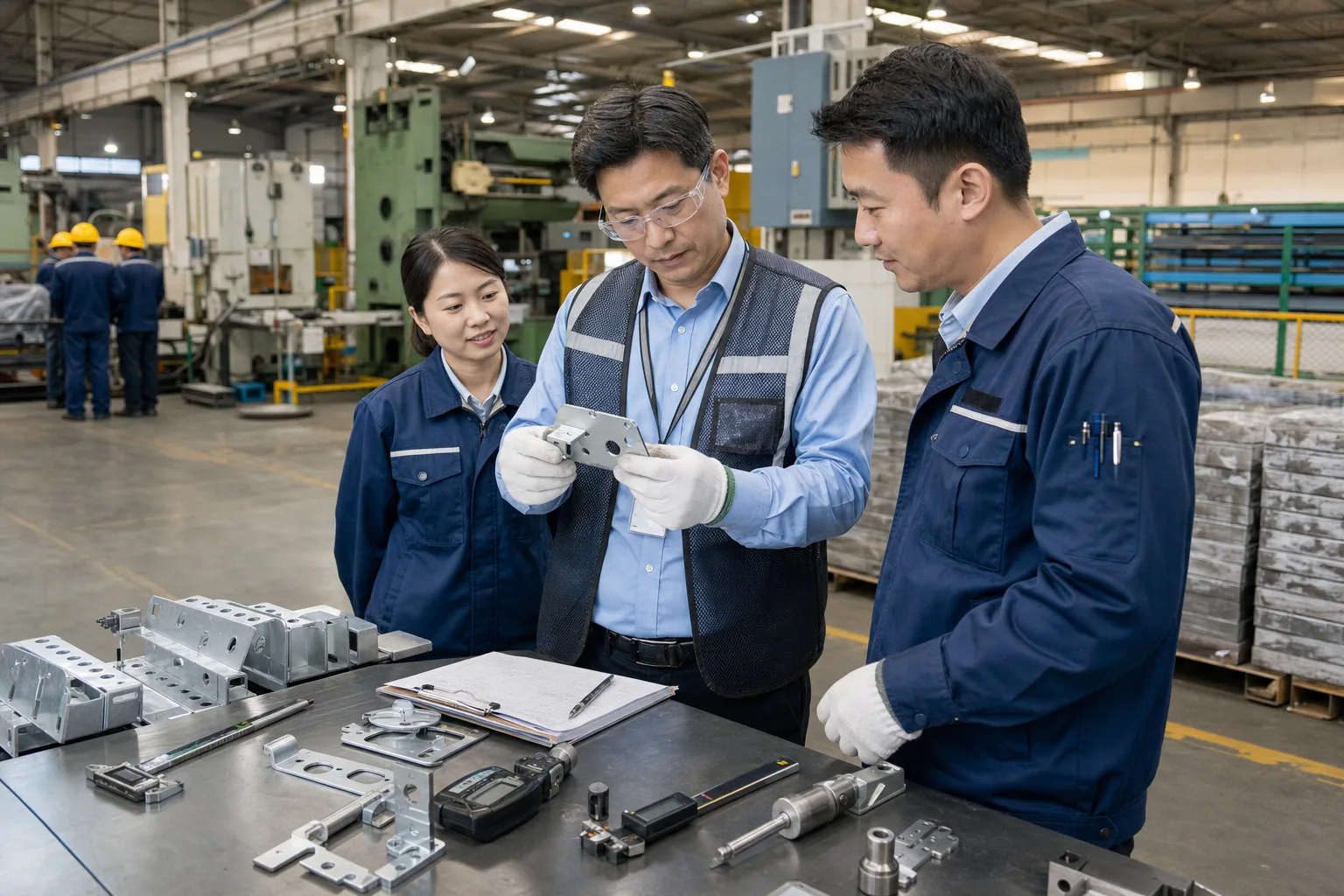
If you send the same drawing to ten suppliers, pick the cheapest quote, and assume the rest will sort itself out, you are not really sourcing. You are outsourcing your risk assessment to a spreadsheet. In metal stamping, that usually ends with tooling arguments, tolerance disputes, delayed pilot parts, or a production run that looks acceptable until the parts reach final assembly.
China is still one of the strongest sourcing bases for metal stamping. The reason is not just lower labor cost. It is the combination of tooling capability, supply chain density, material access, secondary processing capacity, and the willingness of many factories to support both prototype and production programs under one roof.
But those advantages only matter if you know how to qualify the supplier correctly.
This guide explains when sourcing stamped parts from China makes sense, where buyers usually misjudge the risk, how to evaluate a supplier beyond the quote sheet, and what you should lock down before tooling starts.
Why Source Metal Stamping from China?
The short answer is capacity plus manufacturing ecosystem.
A serious Chinese stamping supplier is rarely just a press shop. The better factories also manage die design, toolmaking, prototyping, deburring, plating coordination, tapping, welding, assembly, packaging, and export logistics. That matters because buyers do not actually purchase “stamping” in isolation. They purchase a finished, repeatable supply chain.
The strongest reasons buyers source from China are usually these:
- Tooling economics: Progressive dies, compound dies, and secondary tooling are often more cost-competitive than in the US or Western Europe.
- Integrated manufacturing: Many suppliers can combine stamping with CNC, welding, surface finishing, and assembly without handing the part to multiple vendors.
- Scalability: A factory that supports 500 prototype parts can often support 500,000 production parts later.
- Engineering responsiveness: Good exporters are used to DFM feedback, PPAP-style documentation, and overseas customer requirements.
- Material and process range: Steel, stainless, aluminum, copper, and brass stamping are all widely available across mature supplier clusters.
That said, China is not automatically the lowest total cost option. If your annual volume is small, the part is extremely simple, and freight plus communication overhead are significant, domestic sourcing may be more efficient.
So the real question is not “Is China cheaper?” It is “Does China reduce my total landed cost without increasing my operational risk too much?”
China vs. Domestic Sourcing: Where the Cost Difference Is Real
Many buyers compare only piece price. That is too narrow.
Stamped part sourcing should be evaluated across five cost buckets:
| Cost Element | China Sourcing | Domestic Sourcing |
|---|---|---|
| Tooling cost | Usually lower | Usually higher |
| Piece price at volume | Often lower | Often higher |
| Freight and customs | Higher | Lower |
| Communication / coordination cost | Can be higher if supplier is weak | Usually lower |
| Inventory buffer requirement | Often higher due to transit lead time | Usually lower |
For medium-to-high annual volume parts, China often wins because tooling amortization and production cost outweigh freight.
For low-volume or very urgent programs, domestic supply may win because the commercial savings from offshore production get consumed by shipping cost, longer replenishment cycles, and extra coordination.
A practical rule:
- High-volume stamped parts with repeat demand → China is often attractive
- Complex assemblies requiring supplier engineering support → China can be attractive if the supplier is export-mature
- Very low-volume parts with unpredictable ordering → local or regional sourcing may be easier
- Programs with severe schedule risk and no inventory tolerance → domestic may be safer
If your supplier cannot eprototype toolingt, not just ex-works price, the quote is incomplete.
The First Mistake Buyers Make: Vetting the Factory Too Late
Most sourcing problems start before the PO.
Buyers often ask detailed questions about plating thickness and packaging labels, but they do not test whether the factory can actually manage tooling ownership, engineering changes, or dimensional accountability. In metal stamping, that is backwards. The real risk is not the brochure. It is process control.
Before you compare unit prices, you should determine what kind of supplier you are talking to.
A serious stamping supplier usually shows these signs
- They ask for 2D drawings, 3D files, annual volume, material grade, finish, and application context
- They comment on manufacturability instead of only saying “can do”
- They distinguish prototype tooling from production tooling
- They explain tolerance capability by feature type, not with vague promises
- They can discuss die maintenance, strip layout, burr direction, and inspection method
- They know how to support export documentation and customer approval flow
A weak supplier usually shows these signs
- They respond with price before understanding the drawing
- They claim every tolerance is “no problem”
- They avoid direct discussion of tooling ownership
- They outsource key operations but present themselves as full in-house
- They cannot explain inspection frequency or corrective action process
- They promise unrealistic lead times without technical review
A supplier who says yes too quickly is often more dangerous than one who pushes back.
How to Find and Vet Chinese Metal Stamping Suppliers
The best supplier is not always the one with the best website. It is the one with the best operational fit.
Step 1: Shortlist by capability, not geography alone
Region matters, but process fit matters more. Start by filtering for:
- Progressive die or transfer die capability if your part requires it
- Relevant material experience: stainless, aluminum, copper, brass, HSLA, etc.
- Export experience to North America or Europe
- Ability to manage finishing and sub-assembly
- Toolmaking in-house or tightly controlled
Step 2: Ask technical screening questions early
A short supplier questionnaire will tell you more than a generic capability deck.
Ask:
- What presses do you run, and what tonnage range?
- Do you build dies in-house or through partner tool shops?
- What is your normal tolerance capability for pierced holes, bends, and formed features?
- How do you inspect first article and in-process production?
- What export markets do you currently support?
- Can you provide PPAP, material certs, plating reports, or dimensional reports if required?
- How do you control engineering changes after tooling release?
A serious supplier will answer specifically. A trading company pretending to be a factory often cannot.
Step 3: Review sample parts and documentation
If possible, ask for:
- Sample part photos with close-up feature detail
- Tooling photos
- Inspection report examples
- Packaging examples
- Process flow chart
- Corrective action example for a past defect issue
This tells you whether the supplier operates with discipline or improvisation.
Quality Assurance: What You Should Require
Quality assurance in offshore sourcing should never be implied. It should be written.
For stamped parts, the minimum QA package depends on the product risk, but serious programs often require some combination of the following:
| QA Item | Why It Matters |
|---|---|
| Material certificate | Confirms alloy, temper, thickness, and source |
| Dimensional inspection report | Verifies critical features against drawing |
| First article approval | Locks the baseline before mass production |
| In-process inspection plan | Shows how repeatability is maintained |
| Plating / coating report | Confirms finish thickness or salt spray performance |
| PPAP / control plan (if needed) | Important for automotive-style or controlled industries |
| Nonconformance / CAR workflow | Defines how defects are handled |
Do not assume ISO 9001 alone solves the quality question. Certification helps, but it does not replace process discipline.
If your part has critical functional dimensions, identify them explicitly. If you do not mark the critical features, the supplier may inspect the wrong things thoroughly and the right things casually.
This is especially important when you are already concerned about supplier selection. The better approach is to combine QA requirements with a clear sourcing decision framework, similar to what buyers should do when they choose a metal stamping supplier.
Communication and Technical Documentation: This Is Where Good Projects Stay Good
A surprising number of offshore projects fail even when the factory is capable.
The reason is not that the supplier cannot manufacture the part. The reason is that the technical package leaves too much open to interpretation.
For stamped parts, your RFQ and order package should include:
- 2D drawing with revision level
- 3D CAD if available
- Material grade and thickness
- Finish requirement
- Critical dimensions and tolerances
- Burr direction if functionally important
- Cosmetic standard if visible parts are involved
- Annual volume estimate and order batch size
- Packaging requirement
- Testing or compliance requirement if applicable
One practical rule: if a dimension matters in assembly, say so. Do not expect the supplier to infer intent from the drawing alone.
You should also establish revision control early. Buyers get into avoidable disputes when Rev B is quoted, Rev C is discussed in email, and Rev D is the file someone finally uses to cut tooling.
Tooling Ownership and IP Protection: Clarify Before Money Moves
Tooling arguments are one of the most common points of friction in China sourcing. They are also one of the easiest to prevent.
Before tooling starts, define in writing:
- Who pays for the tool
- Who owns the tool
- Where the tool is stored
- Whether the tool can be transferred
- Who pays for maintenance versus major rebuild
- What happens if the business relationship ends
- Whether the supplier may use the part or tool design for any other customer
If ownership matters to you, do not leave it inside a vague quote line saying “tooling: USD 8,500.” Put the ownership terms in the PO, tooling agreement, or supply contract.
IP protection in manufacturing is rarely solved by one legal sentence. In practice, the most effective controls are operational:
- Split sensitive information only where necessary
- Use revision-controlled documents
- Work with factories that already serve export OEM customers
- Keep tooling, drawing approval, and purchase terms documented cleanly
A supplier that is uncomfortable documenting tool ownership clearly is a supplier to avoid.
Shipping, Customs, and Lead Times: Offshore Savings Disappear Here If You Plan Poorly
China sourcing works best when the logistics model matches the demand model.
If your buyer team expects domestic-style replenishment with no safety stock, offshore stamping can feel unreliable even when the supplier is performing exactly as quoted.
Typical lead time structure
| Stage | Typical Time Range |
|---|---|
| Quotation + technical review | 3–10 days |
| Tooling design / approval | 1–3 weeks |
| Tool build | 3–8 weeks |
| Sample submission | 1–2 weeks |
| Mass production after approval | 2–6 weeks |
| Ocean transit | 3–6 weeks |
| Air shipment | 3–10 days |
The point is not that China is slow. The point is that you must separate manufacturing lead time from replenishment lead time.
A supplier can produce well and still be the wrong fit if your planning model cannot absorb ocean transit, customs clearance, and buffer inventory.
This is why experienced buyers usually decide the logistics model before launch:
- Air freight for pilot or urgent launch support
- Ocean freight for stable recurring volume
- Safety stock at destination for critical programs
- Forecast sharing with the supplier for smoother scheduling
Common Pitfalls and How to Avoid Them
1. Choosing on price before process fit
The cheapest quote may come from the weakest technical review. That is not savings. That is delayed cost.
2. Sending incomplete RFQs
If the supplier never received finish specs, tolerance priorities, or annual volume, then the quote is not comparable.
3. Treating all factories as interchangeable
A supplier strong in simple brackets may be weak in progressive dies, cosmetic stainless parts, or tight-tolerance assemblies.
4. Ignoring pilot-stage validation
Do not move directly from quote to large production order without confirming first samples, inspection results, and packaging execution.
5. Assuming certification equals capability
ISO certificates are helpful. They are not proof that your specific part will run well.
6. Failing to define communication rhythm
Set expectations for quote turnaround, sample approval, NCR response time, and engineering change handling. Offshore sourcing performs much better when cadence is defined.
A Practical Example: What Successful China Sourcing Usually Looks Like
A buyer needs a stainless steel bracket for industrial equipment: 1.2mm SUS304, two bends, four pierced holes, passivated finish, annual demand 180,000 pcs.
A weak sourcing approach is to compare ten quotes, pick the lowest tooling cost, and assume the rest is routine.
A better sourcing approach looks like this:
- Shortlist three suppliers with real stainless stamping experience
- Confirm whether they support in-housChina metal stampingation coordination
- Review DFM feedback on bend radius, hole-to-bend distance, and tolerance stack-up
- Approve prototype or first samples before full production release
- Define tool ownership, inspection plan, and packaging standard in writing
- Launch with agreed forecast and bmetal stamping factory
That project usually succeeds not because the supplier is perfect, but because the buyer managed the risk before the first shipment.
If your business depends on long-term program reliability, sourcing discipline matters more than quote quantity.
When China Sourcing Is a Good Fit — and When It Is Not
China is often a good fit when:
- Your annual volume is meaningful
- The part requires real tooling capability
- You need a supplier that can scale from prototype to production
- Total landed cost matters more than same-week replenishment
- You can manage forecast-based purchasing
China may not be the best fit when:
- You only need very small, irregular quantities
- The part is extremely simple and local fabrication is faster
- Your production cannot tolerate transit variability
- You lack internal bandwidth to manage offshore supplier communication
Good sourcing is not ideology. It is fit.
What to Ask Before You Request a Quote
Before you send the RFQ, ask yourself four questions:
- Do I need prototype support, mass production, or both?
- Which dimensions are truly critical to function?
- Do I care more about lowest unit price, lowest landed cost, or lowest risk?
- Is this a simple buy, or the start of a multi-year tooling relationship?
The clearer your answers, the better your supplier selection will be.
For buyers who are ready to evaluate a real project, the best next step is to contact the team with drawings, annual volume, material spec, and target timeline.
FAQ
Is sourcing stamped parts from China still cost-effective?
Yes, often for medium-to-high volume programs. But the answer depends on landed cost, not just ex-works price.
How do I know if a Chinese supplier is a real factory or just a trading company?
Ask technical process questions, request tooling and inspection examples, and check whether their answers are specific. Real factories usually discuss process detail comfortably.
Should I require PPAP for metal stamping parts from China?
If the program is automotive, safety-critical, or tightly controlled, yes. For less regulated parts, a lighter first article and inspection package may be enough.
What is the biggest risk in China metal stamping sourcing?
Usually not fraud. More often it is poor technical alignment: unclear drawings, weak process control, and undefined tooling or quality expectations.
Can a China supplier support both prototype and production?
Many good suppliers can. In fact, that is one of the advantages of sourcing from a capable metal stamping factory with in-house tooling and engineering support.
Final Takeaway
China can be an excellent sourcing base for metal stamping parts, but only when you qualify the supplier like a manufacturing partner instead of a line item.
The best results usually come from buyers who evaluate tooling capability, process discipline, documentation quality, and communication reliability before they compare the final unit price. If you do that, China sourcing can lower cost and expand capacity without turning your project into a quality-control exercise.
If you skip that work, even a cheap quote can become expensive very quickly.
Work with a proven metal stamping manufacturer in China. We offer custom metal stamping with competitive pricing and fast delivery.
Frequently Asked Questions
What is metal stamping china sourcing?
Metal stamping china sourcing is a specialized manufacturing process used to create precise metal components. Our team has over 25 years of experience delivering high-quality results for global clients across automotive, aerospace, electronics, and construction industries.
What tolerances can you achieve for metal stamping china sourcing?
We achieve standard tolerances of ±0.05mm, with precision tolerances down to ±0.02mm for critical applications. All parts are inspected using CMM equipment with Cpk≥1.33 process capability.
What materials do you work with for metal stamping china sourcing?
We work with a wide range of materials including aluminum (1100-6061), stainless steel (301-430), carbon steel, copper, brass, phosphor bronze, and specialty alloys. Material thickness ranges from 0.1mm to 12mm.
What is your minimum order quantity for metal stamping china sourcing?
We accept prototype orders starting from 1 piece. For production runs, we recommend starting at 1,000 pieces for cost efficiency, though we accommodate various volumes based on project requirements.
How do I get a quote for metal stamping china sourcing?
Submit your drawings (DWG, DXF, STEP, IGES, or PDF) via our contact form or email. We provide DFM feedback and pricing within 24 hours. Our engineering team reviews every inquiry for optimal manufacturability.
What quality certifications do you have for metal stamping china sourcing?
We maintain ISO 9001:2015 and IATF 16949 certifications with full traceability. Every shipment includes inspection reports, material certificates, and compliance documentation as required.
Related Resources
- Custom Metal Stamping Parts — Explore our custom metal stamping capabilities, from prototype to production.