
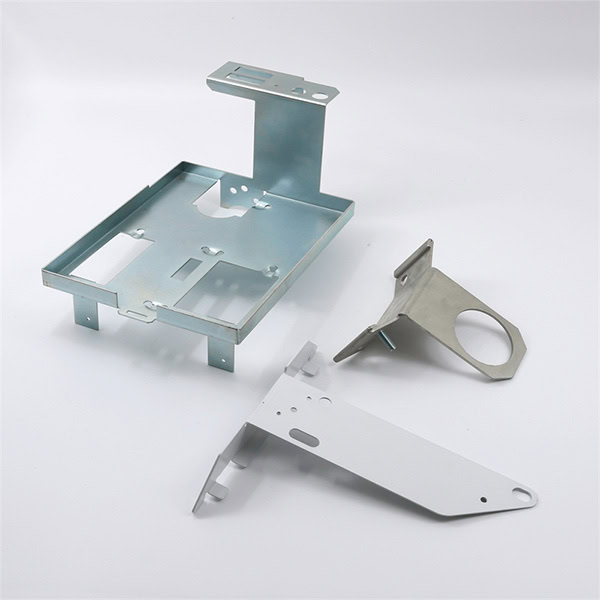
Battery Metal Stamping Components
Precision-stamped battery contacts, busbars, cell holders, terminal plates, and current collectors for lithium-ion, LFP, NMC, and solid-state battery packs. IATF 16949 quality, RoHS/REACH compliant.
Battery Stamping Components We Manufacture
Battery packs depend on hundreds of precision-stamped metal components for electrical connection, structural integrity, and thermal management. We manufacture the full range — from micro cell contacts to large-format busbar assemblies.
Cell Contact Plates
Nickel-plated steel or pure nickel cell-to-cell connection plates. Laser-weld tabs, spot-weld tabs, and spring-contact designs for cylindrical (18650, 21700, 46800) and prismatic cells.
Busbars & Current Collectors
Stamped copper or aluminum busbars for battery module and pack-level interconnects. Custom geometries, laser-cut or stamped apertures, threaded stud inserts, and surface plating available.
Terminal Plates & Pole Caps
Positive and negative terminal components for prismatic and pouch cells. Deep-drawn cups, coined terminals, and laser-weld flanges. Dimensional tolerances to ±0.02 mm on critical seating surfaces.
Cell Holders & Brackets
Stamped and formed cell retention brackets, end plates, and module frames. Structural steel or aluminum. Integrated spring features for cylindrical cell retention without adhesive.
Thermal Management Parts
Aluminum cooling fins, heat-spreader plates, and thermal interface clips. Thin-gauge aluminum 1060 or 3003 with tight flatness tolerance (≤0.1 mm) for uniform thermal contact.
Safety Vents & CID Discs
Scored rupture discs and current interrupt device (CID) components for cylindrical and prismatic cells. Burst pressure engineered to ±5% specification. 100% burst-pressure tested.
EV Battery Market Applications
The global EV battery supply chain demands stamped metal components at unprecedented scale and precision. Our production capabilities align with the requirements of major battery cell and pack manufacturers.
🚗 Electric Vehicles (BEV/PHEV)
Battery pack busbars, module frames, cell interconnects, HVJB components, and BMS sensor mounting brackets. IATF 16949 + PPAP Level 3 documentation.
🔌 Grid Energy Storage (ESS)
Large-format busbar assemblies, cell rack structures, and terminal hardware for utility-scale Li-ion and LFP storage systems. High-current copper busbars up to 6 mm thick.
🛴 Micro-mobility & E-bikes
18650/21700 cell holder strips, BMS PCB mounting brackets, and charging connector shields for e-scooters, e-bikes, and light EV packs.
💻 Consumer Electronics
Laptop, tablet, and power tool battery contacts, spring terminals, and NTC sensor mounts. High-speed progressive die for 10M+ pcs/month capacity.
🏥 Medical Batteries
Defibrillator, hearing aid, and implantable device battery contacts. Full material traceability, ISO 13485-compatible documentation, biocompatible plating options.
Key Material Properties for Battery Stampings
| Material | Conductivity (% IACS) | Typical Thickness | Primary Battery Use |
|---|---|---|---|
| Pure Copper C110 | 101% | 0.1 – 4.0 mm | Busbars, current collectors, EV high-current paths |
| Pure Nickel N6 | 22% | 0.1 – 0.5 mm | Cell-to-cell strips (laser/spot-weld), cylindrical packs |
| Nickel-Plated Steel | ~10% (Ni layer) | 0.15 – 0.4 mm | Consumer battery tabs, low-current cell contacts |
| Aluminum 1060 | 61% | 0.3 – 3.0 mm | Positive busbars, terminal plates, thermal management |
| Aluminum 3003 | 41% | 0.2 – 2.0 mm | Cooling fins, heat spreaders, lightweight enclosures |
| Stainless Steel 304 | 2.5% | 0.1 – 1.0 mm | Cell casings, springs, structural clips requiring corrosion resistance |
Quality Requirements for Battery Components
Zero Burr Tolerance
Burrs in battery components cause internal short circuits. We specify and verify burr height ≤0.01 mm on cell contact surfaces through 100% automated vision inspection. Fine-blanking used where zero-burr is mandatory.
Cleanliness & Contamination Control
Battery parts are stamped with ultra-clean lubricants (food-grade or evaporating oils). Parts are ultrasonically cleaned and air-dried before packaging to meet <1 mg/dm² surface contamination limits.
Dimensional Consistency
Battery assembly lines are highly automated — dimensional variation causes jams, misalignment, and welding failures. Cpk ≥ 1.67 maintained on all critical-to-function dimensions via SPC.
Plating Specification Compliance
Where tin, nickel, or gold plating is specified, we verify thickness (XRF), adhesion, and coverage per IEC 60068-2-58. RoHS/REACH material certification provided for all plated components.
Battery Stamping Manufacturing Process
Material Certification
Mill certificate verified for conductivity, alloy, RoHS compliance before coil is approved for production.
High-Speed Stamping
Progressive die at 300–600 SPM with servo press. Clean lubricant, in-die vision, automatic reject chute.
Ultrasonic Cleaning
Parts cleaned in ultrasonic bath, rinsed in DI water, dried in nitrogen tunnel. Cleanliness verified by gravimetric test.
100% Vision Inspection
Automated vision at 0.01 mm resolution. Burr detection, feature presence, weld tab geometry verification.
Pack & Ship
ESD-safe or moisture-barrier packaging. Lot traceability label, COA, and RoHS declaration per shipment.
Frequently Asked Questions
What battery cell formats can your stamped parts work with?
We manufacture parts for all major cell formats: cylindrical (18650, 21700, 26650, 46800/4680), prismatic (LFP, NMC), and pouch cells. Contact us with your cell format and pack architecture for a custom component recommendation.
Can you produce nickel strip for spot-welding to lithium cells?
Yes. We stamp and slit pure nickel N6 and nickel-plated steel strips in widths from 3 mm to 60 mm, thickness 0.1–0.3 mm. Strip can be supplied on reel or cut-to-length. Weldability tested per IEC 62133 requirements.
Do you offer copper-nickel clad material stamping?
Yes. Cu-Ni clad strip (nickel on copper substrate) is ideal for cell connections where copper conductivity and nickel weldability are both required. We work with certified clad strip suppliers and can stamp to your exact geometry.
What is the MOQ for battery stamping components?
Standard MOQ is 5,000 pcs for new tooling orders. For high-volume EV programs (1M+ pcs/year), we offer dedicated press and die allocation with blanket order scheduling. Prototype quantities from 500 pcs using soft tooling.
Can you provide PPAP documentation for automotive battery programs?
Yes. We provide full PPAP Level 3 documentation including Part Submission Warrant (PSW), dimensional results (FAI), material/performance test results, process flow diagram, PFMEA, control plan, MSA, and SPC initial studies. IATF 16949 certified facility.
Related Resources
- Energy & Power Metal Stamping — Stamped components for energy, power, and renewable applications.