
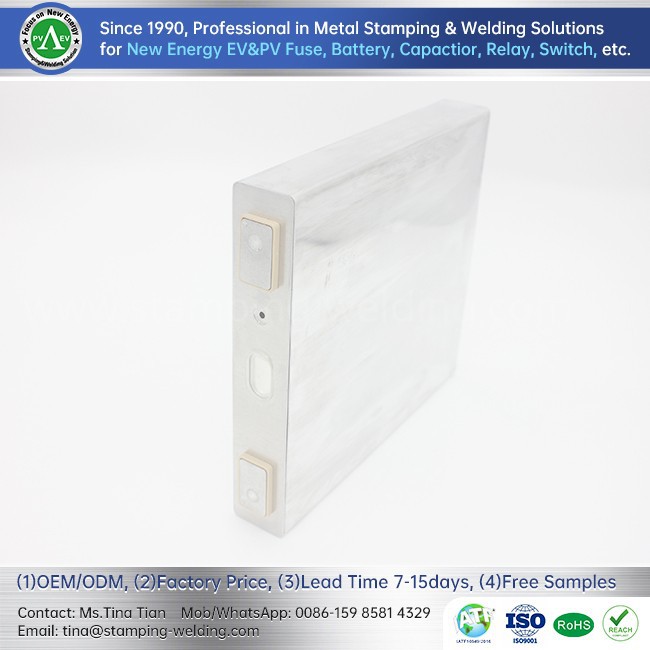
Custom EV battery metal stamping parts help connect, protect, mount, and package the critical systems inside electric vehicle battery packs. As a B2B metal stamping parts manufacturer, we support EV battery module and pack suppliers with stamped busbars, battery tabs, terminals, brackets, shields, covers, and deep drawn metal cases for battery enclosures based on customer drawings, samples, or functional requirements.
EV battery packs place different demands on stamped components than many general battery assemblies. Parts may need high electrical conductivity, stable contact geometry, insulation-ready surfaces, vibration-resistant mounting features, corrosion protection, thermal performance, and repeatable dimensional control for automated assembly. Our role is to manufacture custom metal stampings that match your pack architecture, material specification, plating requirement, and production volume—not to offer one-size-fits-all catalog parts.
This page is focused specifically on EV battery pack metal stamping applications. For a broader overview of stamped components used across battery products, visit our battery metal stamping components page. If your project is related to energy storage, power conversion, or electrical equipment outside vehicle battery packs, you may also find our energy and power industry capabilities helpful.
EV Battery Pack Stamped Components We Manufacture
Every battery platform is different, so EV battery stamping parts are normally produced to print. We can support early design-for-manufacturing review, prototype sampling, tooling development, and production stamping for components used in battery modules, pack housings, battery management system connections, power distribution zones, and mechanical retention assemblies.
| Part Type | Typical Function in EV Battery Packs | Key Manufacturing Considerations |
|---|---|---|
| Stamped busbars | Conduct current between cells, modules, fuses, contactors, and power distribution points | Copper or aluminum selection, flatness, burr control, hole position, bend accuracy, plating, insulation clearance |
| Battery tabs | Provide weldable or joinable interfaces from cells to collectors or module interconnects | Thin-gauge formability, edge quality, weld area consistency, nickel or copper alloy compatibility |
| EV battery terminals | Create reliable electrical connection points for modules, pack outputs, sensing circuits, or harness interfaces | Contact geometry, spring characteristics, conductivity, plating adhesion, mating tolerance |
| Mounting brackets | Hold modules, sensors, harnesses, shields, covers, and auxiliary hardware in position | Strength-to-weight balance, vibration resistance, bend radius, hole alignment, corrosion protection |
| Metal shields and covers | Protect electrical areas from mechanical impact, debris, heat, or electromagnetic interference depending on design | Material thickness, formed ribs, grounding features, coating compatibility, assembly clearance |
| Deep drawn metal cases and enclosures | Provide seamless cups, housings, caps, or protective containers for battery-related assemblies | Draw ratio, wall thinning control, sealing surface quality, corrosion resistance, cleanliness |
| Clips, retainers, and spacers | Secure small components, maintain spacing, or support assembly repeatability | Springback control, fatigue resistance, secondary deburring, material temper |
How This Page Differs From General Battery Metal Stamping
Our battery metal stamping components page addresses a wider range of battery-related applications, including consumer batteries, industrial battery assemblies, storage systems, and general contacts or springs. This EV battery stamping page is intentionally narrower. It emphasizes vehicle battery pack requirements such as high-current busbar geometry, module-to-pack connection hardware, battery tab consistency, crash- and vibration-aware brackets, shield assemblies, and deep drawn cases or enclosures used near EV battery systems.
That distinction matters for SEO and for purchasing teams. An EV battery pack is not simply a larger battery holder. It is an integrated electrical, thermal, structural, and safety-related system. Stamped parts must often be designed around automated cell joining, isolation distances, pack sealing strategy, thermal runaway mitigation concepts, serviceability, and vehicle-level durability testing. We do not claim that a stamped part alone guarantees battery safety or vehicle performance; instead, we help manufacture the metal components that fit into your validated battery pack design.
Materials and Stamping Processes for EV Battery Components
Material selection depends on whether the stamped part primarily carries current, provides mechanical support, shields a sensitive area, dissipates heat, resists corrosion, or supports welding and plating. Our team can review drawings and recommend manufacturable material and process options while respecting your engineering specification.
| Material or Process | Common EV Battery Use | Advantages | Notes |
|---|---|---|---|
| Copper and copper alloys | Busbars, terminals, contacts, high-conductivity tabs | Excellent electrical and thermal conductivity | May require controlled burr direction, plating, or insulation after stamping |
| Aluminum alloys | Lightweight busbars, brackets, shields, covers | Low weight, good conductivity, corrosion resistance | Springback and joining method should be considered during design |
| Nickel and nickel-plated materials | Battery tabs, contact interfaces, weldable surfaces | Good corrosion resistance and weld compatibility in selected designs | Specification depends on cell chemistry and joining process |
| Stainless steel | Shields, retainers, spring clips, durable brackets | High corrosion resistance and strength | Requires attention to work hardening and forming force |
| Cold rolled or galvanized steel | Structural brackets, covers, pack hardware | Cost-effective strength and formability | Coating or plating may be needed for corrosion protection |
| Progressive die stamping | High-volume tabs, terminals, clips, small brackets | Fast, repeatable, cost-efficient after tooling | Best for stable designs and medium- to high-volume production |
| Deep draw stamping | Seamless cases, caps, cups, protective enclosures | Creates formed housings with fewer seams or welds | Learn more about deep draw stamping |
| Secondary operations | Deburring, tapping, cleaning, plating support, assembly | Helps parts meet fit, finish, and connection needs | Available operations depend on part design and acceptance criteria |
EV-Specific Design and Manufacturing Priorities
EV battery components may look simple, but small dimensional or surface variations can affect downstream assembly. For busbars and terminals, bend angle, flatness, hole position, contact area, plating thickness, and burr location can influence fit and electrical performance. For battery tabs, consistency of the weld zone and material condition may be more important than visual complexity. For brackets and shields, formed ribs, mounting hole alignment, and coating compatibility help parts survive vibration and packaging constraints.
We support EV battery projects with manufacturability feedback on strip layout, grain direction, inside bend radius, sharp corner reduction, pilot hole strategy, tolerance stack-up, and economical tooling choices. Where appropriate, we can suggest progressive die stamping for repeatable high-volume parts, compound or transfer tooling for larger formed parts, and deep drawn metal cases for battery enclosures when a seamless or deep formed shape is preferred over welded fabrication.
Applications Across EV and Power Systems
Our EV battery stamping capabilities serve suppliers involved in passenger vehicles, commercial EVs, electric buses, low-speed vehicles, charging-related hardware, and adjacent power storage products. Many stamped components also overlap with automotive metal stamping requirements, where vibration, repeatability, corrosion resistance, and production traceability are important. Electrical connection parts may also relate to our electrical metal stamping services and dedicated stamped busbars capabilities.
Typical applications include module interconnects, pack output terminals, current collector components, BMS connection hardware, contactor and fuse area conductors, grounding straps, sensor brackets, cooling plate retainers, protective shields, service disconnect hardware, and deep drawn housings for battery-related subassemblies. We manufacture to your drawings and quality requirements rather than making assumptions about the final battery system.
Quality Expectations for EV Battery Metal Stamping Parts
For EV battery pack parts, quality is not only about meeting nominal dimensions. Depending on the component, requirements may include burr height limits, deburred edges for insulation safety, controlled flatness for busbar interfaces, plating appearance and adhesion, conductivity checks, packaging to prevent scratches, and documentation for lot traceability. We can align inspection plans with your critical-to-quality dimensions and functional features.
During quotation, it is helpful to provide 2D drawings, 3D CAD files, material grade, thickness, annual volume, surface finish, plating or coating requirements, assembly method, and any special standards your project must follow. If the design is still early, we can review manufacturability and point out cost drivers such as extremely tight tolerances, difficult draw ratios, small bend radii, or secondary operations that may affect tooling complexity.
Why Work With a Custom EV Battery Stamping Manufacturer?
A custom EV battery metal stamping parts manufacturer can help reduce per-part cost, improve repeatability, and support scalable production once the design is validated. Stamping is especially effective for parts that need consistent geometry across thousands or millions of pieces: busbars, battery tabs, EV battery terminals, shields, brackets, clips, and formed enclosures. Compared with machining every feature, stamping can reduce material waste and cycle time for suitable designs.
We keep the focus on practical manufacturing support: reviewing your print, selecting a stamping route, developing tooling, producing samples, making dimensional adjustments, and scaling to production when approved. We avoid unrealistic promises such as universal lead times or guaranteed performance without engineering validation. Your battery pack design, testing plan, and end-use requirements remain the foundation; our contribution is reliable stamped metal part manufacturing.
EV battery stamping RFQ checklist
EV battery stamped parts need electrical, thermal, coating, and assembly requirements defined before tooling and production review.
| Part type | Busbar, tab, current collector, bracket, shield, contact, connector part, or custom battery pack component. |
|---|---|
| Electrical requirements | Current rating, resistance target, voltage clearance, heat rise limit, and insulation or creepage requirements. |
| Material and thickness | Copper, aluminum, nickel-plated steel, copper alloy, temper, conductivity, and thickness tolerance. |
| Finish and plating | Tin, nickel, silver, selective plating, anti-oxidation treatment, masking, cleaning, or insulation interface. |
| Assembly details | Weld areas, fastening holes, bend geometry, datum features, packaging constraints, and mating parts. |
| Quality documents | Dimensional report, plating thickness, conductivity check, material certificate, traceability, and PPAP needs. |
Request a Quote for EV Battery Stamping Parts
If you need custom EV battery terminals, battery tabs, stamped busbars, brackets, metal shields, or deep drawn metal cases for battery enclosures, send us your drawings, material requirements, estimated annual volume, and target application. Our engineering and sales team will review the project and provide manufacturability feedback, tooling considerations, and a quotation based on your specifications.
Start your EV battery stamping project today: request a quote for custom metal stampings built for your battery pack, module, or power distribution assembly.
FAQ: EV Battery Metal Stamping Parts
What EV battery stamping parts can you manufacture?
We manufacture custom busbars, battery tabs, EV battery terminals, brackets, shields, covers, retainers, clips, spacers, and deep drawn cases or enclosures based on customer drawings and requirements.
Can you make deep drawn metal cases for battery enclosures?
Yes. Deep draw stamping can produce seamless cups, caps, housings, and enclosure-like parts when the geometry, material, and draw ratio are suitable. We can review your drawing to confirm manufacturability and tooling requirements.
What materials are common for EV battery busbars and terminals?
Copper, copper alloys, aluminum, nickel-plated materials, and selected stainless steels are common, depending on conductivity, strength, corrosion resistance, plating, welding, and cost requirements.
Do you provide standard catalog EV battery parts?
Our focus is custom manufacturing. EV battery packs vary widely, so most parts are produced to customer drawings rather than stocked as universal catalog items.
Can you help with design for manufacturability?
Yes. We can review bend radii, tolerances, material choice, burr direction, strip layout, draw depth, hole locations, and secondary operations to help improve manufacturability before production tooling.
What information is needed for a quote?
Please provide drawings or CAD files, material grade and thickness, surface finish or plating needs, tolerance requirements, estimated order quantity or annual volume, application notes, and any inspection or packaging requirements.