
Metal stamping shapes sheet metal into parts using dies and press force, while injection molding injects molten plastic into a cavity to form components. The right choice depends on your material requirements, production volume, per-part cost targets, and dimensional tolerances. This guide compares both processes across every factor that matters to procurement and engineering teams.
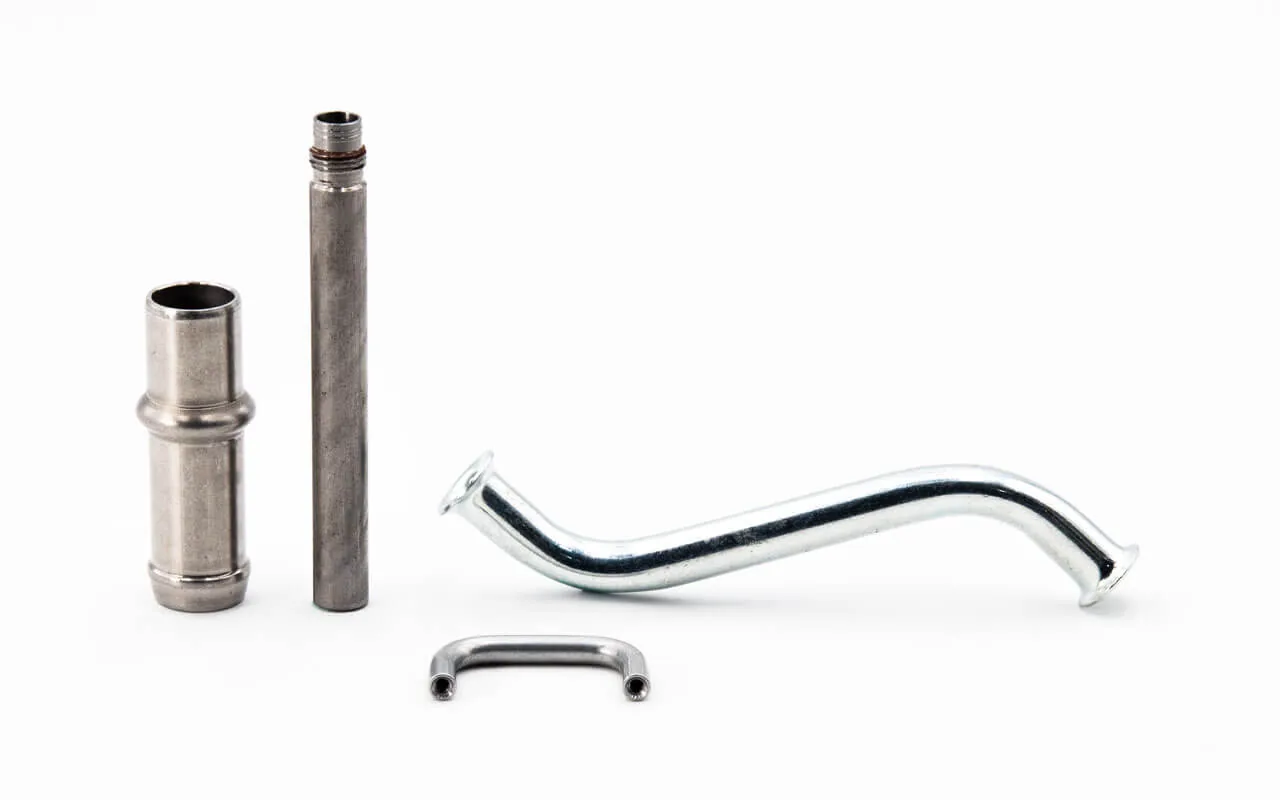
If your project requires high-strength metal parts at scale, custom metal stamping typically delivers the lowest per-unit cost. If you need complex 3D geometries in plastic or rubber, injection molding is usually the better fit. Below, we break down the differences in detail.
How Metal Stamping Works
Metal stamping uses a hydraulic or mechanical press to force flat sheet metal through a series of dies. Operations include blanking, punching, bending, coining, and deep draw forming. A progressive die stamping line can perform multiple operations in a single press stroke, producing finished parts at rates of 600–1,500+ parts per minute.
Stamping excels when you need flat or moderately formed metal components—brackets, contacts, clips, terminals, shields, and structural reinforcements. The process works with steel, stainless steel, aluminum, copper, brass, and exotic alloys.
How Injection Molding Works
Injection molding melts thermoplastic or thermoset resin and injects it under high pressure into a steel or aluminum mold. After cooling, the mold opens and the part is ejected. Cycle times range from 15–60 seconds depending on part size and wall thickness. Multi-cavity molds can produce 4, 8, 16, or more parts per cycle.
The process handles complex 3D geometries, internal features, undercuts (with slides), and textured surfaces in a single operation. Common materials include ABS, polycarbonate, nylon, polypropylene, PEEK, and glass-filled resins.
Metal Stamping vs Injection Molding: Side-by-Side Comparison
| Factor | Metal Stamping | Injection Molding |
|---|---|---|
| Materials | Steel, stainless, aluminum, copper, brass, titanium | ABS, polycarbonate, nylon, PP, PEEK, rubber, glass-filled resins |
| Typical Tooling Cost | $3,000–$50,000 (progressive die) | $5,000–$100,000+ (steel mold) |
| Per-Part Cost at Volume | $0.01–$0.50 | $0.05–$2.00 |
| Minimum Economical Volume | 10,000–50,000+ parts/year | 5,000–100,000+ parts/year |
| Production Speed | 600–1,500+ parts/minute | 15–60 seconds/cycle (multi-cavity) |
| Dimensional Tolerance | ±0.025 mm (±0.001″) | ±0.05–0.10 mm (±0.002–0.004″) |
| Wall Thickness | 0.10–6.0 mm (sheet gauge) | 0.50–4.0 mm typical |
| Part Geometry | Flat, bent, drawn, formed; limited 3D complexity | Complex 3D, internal channels, living hinges, overmolding |
| Secondary Operations | Tapping, welding, plating, heat treat | Painting, printing, ultrasonic welding |
| Part Strength | High — retains metal grain structure | Moderate — depends on resin and reinforcement |
Tooling Cost Comparison
| Tooling Type | Metal Stamping | Injection Molding |
|---|---|---|
| Prototype / Short-Run | $500–$3,000 (soft tooling) | $1,000–$5,000 (aluminum mold / 3D-printed) |
| Production Die / Mold | $3,000–$50,000 | $10,000–$100,000+ |
| Progressive / Multi-Cavity | $15,000–$80,000 | $30,000–$200,000+ |
| Tool Life | 1M–50M+ hits | 500K–1M+ shots |
| Lead Time | 4–10 weeks | 6–16 weeks |
Stamping tooling generally costs less and lasts longer because it processes sheet metal at room temperature. Injection molds must withstand repeated heating and cooling cycles, which accelerates wear on cavity surfaces.
When to Choose Metal Stamping
Metal stamping is the right process when your project meets most of these criteria:
- Material must be metal — electrical conductivity, EMI shielding, structural strength, or heat resistance is required.
- High annual volume — 10,000+ parts per year justify progressive die tooling. At volumes above 100,000/year, per-part costs drop below $0.05.
- Tight tolerances — stamping holds ±0.025 mm on critical dimensions, outperforming most molding processes.
- Flat or moderately formed parts — brackets, contacts, clips, shields, EMI cans, busbars, and terminal pins.
- Fast cycle time needed — progressive dies produce 600–1,500+ finished parts per minute.
For applications in automotive, aerospace, electronics, and medical devices, metal stamping parts deliver the combination of strength, conductivity, and precision that plastic alternatives cannot match.
When to Choose Injection Molding
Injection molding is the better option when:
- Complex 3D geometry — internal channels, snap fits, living hinges, textured surfaces, and multi-material overmolding.
- Weight reduction is critical — plastic parts weigh 40–70% less than equivalent metal parts.
- Corrosion resistance — plastics do not rust or corrode in chemical environments.
- Lower tooling budget — simple single-cavity molds start at $5,000–$10,000.
- Color and finish flexibility — molded-in color, texture, and transparency eliminate secondary finishing.
Volume and Per-Part Cost Analysis
The crossover point where stamping becomes cheaper than molding depends on tooling amortization and cycle rate. For a part requiring a $10,000 stamping die vs. a $40,000 injection mold:
| Annual Volume | Stamping Per-Part (est.) | Molding Per-Part (est.) | Winner |
|---|---|---|---|
| 1,000 | $10.50 | $42.00 | Stamping (tooling spread) |
| 10,000 | $0.15 | $4.25 | Stamping |
| 100,000 | $0.03 | $0.45 | Stamping |
| 1,000,000 | $0.01 | $0.08 | Stamping |
At every volume tier above 1,000 units, metal stamping delivers a lower per-part cost for equivalent metal-capable geometries. Injection molding wins only when the part geometry requires plastic or when volumes are too low to justify stamping tooling.
Tolerance and Quality Considerations
Metal stamping achieves tighter dimensional tolerances than injection molding on most features. Progressive dies hold ±0.025 mm (±0.001″) on critical dimensions, while injection molding typically delivers ±0.05–0.10 mm. This matters for:
- Electrical contacts and connectors — consistent contact force and insertion geometry.
- Automotive safety components — crash-relevant brackets must meet strict GD&T requirements.
- Medical device housings — dimensional stability across temperature cycles.
Injection molding tolerances improve with hardened steel molds and scientific molding practices, but wall thickness variation and sink marks remain challenges for thick-section parts.
Combining Both Processes
Many products use both metal stamping and injection molding. Insert molding places a stamped metal component into an injection mold, where plastic is formed around it. This approach combines the strength and conductivity of metal with the complex geometry and insulation of plastic. Common applications include connector housings, sensor assemblies, and power tool components.
How to Decide: A Quick Checklist
Answer these questions to determine the best process for your project:
- Does the part need to be metal? If yes → stamping or CNC machining.
- Is the part flat, bent, or drawn? If yes → stamping is likely ideal.
- Does the part have complex 3D features? If yes → injection molding or casting.
- What is your annual volume? Above 10,000 → stamping. Below 5,000 → consider CNC or 3D printing.
- What are your tolerance requirements? Tighter than ±0.05 mm → stamping.
- What is your tooling budget? Under $10,000 → stamping or soft-tooling molding.
Frequently Asked Questions
Is metal stamping cheaper than injection molding?
Metal stamping is typically cheaper per part at volumes above 10,000 units per year. Stamping tooling costs less ($3,000–$50,000 vs. $10,000–$100,000+) and lasts longer (1M–50M+ hits vs. 500K–1M shots), which drives per-part costs below $0.05 at high volume. Injection molding may be more cost-effective for low-volume complex plastic parts.
What materials can metal stamping process that injection molding cannot?
Metal stamping processes steel, stainless steel, aluminum, copper, brass, titanium, and exotic alloys — none of which can be injection molded in their native form. Metal injection molding (MIM) exists but is a fundamentally different process with much higher per-part costs. For applications requiring electrical conductivity, EMI shielding, or high-temperature performance, stamping is the only viable mass-production option.
Which process offers tighter tolerances?
Metal stamping achieves ±0.025 mm (±0.001″) on critical dimensions, roughly 2–4× tighter than injection molding’s typical ±0.05–0.10 mm. Stamping tolerances are also more consistent across large production runs because die wear is minimal compared to mold cavity erosion.
Can you combine metal stamping and injection molding in one part?
Yes. Insert molding places a stamped metal component into an injection mold, where plastic is formed around it. This technique combines metal strength and conductivity with plastic geometry and insulation. It is widely used in automotive connectors, sensor housings, and electronic enclosures.
What is the minimum volume for metal stamping to be economical?
Most stamping projects become economical at 10,000–50,000 parts per year, depending on part complexity and die cost. Simple blanking operations may break even at 5,000 units, while complex progressive dies typically require 50,000+ annual volume to justify tooling investment.
Which process is faster for high-volume production?
Metal stamping is significantly faster. A progressive die press produces 600–1,500+ finished parts per minute, while an injection molding cycle takes 15–60 seconds per shot. Even with multi-cavity molds, stamping throughput is 10–100× higher for equivalent part counts.
Next Steps
Choosing between metal stamping and injection molding comes down to material requirements, volume, geometry complexity, and tolerance targets. If your project needs high-strength metal parts at scale, request a custom stamping quote to see how progressive die tooling can reduce your per-part cost. For complex plastic components, consult with an injection molding specialist to evaluate mold design and material selection.
Published: May 2026 | Last updated: May 9, 2026