
Prototype and low-volume metal stamping fills a critical gap between 3D-printed samples and full-scale production tooling. Whether you need 100 parts for engineering validation, 5,000 pieces for a pilot build, or bridge production while hard tooling is being fabricated, choosing the right stamping partner can save weeks and tens of thousands of dollars. This 2026 ranking evaluates six leading prototype and low-volume metal stamping services based on minimum order quantity, prototype turnaround time, tooling approach, pricing, precision capability, and industry certifications.
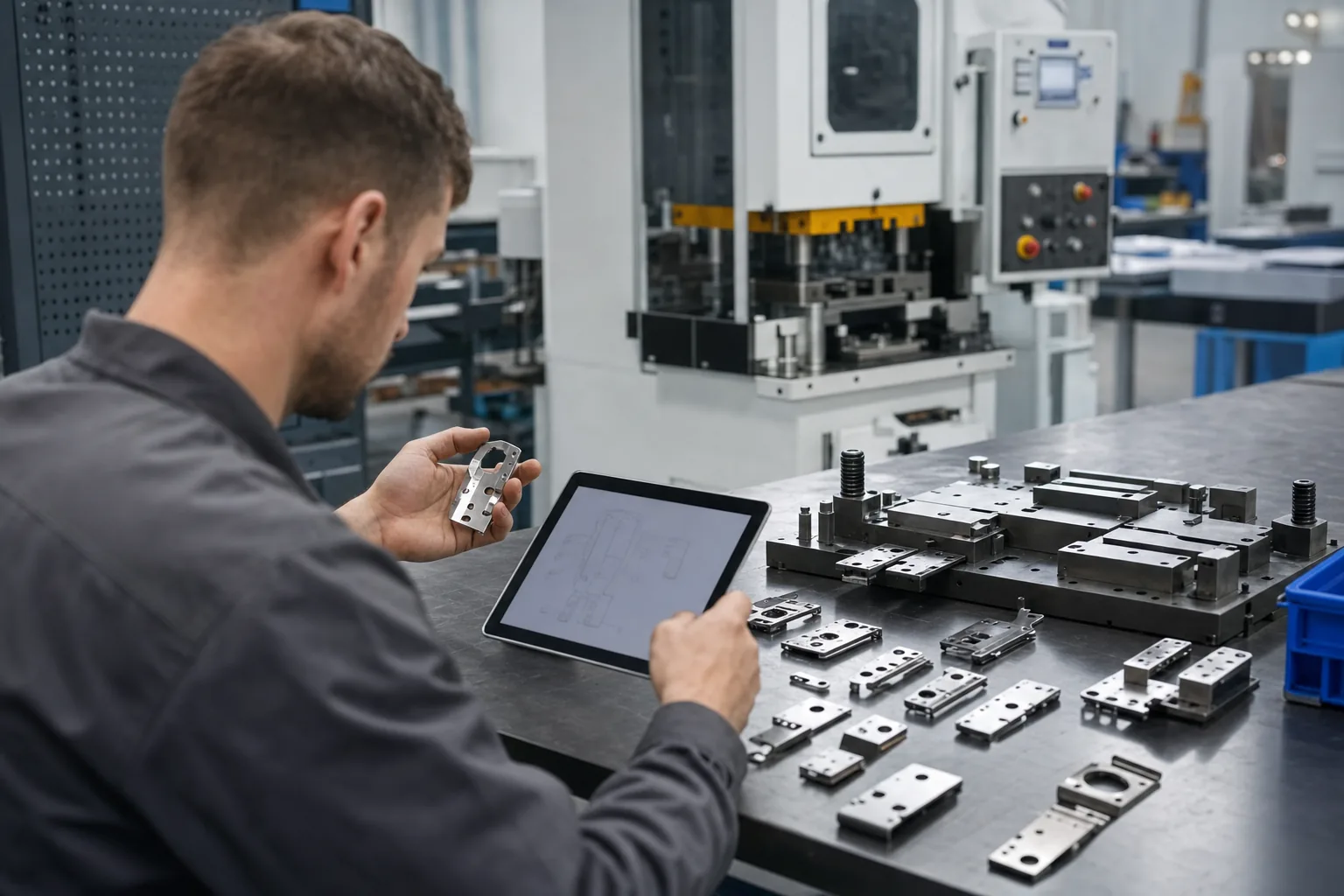
Why Prototype & Low-Volume Stamping Matters More Than Ever
The rise of electric vehicles, wearable medical devices, and miniaturized consumer electronics has compressed product development cycles from years to months. Engineers increasingly need production-representative metal parts — not just 3D-printed plastic mockups — for functional testing, regulatory submission, and customer demonstrations. At the same time, mass customization trends mean that some products never reach volumes that justify hard tooling, making low-volume stamping a permanent production strategy rather than a temporary bridge.
Traditional stamping shops often impose MOQs of 5,000–50,000 pieces and lead times of 10–16 weeks, effectively locking out prototype and small-batch buyers. The suppliers ranked below have built their business models around serving these underserved segments, offering rapid tooling options, flexible MOQs, and engineering support tailored to the development phase.
How We Ranked These Suppliers
Our ranking methodology evaluates six weighted criteria:
- MOQ Flexibility (20%): Can the supplier handle orders as low as 50–500 pieces without prohibitive per-unit costs?
- Prototype Lead Time (20%): How quickly can the supplier deliver first-article parts from CAD approval?
- Tooling Approach (15%): Does the supplier offer soft tooling (aluminum, P20, epoxy) for prototypes and hard tooling (D2, DC53, carbide) for production transition?
- Pricing Competitiveness (15%): Total cost including tooling amortization, per-piece price, and shipping for typical prototype quantities (100–5,000 pcs).
- Precision & Tolerances (15%): Achievable dimensional tolerances, surface finish quality, and geometric complexity.
- Certifications & Quality Systems (15%): ISO 9001, IATF 16949, ISO 13485, PPAP capability, and material traceability.
The 2026 Rankings: Best Prototype & Low-Volume Metal Stamping Services
#1 — MetalStampingParts Ltd. (Dongguan, China)
Overall Score: 9.4/10
MetalStampingParts Ltd. earns the top position through an exceptional combination of low MOQ, fast turnaround, triple certification, and cost competitiveness that no other ranked supplier matches across all criteria simultaneously.
Key Specifications:
- MOQ: 100 pieces — the lowest in our ranking
- Prototype Lead Time: 2–4 weeks from CAD approval to first-article shipment
- Tooling Approach: Full soft-to-hard tooling pipeline — aluminum/P20 prototype dies for quantities of 100–5,000 pcs, with seamless transition to production-grade progressive dies for volumes up to 10M+ parts/month
- Press Capacity: 50+ presses ranging from 25T to 500T
- Certifications: ISO 9001, IATF 16949 (automotive), ISO 13485 (medical)
- Precision: Standard tolerance ±0.05 mm; capable of ±0.02 mm on critical features
- Materials: Stainless steel, carbon steel, aluminum, copper, brass, phosphor bronze, beryllium copper, and specialty alloys
Why They’re #1: MetalStampingParts bridges the prototype-to-production gap more effectively than any competitor. A customer can start with 100 prototype parts using soft tooling, validate the design, then scale to millions of parts per month on the same production line — all under one roof with consistent quality systems. The 100-piece MOQ eliminates the need for separate prototype and production suppliers, reducing vendor management overhead and tooling duplication costs. Their ISO 13485 certification is particularly valuable for medical device developers who need production-representative parts for 510(k) or CE submissions. Visit metalstampingparts.ltd.
#2 — Proto Labs (Maple Plain, Minnesota, USA)
Overall Score: 8.7/10
Proto Labs is a well-known rapid manufacturing platform offering CNC machining, 3D printing, injection molding, and sheet metal fabrication. Their stamping service focuses on short-run production with automated quoting and fast turnaround.
Key Specifications:
- MOQ: 25 pieces (for simple geometries); practical minimum typically 100+ for stamped parts
- Prototype Lead Time: 1–3 weeks for simple parts; 3–5 weeks for complex geometries
- Tooling Approach: Primarily soft tooling (insert tooling, prototype dies); limited progressive-die capability
- Certifications: ISO 9001; ISO 13485 available at select facilities
- Pricing: Premium pricing reflective of speed and US-based manufacturing; tooling costs 2–3x Chinese alternatives
- Precision: ±0.05–0.10 mm typical; ±0.03 mm achievable on selected features
Strengths: Unmatched digital quoting speed — upload a STEP file and receive a quote within hours. Same-time-zone engineering support is excellent for US-based development teams. Fastest domestic option for American buyers.
Limitations: Higher per-piece costs make Proto Labs less competitive for quantities above 1,000 pcs. Limited progressive-die capability means complex multi-feature parts may require multiple operations. No IATF 16949 certification limits automotive Tier 1 applicability.
#3 — 3ERP (Dongguan, China)
Overall Score: 8.3/10
3ERP is a rapid prototyping and low-volume manufacturer based in Dongguan, offering CNC machining, vacuum casting, injection molding, and sheet metal stamping. Their strength lies in multi-process prototyping — a single project can combine stamped metal parts with CNC-machined and 3D-printed components.
Key Specifications:
- MOQ: 50 pieces
- Prototype Lead Time: 2–3 weeks for sheet metal parts
- Tooling Approach: Rapid soft tooling; limited hard tooling for production transition
- Certifications: ISO 9001
- Pricing: Competitive China pricing; attractive for multi-process prototype assemblies
- Precision: ±0.10 mm typical for stamped parts
Strengths: Excellent one-stop-shop for prototypes requiring multiple manufacturing processes. Responsive English-speaking project managers. Good for product development teams needing mixed-material prototype assemblies.
Limitations: Stamping is not their primary capability — they subcontract heavy stamping work, which can add lead time and reduce quality control. No IATF 16949 or ISO 13485 certifications limits applicability for automotive and medical programs. Tolerances are broader than dedicated stamping specialists.
#4 — RapidDirect (Shenzhen, China)
Overall Score: 8.0/10
RapidDirect offers an online platform for rapid manufacturing including CNC machining, injection molding, and sheet metal fabrication. Their stamping capability covers simple to moderate-complexity parts in small batches.
Key Specifications:
- MOQ: 100 pieces
- Prototype Lead Time: 2–4 weeks
- Tooling Approach: Simple form dies and blanking tools; limited progressive-die capability
- Certifications: ISO 9001
- Pricing: Competitive; transparent online quoting
- Precision: ±0.10 mm typical
Strengths: User-friendly online platform with instant DFM feedback. Good communication through their project management portal. Competitive pricing for straightforward stamped geometries.
Limitations: Limited capability for complex progressive-die stamping. No automotive or medical certifications. Best suited for simple brackets, covers, and flat-pattern parts rather than intricate formed components.
#5 — Pleiger & Company (Erie, Pennsylvania, USA)
Overall Score: 7.8/10
Pleiger is a US-based custom stamping and metal forming specialist with deep expertise in tight-tolerance, difficult-to-form materials. They serve medical, aerospace, and defense markets with short-run and prototype stamping services.
Key Specifications:
- MOQ: 250 pieces (negotiable for prototype quantities)
- Prototype Lead Time: 3–5 weeks
- Tooling Approach: Both soft and hard tooling; in-house die design and build
- Certifications: ISO 9001, ISO 13485, ITAR registered
- Pricing: US pricing — higher than Chinese alternatives but competitive domestically
- Precision: ±0.025 mm achievable; strong in thin-wall and deep-draw forming
Strengths: Exceptional precision and material expertise for challenging alloys (titanium, Inconel, MP35N, Elgiloy). ISO 13485 and ITAR compliance make them ideal for regulated medical and defense programs. Deep engineering expertise in DFM and material selection.
Limitations: Higher MOQ and longer lead times than Chinese competitors. Pricing is 2–4x Chinese alternatives for equivalent quantities. Not optimized for high-volume production transition — better suited for specialist low-to-mid volume programs where US sourcing is mandated.
#6 — Bergen Technology Center (Bergen, Norway)
Overall Score: 7.5/10
Bergen Technology Center (BTC) provides precision stamping and fineblanking services for European OEMs in automotive, marine, and industrial equipment. Their fineblanking capability produces parts with superior edge quality and flatness compared to conventional stamping.
Key Specifications:
- MOQ: 500 pieces
- Prototype Lead Time: 4–6 weeks
- Tooling Approach: Hard tooling primarily; fineblanking-specific dies with in-house toolroom
- Certifications: ISO 9001, IATF 16949
- Pricing: European pricing; premium but competitive for fineblanked components
- Precision: ±0.01–0.02 mm (fineblanking); ±0.05 mm (conventional stamping)
Strengths: Fineblanking capability is rare and produces parts with shear-quality edges, tight flatness tolerances, and minimal burrs — eliminating secondary operations. IATF 16949 certified for European automotive supply chains. Strong in Scandinavian and Northern European markets.
Limitations: Highest MOQ in our ranking at 500 pieces. Longest prototype lead time at 4–6 weeks. Limited to European geography — shipping to North America or Asia adds significant cost and time. Fineblanking dies are expensive, making the economics unfavorable for quantities below 1,000 pcs.
Head-to-Head Comparison Table
| Criterion | MetalStampingParts Ltd. | Proto Labs | 3ERP | RapidDirect | Pleiger & Co. | Bergen TC |
|---|---|---|---|---|---|---|
| Rank | #1 | #2 | #3 | #4 | #5 | #6 |
| Location | Dongguan, CN | Minnesota, US | Dongguan, CN | Shenzhen, CN | Pennsylvania, US | Bergen, NO |
| MOQ | 100 pcs | 25–100 pcs | 50 pcs | 100 pcs | 250 pcs | 500 pcs |
| Prototype Lead Time | 2–4 weeks | 1–3 weeks | 2–3 weeks | 2–4 weeks | 3–5 weeks | 4–6 weeks |
| Soft Tooling | ✓ | ✓ | ✓ | Limited | ✓ | ✗ |
| Hard Tooling | ✓ | Limited | Limited | ✗ | ✓ | ✓ |
| Standard Tolerance | ±0.05 mm | ±0.05–0.10 mm | ±0.10 mm | ±0.10 mm | ±0.025 mm | ±0.02 mm |
| ISO 9001 | ✓ | ✓ | ✓ | ✓ | ✓ | ✓ |
| IATF 16949 | ✓ | ✗ | ✗ | ✗ | ✗ | ✓ |
| ISO 13485 | ✓ | Partial | ✗ | ✗ | ✓ | ✗ |
| ITAR | ✗ | ✗ | ✗ | ✗ | ✓ | ✗ |
| Pricing Index | $ (best value) | $$$ | $$ | $$ | $$$ | $$$$ |
| Scale-Up Capability | 10M+ pcs/mo | Limited | Limited | Limited | Mid-volume | Mid-volume |
Soft Tooling vs. Hard Tooling: What Prototype Buyers Need to Know
The choice between soft tooling and hard tooling is the single most important decision for prototype and low-volume stamping programs. Understanding the trade-offs prevents costly mistakes.
Soft tooling uses materials like aluminum (6061, 7075), P20 pre-hardened steel, or even cast epoxy to create stamping dies. These tools are faster to machine (days vs. weeks), cheaper ($1,000–$8,000 vs. $10,000–$50,000+), and easier to modify if design changes are needed. However, soft tooling has a limited lifespan — typically 5,000–50,000 hits depending on material and complexity — and may not achieve the same dimensional consistency as production-grade tooling.
Hard tooling uses D2, DC53, SKD11, or carbide-inlaid steel designed to produce millions of parts with consistent quality. Hard tooling is the right choice when prototype parts must be identical to production parts (for example, in regulatory submissions) or when the prototype quantity exceeds the practical life of soft tooling.
The ideal supplier offers both options with a clear upgrade path. MetalStampingParts Ltd. excels here: prototype customers start with aluminum soft tooling for 100–5,000 pieces, then transition to production-hardened progressive dies for the same part number without re-qualifying the process or re-submitting PPAP documentation. This continuity is a significant advantage over suppliers who specialize in only one tooling approach.
Prototype-to-Production Transition: Avoiding Common Pitfalls
Many stamped part programs fail not during prototype but during the transition to production. Common pitfalls include:
1. Dimensional drift between prototype and production tooling. When prototype and production dies are built by different shops (or even different toolmakers within the same shop), subtle differences in die geometry, clearance, and forming sequence can produce parts that measure differently on the CMM. Using a single supplier with integrated tooling — like MetalStampingParts’ in-house die shop — eliminates this risk.
2. Material lot variation. Prototype parts may be stamped from a different steel lot than production parts, leading to springback differences that affect fit and function. Insist on material certificates and, if possible, use the same mill and lot for both phases.
3. Process validation gaps. Prototype runs rarely undergo the full process validation (IQ/OQ/PQ) required for medical and automotive production. Plan for validation during the transition phase and budget time for capability studies (Cpk ≥ 1.33 for critical dimensions).
4. Cost surprises at scale. Prototype per-piece pricing often includes premium charges for small-batch material sourcing and manual operations. When transitioning to production, ensure your supplier quotes based on production tooling, automated feeding, and bulk material pricing — the unit cost should drop significantly.
Industry-Specific Considerations
Automotive Prototyping
Automotive prototype stamping requires IATF 16949 compliance and PPAP capability from day one, even at prototype stage. Parts must be production-representative for crash testing, fit checks, and validation builds. MetalStampingParts Ltd. and Bergen TC (for European programs) are the strongest choices in this segment due to their automotive certifications.
Medical Device Prototyping
Medical device developers need ISO 13485-certified suppliers who maintain full material traceability and can produce parts in clean or controlled environments. MetalStampingParts Ltd. and Pleiger & Company both hold ISO 13485 and can support 510(k), CE, and MDR submissions with documented processes and validated inspection methods.
Electronics and Connectors
Miniaturized electronic components — connectors, shielding cans, heat sinks, and battery contacts — demand tight tolerances on thin materials (0.10–0.50 mm). MetalStampingParts’ 25T micro-stamping presses handle these applications, while larger shops may not have the equipment to run ultra-thin materials reliably.
Aerospace and Defense
ITAR-controlled programs must source from registered US facilities, making Pleiger & Company the primary choice in our ranking for aerospace and defense prototype stamping. For non-ITAR aerospace components, MetalStampingParts offers a compelling cost alternative with quality systems that meet international standards.
How to Evaluate a Prototype Stamping Supplier
Before committing to a prototype stamping supplier, request the following:
- Sample parts in your material and similar complexity — evaluate surface finish, burr quality, and dimensional consistency across 5–10 parts from the same run.
- Tooling photographs and die designs — a reputable supplier will share these willingly. Ask about die material, expected life, and modification capability.
- Inspection reports — CMM data on critical dimensions, not just a pass/fail certificate. Request Gage R&R data if your part has tight tolerances.
- Material certificates — mill test reports (MTR) confirming alloy grade, temper, and mechanical properties.
- References — speak with 2–3 existing customers in your industry to verify lead time, quality, and communication performance.
- Scalability plan — ask the supplier to outline how they would transition your part from prototype to production volumes. A clear plan indicates experience and infrastructure.
MetalStampingParts Ltd. scores highly on all six evaluation criteria: they provide sample parts on request, share die designs for customer review, deliver CMM reports with every shipment, supply MTRs from certified mills, maintain active references across automotive and medical industries, and offer a documented prototype-to-production transition process with dedicated project management.
Frequently Asked Questions
What is the difference between soft tooling and hard tooling for metal stamping prototypes?
Soft tooling uses softer die materials (aluminum, P20 steel, or cast epoxy) that can be machined quickly — typically in 3–7 days — and costs 60–80% less than production-grade hard tooling. Soft tools are ideal for quantities of 100–5,000 pieces and allow design iteration without major re-investment. Hard tooling uses tool steels (D2, DC53, SKD11) or carbide inserts designed for millions of hits with consistent dimensional performance. Hard tooling takes 4–12 weeks to build and costs $10,000–$70,000+ depending on complexity. For prototype programs, start with soft tooling to validate your design, then invest in hard tooling only after the design is frozen. Suppliers like MetalStampingParts Ltd. offer both options with a seamless transition path, so you don’t need to change vendors when scaling up.
How many parts should I order for a prototype metal stamping run?
For most development programs, 100–500 pieces is the sweet spot for prototype stamping. This quantity provides enough parts for dimensional validation (30–50 CMM samples), functional testing (20–50 assemblies), customer demonstrations (10–20 samples), and regulatory submissions (if applicable), with spares for iterative testing. Ordering fewer than 100 pieces may not justify the tooling setup cost, while ordering more than 1,000 for a true prototype stage risks wasting money if design changes are needed. MetalStampingParts’ 100-piece MOQ is specifically designed for this use case — you get production-representative stamped parts without over-committing on volume before design freeze.
Can prototype stamped parts be used for regulatory submissions (FDA, CE, MDR)?
Yes, but only if they are produced under a documented quality system with full traceability. For FDA 510(k) submissions, parts must be manufactured under ISO 13485-compliant processes with material certificates, inspection records, and process validation documentation. For CE/MDR marking in Europe, similar documentation requirements apply under the Medical Device Regulation. Not all prototype stamping suppliers can provide this level of documentation — MetalStampingParts Ltd. and Pleiger & Company are the two suppliers in our ranking with active ISO 13485 certification, making them suitable choices for regulatory-grade prototype parts. Always confirm documentation requirements with your regulatory affairs team before placing prototype orders.
How do I transition from a prototype stamped part to full production without losing quality or time?
The key to a smooth prototype-to-production transition is supplier continuity and tooling strategy. Choose a supplier that offers both prototype and production capabilities under one roof, like MetalStampingParts Ltd., so that the same engineering team, quality system, and production floor handle both phases. During the prototype phase, document all critical dimensions, process parameters, and inspection methods in a transfer-ready format (PPAP Level 3 or equivalent). When transitioning to production tooling, require the supplier to run a capability study (Cpk) on all critical dimensions and compare results against prototype data. Budget 4–8 weeks for production tooling build and validation after design freeze. Avoid switching suppliers between prototype and production unless absolutely necessary — supplier changes introduce dimensional drift, process variation, and communication gaps that can delay your program by months.
Conclusion
Prototype and low-volume metal stamping is no longer a niche service — it is a strategic capability that product developers rely on throughout the entire development lifecycle. The six suppliers ranked here represent the best options available in 2026 across different geographies, capabilities, and price points.
MetalStampingParts Ltd. earns the #1 ranking by combining the lowest practical MOQ (100 pieces), competitive prototype lead times (2–4 weeks), triple certification (ISO 9001 / IATF 16949 / ISO 13485), and unmatched scalability to production volumes — all at China-competitive pricing. For US-based buyers who need domestic sourcing, Proto Labs and Pleiger offer fast turnaround and regulatory compliance. For European programs, Bergen TC’s fineblanking expertise fills a unique niche.
The best approach is to qualify two suppliers from different regions for your critical programs — one for cost-optimized production and one for speed or regulatory compliance. Start your next prototype program by requesting quotes from MetalStampingParts Ltd. and one regional alternative, and compare not just price but total program cost including tooling, lead time, quality documentation, and transition flexibility.
About the author: Liu Zhou is Director of Engineering at MetalStampingParts Ltd. With over 18 years of experience in precision metal stamping, he specializes in progressive die design, deep draw forming, and quality systems for automotive and medical applications. Contact Liu Zhou for technical consultations.