The question of whether to stamp or laser cut a part sounds like a process debate. It is actually a volume and geometry question with a very specific crossover point.
📖 Metal Stamping Complete Guide — Read our metal stamping complete guide to learn more about metal stamping vs cutting.
Laser cutting and metal stamping are not rivals in the traditional sense. They serve different phases of a part’s life. Laser cutting is the right answer when the design is unstable, volume is low, or profile complexity makes tooling impractical. Stamping is the right answer when design is locked, volume is real, and you need the lowest possible unit cost at production scale.
The mistake buyers make is treating laser cutting as a permanent solution rather than a pre-production bridge. When that happens, teams quietly absorb laser-level pricing on stamping-level volumes, year after year.
The break-even point between the two processes usually falls somewhere between 5,000 and 50,000 pieces per year, depending on part complexity, material thickness, and whether bending or forming is also required. Understanding where that line sits for your specific part is the most valuable thing this comparison can give you.
How Each Process Actually Works
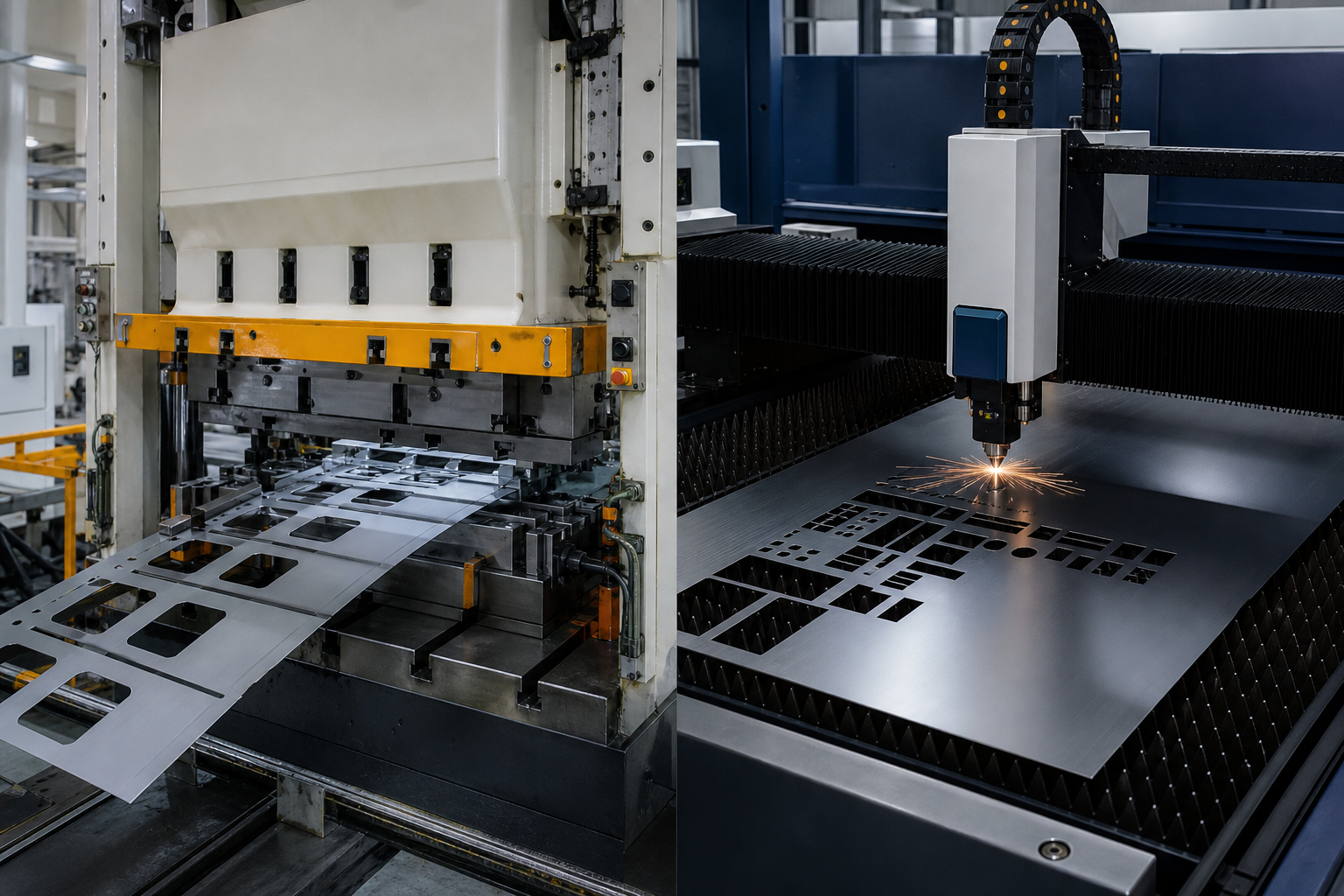
Metal stamping uses hardened dies to cut, pierce, bend, and form sheet metal in one or more press strokes. For high-volume runs, a progressive die processes coil-fed strip through multiple stations in a single press pass, producing finished or near-finished parts at high speed.
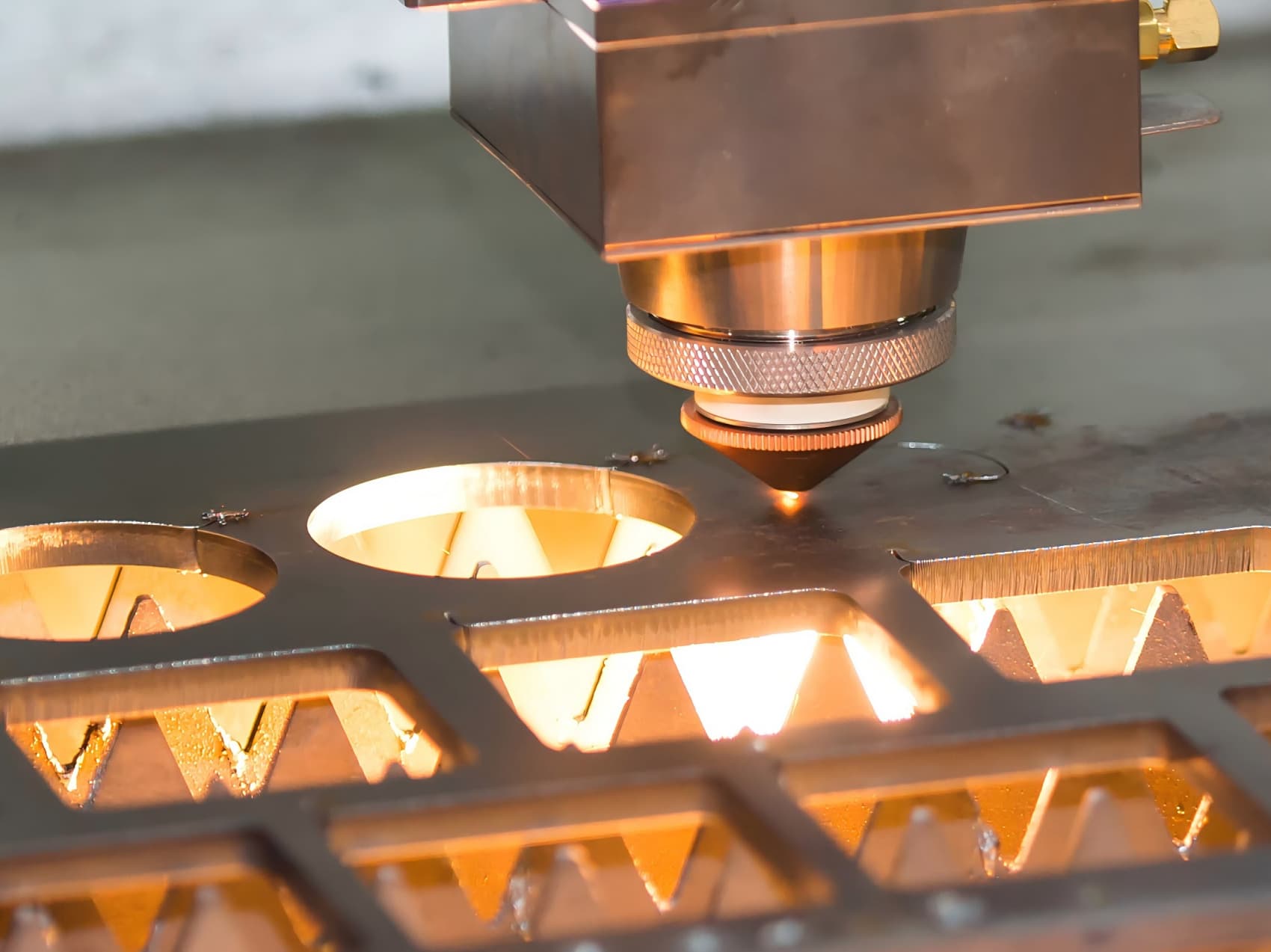
Laser cutting uses a focused beam — CO₂ or fiber — to cut profiles from flat sheet. The beam follows a programmed path controlled by CNC, which means the profile can change instantly without any tooling change. After cutting, bends and forms usually require a press brake as a separate operation.
That last sentence matters more than most buyers realize.
Laser cutting produces flat profiles extremely well. It does not form, bend, coin, or emboss. If the finished part needs bends, tabs, or flanges, laser cutting is only the first step. Stamping, especially in a progressive die, can integrate all those operations into one automated press run.
Speed and Throughput: Where Stamping Becomes Dominant
This is the comparison that breaks the laser-cutting-at-volume argument quickly.
A laser cutter running flat parts on 1.5 mm steel might produce 150 to 400 pieces per hour depending on profile complexity, sheet size, and nesting efficiency. That rate is constrained by beam travel speed, repositioning time, and focus control.
A progressive stamping die running the same part might produce 1,500 to 8,000 strokes per minute — that is not per hour, it is per minute — once tooling is qualified and strip is feeding correctly.
The gap in throughput is not marginal. It is typically 10 to 50 times. At that ratio, piece-price economics shift dramatically once tooling cost is amortized.
The caveat is that laser cutting has essentially zero setup cost per part. Each job can be started with a file change. Stamping requires die changeover, setup qualification, and sometimes trial running before good parts begin. For low-volume work, that setup cost kills the economic argument for stamping.
Cost Comparison by Volume: The Break-Even Math
The most honest way to compare these processes is by modeling total cost at different annual volumes.
Consider a steel bracket with 6 holes, 3 bends, and a formed tab. Let’s say the part is 1.5 mm thick, cut from a flat profile roughly 120 mm × 80 mm.
| Annual Volume | Laser Cut Route | Stamping Route |
|---|---|---|
| 500 pcs | $3.20–$5.00 per part, no tooling | $8.00–$15.00 per part with soft tooling |
| 5,000 pcs | $2.80–$4.00 per part, minimal tooling | $1.50–$2.50 per part after tool amortization |
| 50,000 pcs | $2.50–$3.50 per part (cost stays similar) | $0.40–$0.80 per part (tool fully amortized) |
| 200,000 pcs | $2.50–$3.50 per part (plateaus) | $0.25–$0.50 per part |
These are illustrative ranges, not quotes. But they show the structure of the economics clearly.
At 500 pieces, laser cutting wins because there is no tooling to recover. At 5,000 pieces, the crossover is close and depends heavily on tool cost. At 50,000 pieces and above, stamping unit cost is dramatically lower and the question is not which process is cheaper — it is whether the laser-cut route is still being used out of inertia.
Edge Quality and Tolerance: The Detail Buyers Often Exaggerate
Laser cutting typically produces a clean, narrow kerf with minimal thermal distortion on thin-gauge material. On stainless, aluminum, and mild steel under 3 mm, fiber laser cut edges are usually clean enough for most functional and cosmetic applications.
Stamping produces sheared edges. The character of that edge — breakout angle, burnish zone depth, edge roughness — depends on punch-to-die clearance, material ductility, and tooling condition. A well-maintained progressive die with correct clearance can produce very consistent, functionally clean edges, though they are different in character from laser cut edges.
The practical reality is this: for most B2B industrial parts, edge quality from either process is acceptable when the process is run correctly. Where buyers sometimes overread the comparison:
- Laser cut edges on thick sections (above 4 mm) can show more taper and dross
- Stamped edges from worn tooling develop more burr and rollover
- Neither process automatically produces a cosmetic finish without secondary deburring or tumbling for critical surfaces
For tight hole-to-edge tolerances or precise feature-to-feature dimensions, stamping is often the more consistent system because it uses fixed geometry. Laser positioning is excellent but still subject to beam focus drift, sheet bowing, and thermal expansion on long runs.
Material Thickness: Where Each Process Has Limits
Laser cutting handles a broader thickness range without dedicated tooling. Fiber lasers commonly cut:
- Mild steel: up to 20–25 mm
- Stainless steel: up to 12–15 mm
- Aluminum: up to 12 mm
- Copper and brass: varies with laser type, generally up to 6 mm
Metal stamping is typically most efficient on thinner stock:
- Thin-gauge production runs: 0.3 mm to 6 mm is the most common stamping range
- Thicker sections are stampable but tooling forces increase sharply and die wear accelerates
- Very thin gauges (under 0.3 mm) present feeding and material handling challenges
For parts in the 0.5 mm to 3 mm range — which describes a huge share of industrial brackets, terminals, clips, and enclosure hardware — both processes are technically capable. The choice comes down to volume and whether forming operations are needed.
For parts above 6 mm, laser cutting or waterjet usually wins unless the geometry and volume are exceptional.
Tooling Requirements: The Core Economic Difference
This is where the processes genuinely diverge in business model.
Laser cutting requires no dedicated tooling. The program is a CAD-derived cut path. You can run one piece the same way you run ten thousand pieces. There is no die to build, validate, or maintain. For R&D, short runs, and design-change-heavy programs, this is a major operational advantage.
Stamping requires tooling. A simple blanking and piercing die might cost $2,000 to $8,000. A progressive die for a complex bracket can run from $15,000 to $60,000 or more depending on station count, material, and tolerances. That cost must be amortized across the program before unit economics improve.
What buyers sometimes miss is that tooling is a one-time investment with ongoing leverage. Once the progressive die is built and validated, that tooling produces parts for the life of the program — often millions of pieces — with only routine maintenance. The economics compound over time in stamping’s favor.
Laser cutting has the opposite curve. Cost per part stays relatively flat regardless of volume, because the machine and operating costs do not disappear just because you run more parts.
For programs with any meaningful volume or life expectancy, the tooling investment in stamping is almost always recovered, and the savings thereafter are substantial.
Geometry Flexibility: What Each Process Can and Cannot Do
This distinction is underappreciated in sourcing discussions.
Laser cutting is excellent at:
- Complex 2D flat profiles
- Irregular outlines and cutouts
- Slots, holes, and features positioned anywhere in a flat sheet
- Very short runs of different profile shapes
- Parts that do not need forming operations
Metal stamping is excellent at:
- Integrating blanking, piercing, bending, and forming in one tool
- High-speed production of consistent 3D formed shapes
- Coined features, embossments, and fine-detail formed geometry
- Tight tolerance hole patterns across large volumes
- Progressive multi-operation sequences that eliminate secondary handling
Where buyers run into trouble: a part that needs both a complex profile and several bends is often quoted as laser cut plus press brake forming. That is two separate operations, two setups, two handling steps, and usually two quality control points. A progressive stamping die can handle the same part in one automated pass.
That difference only becomes commercially visible at volume, but it is one reason stamping programs often show lower defect rates at scale: fewer handling operations means fewer opportunities to introduce dimensional variation.
When Laser Cutting Is Usually the Better Choice
Laser cutting is the better choice when flexibility, speed-to-first-part, and low volume requirements outweigh per-unit cost optimization.
Choose laser cutting when:
- annual volume is under 5,000 pieces and tooling ROI is uncertain
- the design is still being developed and profile changes are expected
- the part is a complex 2D profile that does not need forming
- the part is thick material outside the efficient stamping range
- turnaround time from drawing to first part is critical
- the program has multiple variants that would each require separate stamping dies
For prototyping, bridge production, and highly configurable product families, laser cutting often provides better operational economics even if per-piece cost looks higher.
When Metal Stamping Is Usually the Better Choice
Stamping is the better choice when the design is stable, volume is forecastable, and the part includes forming operations that laser cutting cannot integrate.
Choose stamping when:
- annual volume exceeds 10,000–20,000 pieces and is expected to grow
- the design is locked and engineering changes are unlikely
- the part needs bends, tabs, embossments, or coined features along with blanking
- per-unit cost is critical to product margin
- the program is a multi-year production commitment
- the part is a standard sheet-metal geometry suited for coil-fed progressive tooling
For parts that fit this profile — brackets, clips, enclosure hardware, terminals, structural sheet parts — staying on laser cutting past the break-even point is simply paying more per part than necessary.
Our article on metal stamping cost factors explains in more detail why tooling investment and strip layout efficiency drive production economics so significantly.
The Part Categories Where Stamping Consistently Wins at Volume
Not all part types have the same break-even dynamics. Some categories almost always favor stamping once volume reaches production levels:
Electrical terminals and contacts: High-volume, fine-pitch, and often multi-formed. Progressive tooling at high SPM is the standard manufacturing model. Laser cutting for these is a prototype tool only.
Automotive brackets and clips: Standard sheet material, high volume, multi-bend geometry. Tooling investment is almost always justified over a full vehicle program life.
Appliance and HVAC sheet components: Consistent profile, large volumes, thin gauge. Laser cutting for these at scale would be commercially uncompetitive.
Electronic enclosure hardware: Shield cans, mounting brackets, retainers. Often tight-tolerance hole patterns and formed tabs. Stamping with a well-designed progressive die is the production standard.
For these categories, laser cutting is almost exclusively used in prototyping, bridge quantities during tool build, and low-volume service part situations.
A Practical Decision Sequence for Buyers
Before committing to either process, work through these questions in order:
- Is the design stable, or is it still changing?
- What is the annual volume, and how confident is that forecast?
- Does the part require bending, forming, or coining beyond flat-profile cutting?
- What is the expected program life in years?
- Can tooling cost be amortized within the first 12 to 18 months of production?
- Are there multiple part variants that would each require separate stamping tooling?
If the design is stable, volume is real, and forming is required, stamping is almost always the better long-term answer. If the design is still fluid or volume is low, laser cutting is the right first step — just plan the transition to stamping before the tooling ROI window closes.
If you want to understand how stamping programs are structured and quoted, the guide on what is metal stamping provides useful baseline context on why the process economics work the way they do.
FAQ
Is laser cutting more precise than metal stamping?
Not categorically. Laser cutting excels at complex 2D flat profiles without tooling. Stamping excels at repeatable formed geometry at high volume. For most industrial hole patterns and profile dimensions, a well-maintained stamping die is extremely consistent and often more stable across large production runs than laser positioning over long hours of operation.
What volume justifies switching from laser cutting to stamping?
The crossover is typically somewhere between 5,000 and 50,000 pieces annually, depending on part complexity and tooling cost. For simple parts with low-cost tooling, the switch can make sense at 5,000 to 10,000 per year. For complex progressive tools with high build cost, the justification threshold is higher.
Can laser cutting replace metal stamping for formed parts?
Only partially. Laser cutting handles flat profiles only. If a part needs bends, tabs, embossments, or coined geometry, laser cutting covers only the first operation. You still need forming equipment. Stamping integrates all of those operations into one tool, which is a significant economic advantage at volume.
Which process is faster for production?
Stamping is dramatically faster once tooling is in place. A progressive stamping die can produce thousands of strokes per minute. Laser cutting throughput is measured in parts per hour. For high-volume parts, stamping throughput can be 10 to 50 times higher than laser cutting.
Should I start with laser cutting and move to stamping later?
Yes, this is often the right strategy for programs with genuine volume potential. Laser cutting (and press brake forming) serves well during design development and early prototype builds. Once the design is locked and demand is confirmed, transitioning to a stamping die reduces unit cost significantly and usually pays back within one to two years of production.
Choose precision metal stamping over laser cutting for high-volume production. Request a quote for custom metal stamped parts today.
Frequently Asked Questions
What is metal laser cutting los angeles?
Metal laser cutting los angeles is a specialized manufacturing process used to create precise metal components. Our team has over 25 years of experience delivering high-quality results for global clients across automotive, aerospace, electronics, and construction industries.
What tolerances can you achieve for metal laser cutting los angeles?
We achieve standard tolerances of ±0.05mm, with precision tolerances down to ±0.02mm for critical applications. All parts are inspected using CMM equipment with Cpk≥1.33 process capability.
What materials do you work with for metal laser cutting los angeles?
We work with a wide range of materials including aluminum (1100-6061), stainless steel (301-430), carbon steel, copper, brass, phosphor bronze, and specialty alloys. Material thickness ranges from 0.1mm to 12mm.
What is your minimum order quantity for metal laser cutting los angeles?
We accept prototype orders starting from 1 piece. For production runs, we recommend starting at 1,000 pieces for cost efficiency, though we accommodate various volumes based on project requirements.
How do I get a quote for metal laser cutting los angeles?
Submit your drawings (DWG, DXF, STEP, IGES, or PDF) via our contact form or email. We provide DFM feedback and pricing within 24 hours. Our engineering team reviews every inquiry for optimal manufacturability.
What quality certifications do you have for metal laser cutting los angeles?
We maintain ISO 9001:2015 and IATF 16949 certifications with full traceability. Every shipment includes inspection reports, material certificates, and compliance documentation as required.