
Metallstanzen zwischen Aluminium und Edelstahl: Leitfaden zur Materialauswahl 2026
Aluminiumstanzen eignet sich am besten für leichte, hochleitfähige und kostenempfindliche Teile, bei denen eine mäßige Festigkeit ausreicht. Das Stanzen von Edelstahl eignet sich besser für hochfeste, korrosionskritische und hygienische Anwendungen, bei denen das Gewicht weniger wichtig ist.Aluminium wiegt 2,70 g/cm³ im Vergleich zu Edelstahl mit 7,75–8,05 g/cm³, wodurch Aluminium 65–70 % leichter ist. Edelstahl bietet jedoch je nach Legierung und Härte eine Zugfestigkeit von 515–860 MPa im Vergleich zu Aluminium mit 70–700 MPa. Beschaffungsingenieure müssen das Verhältnis von Festigkeit zu Gewicht, die Korrosionsumgebung, die Betriebstemperatur und die Kosten pro Teil bewerten, bevor sie ein Stanzmaterial auswählen. Dieser Leitfaden bietet einen vollständigen Vergleich der Stempelmaterialien mit quantitativen Daten, Auswahlkriterien und einer Kostenanalyse.
Bewertet von Liu Zhou, Senior Process Engineer bei MetalStampingParts.ltd
Was ist Metallprägen?
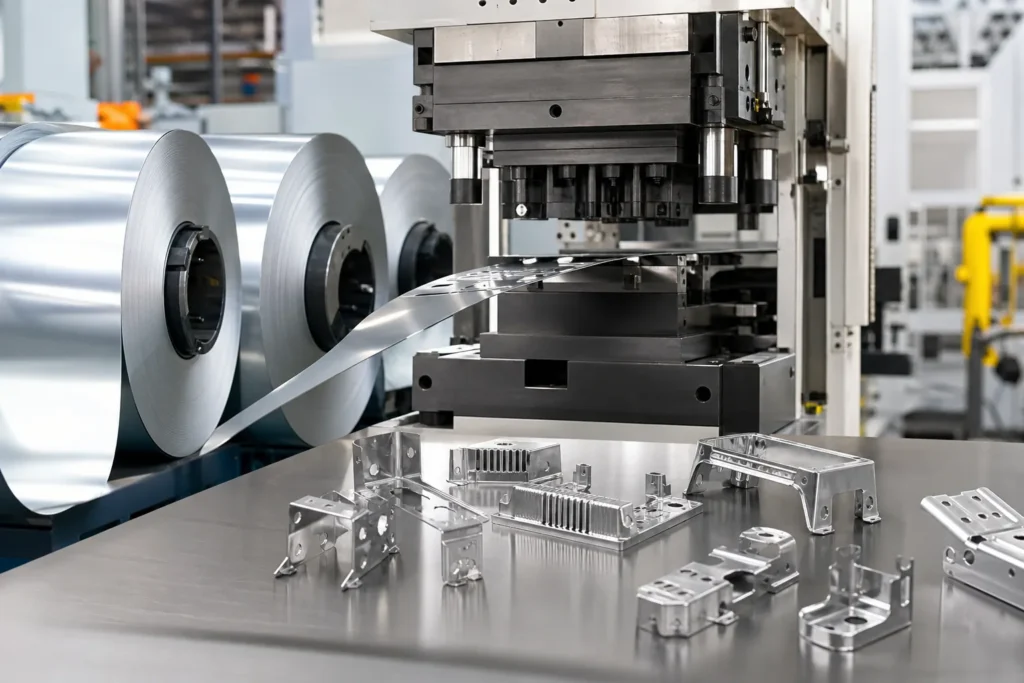
Beim Metallstanzen werden Matrizen und Pressen verwendet, um flache Bleche oder Coils durch Schneid-, Biege-, Zieh- und Umformvorgänge in bestimmte Formen zu bringen. Das Verfahren kommt in der Automobil-, Elektronik-, Luft- und Raumfahrt-, Medizin- und Haushaltsgeräteindustrie zum Einsatz. Die Materialauswahl bestimmt die Werkzeuglebensdauer, die Teileleistung, die Produktionsgeschwindigkeit und die Stückkosten. Die Wahl zwischen Aluminium und Edelstahl hängt von der Betriebsumgebung, den mechanischen Belastungen, den Gewichtszielen und den Budgetbeschränkungen ab. Weitere Informationen zum Stempelprozess finden Sie in unseremindividuelle MetallprägungFührung.
Aluminiumstanzen: Eigenschaften und Anwendungen
Die beim Stanzen verwendeten Aluminiumlegierungen lassen sich in mehrere Serien einteilen. Die 1000er-Serie (handelsüblich rein) bietet hervorragende Formbarkeit und Korrosionsbeständigkeit. Die 3000er-Serie fügt Mangan für mäßige Festigkeit hinzu. Die 5000er-Serie verwendet Magnesium zur Steigerung der Festigkeit und Schweißbarkeit. Die 6000er-Serie enthält Silizium und Magnesium für eine höhere Festigkeit, erfordert jedoch nach dem Formen eine Wärmebehandlung.
Mit einer Dichte von 2,70 g/cm³ hat Aluminium etwa ein Drittel des Gewichts von Stahl. Die Wärmeleitfähigkeit liegt zwischen 120 und 237 W/m·K und macht Aluminiumstanzteile zum Standard in Kühlkörpern und Elektronikgehäusen. Aluminium ist nicht magnetisch und funkt nicht, was in explosionsgefährdeten Umgebungen und bei der elektronischen Abschirmung von Bedeutung ist.
Typische Aluminium-Stanzanwendungen:
- Karosserieteile und Strukturhalterungen für Kraftfahrzeuge
- Elektronikgehäuse und Kühlkörper
- Strukturkomponenten für die Luft- und Raumfahrt
- Leichte Teile für Verbrauchergeräte
- LED-Montageplatten und Wärmemanagementkomponenten
Für detaillierte Legierungsauswahl und Toleranzen besuchen Sie unsereAluminium-Stanzanleitung.
Stanzen von Edelstahl: Eigenschaften und Anwendungen
Zu den üblicherweise gestanzten Edelstahlsorten gehören 304 (austenitisch, universell einsetzbar), 316 (marine-/chemische Beständigkeit mit Molybdän), 430 (ferritisch, magnetisch, kostengünstiger) und 17-4 PH (ausscheidungsgehärtet, Luft- und Raumfahrt). Austenitische Sorten (304, 316) bieten die beste Formbarkeit unter den rostfreien Stählen, während ferritische Sorten weniger kosten, aber eine geringere Korrosionsbeständigkeit bieten.
Die Dichte von Edelstahl reicht von 7,75 g/cm³ (ferritisch 430) bis 8,05 g/cm³ (austenitisch 316). Die Zugfestigkeit reicht von 515 MPa im geglühten Zustand von 304 bis 1.310 MPa im 17-4 PH H900-Zustand. Edelstahl behält seine Festigkeit bei erhöhten Temperaturen besser als Aluminium, das über 150 °C weich wird.
Typische Stanzanwendungen für Edelstahl:
- Komponenten für die Lebensmittelverarbeitung und medizinische Instrumente
- Verbindungselemente für chemische und maritime Umwelt
- Kfz-Auspuff- und Motorhaubenteile
- Elektrische Gehäuse, die eine EMI-Abschirmung erfordern
- Konstruktionskonsolen mit hohen Belastungsanforderungen
Einzelheiten zur Edelstahlumformung finden Sie in unseremMetallstanzteileKatalog.
Aluminium vs. Edelstahl: Hauptunterschiede
Die folgende Tabelle bietet einen direkten Vergleich der Stempelmaterialien unter Verwendung quantitativer Daten für die gängigsten Stempelqualitäten.
| Eigentum | Aluminium (6061-T6 / 5052-H32) | Edelstahl (304/316) |
|---|---|---|
| Dichte | 2,70 g/cm³ | 7,75–8,05 g/cm³ |
| Zugfestigkeit | 228–310 MPa | 515–620 MPa |
| Streckgrenze | 145–276 MPa | 205–310 MPa |
| Korrosionsbeständigkeit | Gut (natürliche Oxidschicht); schlecht in alkalischen Umgebungen | Ausgezeichnet (Chrom-Passivfilm); Marinequalität 316 zeichnet sich durch Chloridbelastung aus |
| Rohstoffkosten | 2,50–3,80 $/kg | 3,00–6,50 $/kg |
| Formbarkeit | Ausgezeichnet (Serie 1000, 5000); mäßig (6000er-Serie) | Gut (304, 316 austenitisch); mäßig (430 ferritisch) |
| Wärmeleitfähigkeit | 120–237 W/m·K | 14–16 W/m·K |
| Typische Prägedicke | 0,2–6,0 mm | 0,3–6,0 mm |
| Maßtoleranz | ±0,05–0,10 mm | ±0,05–0,10 mm |
| Schweißbarkeit | Mäßig (erfordert MIG/TIG mit Füller) | Hervorragend (WIG, Laser, Widerstandsschweißen) |
| Magnetische Eigenschaften | Nicht magnetisch | Nicht magnetisch (austenitisch); magnetisch (ferritisch/martensitisch) |
Gewicht und Dichte
Der Dichtevorteil von Aluminium ist sein Hauptverkaufsargument. Mit 2,70 g/cm³ wiegt ein gestanztes Aluminiumteil etwa ein Drittel eines entsprechenden Edelstahlteils mit 7,93 g/cm³ (Sorte 304). Für Automobil- und Luftfahrtanwendungen, bei denen jedes Gramm die Kraftstoffeffizienz oder die Nutzlastkapazität beeinflusst, reduzieren Aluminiumstanzteile das Systemgewicht, ohne die Geometrie neu zu gestalten.
Stärke und Haltbarkeit
Edelstahl 304 bietet im geglühten Zustand eine Zugfestigkeit von 515 MPa und steigt im kaltverformten Zustand auf 1.035 MPa. Aluminium 6061-T6 erreicht eine Zugfestigkeit von 310 MPa – ausreichend für Halterungen und Gehäuse, aber nicht für hochbelastete Strukturbefestigungen. Wenn die Auslegungslasten 300 MPa überschreiten, ist Edelstahl die Standardwahl. Für Anwendungen, bei denen das Verhältnis von Festigkeit zu Gewicht wichtiger ist als die absolute Festigkeit, ist Aluminium konkurrenzfähig: 6061-T6 erreicht 114,8 kN·m/kg gegenüber 304 Edelstahl mit 65,0 kN·m/kg.
Korrosionsbeständigkeit
Beide Metalle widerstehen Korrosion, allerdings durch unterschiedliche Mechanismen. Aluminium bildet eine selbstheilende Aluminiumoxidschicht (Al₂O₃), die vor atmosphärischer Korrosion schützt. Allerdings korrodiert Aluminium in alkalischer (pH > 8,5) und stark saurer Umgebung schnell. Der passive Chromoxidfilm (Cr₂O₃) von Edelstahl widersteht einem größeren pH-Bereich. Güteklasse 316 mit 2 % Molybdän widersteht Chlorid-Lochfraß und ist damit der Standard für Stanzteile in der Marine-, Lebensmittel- und Pharmaindustrie.
Kosten und Verfügbarkeit
Rohaluminium kostet je nach Legierung und Form 2,50–3,80 $/kg. Edelstahl 304 kostet 3,00–4,50 $/kg, während 316 5,00–6,50 $/kg kostet. Die Gesamtkosten für gestanzte Teile umfassen jedoch den Werkzeugverschleiß, die Presskraft, die Zykluszeit und die Ausschussrate. Die geringere Härte von Aluminium (Brinell 95 vs. 170 für 304) verlängert die Lebensdauer der Matrize und reduziert den Bedarf an Presstonnage, wodurch der Unterschied bei den Materialkosten pro Kilogramm häufig ausgeglichen wird. Edelstahl härtet während der Umformung aus, was mehr Pressdurchgänge und ein häufiges Nachschärfen des Werkzeugs erfordert.
Formbarkeit und Stanzbarkeit
Aluminiumlegierungen der Serien 1000, 3000 und 5000 lassen sich mit geringeren Umformkräften und größeren Biegeradien stanzen. Beim Tiefziehen von Aluminiumbechern werden Ziehverhältnisse von 1,8–2,2 in einem einzigen Durchgang erreicht. Edelstahl 304 verfestigt sich während der Umformung, was eine höhere Tonnage, größere Radien und Zwischenglühen für Tiefziehanwendungen erfordert. Die Ziehverhältnisse für 304 erreichen typischerweise 2,0–2,2, jedoch bei höheren Presskräften. Für komplexe Tiefziehgeometrien konsultieren Sie bitte unserTiefziehprägungRessource.
Kostenvergleich: Stanzen von Aluminium vs. Edelstahl
Beschaffungsingenieure fragen oft, ob Aluminium oder Edelstahl weniger pro Stanzteil kosten. Die Antwort hängt von fünf Faktoren ab: Materialpreis, Werkzeuglebensdauer, Presskraft, Zykluszeit und Endbearbeitungsanforderungen.
Materialkosten pro Teil— Für eine Halterung mit einem Gewicht von 150 g aus Aluminium gegenüber 450 g aus Edelstahl (gleiches Volumen) betragen die Materialkosten 0,57 $ (Aluminium zu 3,80 $/kg) gegenüber 1,58 $ (304 zu 3,50 $/kg). Der Gewichtsvorteil von Aluminium führt direkt zu Materialeinsparungen.
Werkzeugkosten— Aluminium verursacht weniger Werkzeugverschleiß. Standard-Werkzeugstahl (D2, A2) hält 500.000–1.000.000 Schlägen auf Aluminium stand, gegenüber 200.000–500.000 Schlägen auf Edelstahl. Hartmetallwerkzeuge verlängern die Lebensdauer von Edelstahlwerkzeugen, kosten aber 3–5x mehr als Standard-Werkzeugstahl.
Presstonnage— Das Stanzen von Aluminium erfordert bei gleichwertigen Teilen 30–50 % weniger Presskraft als Edelstahl. Eine geringere Tonnage bedeutet kleinere Pressen, weniger Energieverbrauch und geringere Werkzeugbelastung.
Fertigstellung— Aluminium muss für die meisten Anwendungen eloxiert oder pulverbeschichtet werden (0,50–2,00 $/Teil). Edelstahl wird oft blank oder passiviert geliefert (0,20–0,80 $/Teil), da seine Oberfläche einen inhärenten Korrosionsschutz bietet. Eloxiertes Aluminium und blanker Edelstahl weisen in den meisten Innenräumen eine vergleichbare langfristige Korrosionsleistung auf.
Laut Liu Zhou, leitender Prozessingenieur: „Bei mittelgroßen Auflagen von 10.000 bis 50.000 Stück kosten Aluminium-Stanzteile oft 20 bis 35 % weniger pro Einheit als gleichwertige Edelstahlteile, wenn man das Materialgewicht, die Werkzeuglebensdauer und die Presseneffizienz berücksichtigt. Bei über 100.000 Stück verringert sich die Lücke, weil sich die Werkzeugkosten amortisieren, aber Aluminium gewinnt immer noch bei den Gesamtmaterialausgaben.“
Wann Sie sich für die Aluminiumprägung entscheiden sollten
Wählen Sie Aluminium, wenn die Designprioritäten Folgendes umfassen:
- Gewichtsreduktion— Luft- und Raumfahrt, Automobil, tragbare Elektronik
- Wärmemanagement— Kühlkörper, Elektronikgehäuse, LED-Gehäuse
- Nichtmagnetische Anforderung— MRT-kompatible Geräte, empfindliche Elektronik
- Großvolumige, kostensensible Produktion— Konsumgüter, Geräteverkleidung
- Einfache Nachbearbeitung— Aluminium schneidet schneller und verschleißt die Werkzeuge weniger
Aluminium ist nicht für Dauertemperaturen über 150 °C, Umgebungen mit hohem pH-Wert oder Anwendungen geeignet, die Dauerbelastungen über 310 MPa erfordern.
Wann sollte man sich für das Stanzen von Edelstahl entscheiden?
Wählen Sie Edelstahl, wenn die Designprioritäten Folgendes umfassen:
- Hohe Festigkeit und Tragfähigkeit— Strukturhalterungen, Montageplatten, Befestigungselemente
- Aggressive Korrosionsumgebungen— Marine, Chemie, Lebensmittelverarbeitung, Pharmazeutik
- Betrieb bei erhöhter Temperatur— Abgaskomponenten, Teile unter der Haube, Ofeninnenräume
- Hygieneanforderungen— medizinische Instrumente, Oberflächen mit Lebensmittelkontakt, Reinraumausrüstung
- Abrieb- und Verschleißfestigkeit— Gleitkontaktflächen, Verschleißplatten
Edelstahl ist nicht ideal, wenn das Gewicht eine entscheidende Rolle spielt, wenn eine extrem hohe Wärmeleitfähigkeit erforderlich ist oder wenn das Budget die Materialkosten auf unter 3,00 $/kg begrenzt.
Kurzanleitung zur Materialauswahl
Verwenden Sie diese Entscheidungstabelle, um allgemeine Designanforderungen dem richtigen Stempelmaterial zuzuordnen.
| Wenn Ihr Teil benötigt ... | Wählen Sie… | Grund |
|---|---|---|
| Mindestgewicht | Aluminium (5052, 6061) | 2,70 g/cm³ – 65 % leichter als Edelstahl |
| Maximale Zugfestigkeit (>500 MPa) | Edelstahl (304, 316) | 515–620 MPa geglüht; bis 1.035 MPa kaltverformt |
| Meeres- oder chemische Belastung | Edelstahl (316) | Der Zusatz von Molybdän verhindert Chlorid-Lochfraß |
| Hohe Wärmeleitfähigkeit | Aluminium (1100, 6061) | 120–237 W/m·K gegenüber 14–16 W/m·K für Edelstahl |
| Lebensmittelkontakt oder medizinisch | Edelstahl (304, 316L) | FDA-konform, leicht zu sterilisieren, keine Beschichtung erforderlich |
| Tiefziehteile (hohes Ziehverhältnis) | Aluminium (1100, 3003, 5052) | Geringere Kaltverfestigung, größere Biegeradien, geringere Tonnage |
| Budget unter 3 $/kg Material | Aluminium | 2,50–3,80 $/kg bei geringeren Gesamtverarbeitungskosten |
| Betrieb über 150 °C | Edelstahl (304, 321) | Behält die Festigkeit bei 400 °C+; Aluminium erweicht über 150°C |
| Nichtmagnetische Anforderung | Aluminium (jede Legierung) | Von Natur aus nicht magnetisch; oder verwenden Sie Edelstahl 304/316 |
| EMI-Abschirmung | Edelstahl (304, 430) | Höhere Dichte und Leitfähigkeit für HF-Dämpfung |
Häufig gestellte Fragen
Was ist günstiger zu stanzen: Aluminium oder Edelstahl?
Das Stanzen von Aluminium kostet bei Stückzahlen von 10.000–50.000 Einheiten in der Regel 20–35 % weniger pro Teil als Edelstahl. Einsparungen ergeben sich aus einem geringeren Materialgewicht, einer geringeren Presskraft und einer längeren Werkzeuglebensdauer. Bei sehr hohen Stückzahlen (100.000+) verringert sich die Lücke pro Einheit, da sich die Werkzeugkosten amortisieren, Aluminium behält jedoch einen Materialkostenvorteil.
Kann Aluminium beim Stanzen Edelstahl ersetzen?
Aluminium ersetzt Edelstahl, wenn die Anwendung eine leichte Konstruktion, mäßige Festigkeit (unter 310 MPa) und standardmäßige atmosphärische Korrosionsbeständigkeit erfordert. Aluminium kann Edelstahl in Meeresumgebungen, bei Anwendungen mit Lebensmittelkontakt, bei Hochtemperaturanwendungen oder bei Zugbelastungen über 310 MPa nicht ersetzen. Der Materialaustausch erfordert eine technische Überprüfung der spezifischen Belastungs- und Umgebungsbedingungen.
Welche Aluminiumlegierung eignet sich am besten zum Stanzen?
Alloy 3003 bietet die beste Rundum-Stanzbarkeit bei mäßiger Festigkeit. Alloy 5052 bietet eine höhere Festigkeit bei guter Formbarkeit. Alloy 1100 (handelsüblich rein) bietet maximale Formbarkeit für Tiefziehvorgänge. Die Legierung 6061-T6 bietet eine höhere Festigkeit, erfordert jedoch eine höhere Umformkraft und erfordert möglicherweise eine Wärmebehandlung nach dem Umformen. Wählen Sie danach aus, ob Formbarkeit oder Festigkeit im Vordergrund stehen.
Welcher Dickenbereich kann in Aluminium vs. Edelstahl gestanzt werden?
Beim Aluminiumstanzen werden Dicken von 0,2 mm bis 6,0 mm verarbeitet, wobei die meisten Produktionsarbeiten im Bereich von 0,5 bis 3,0 mm liegen. Edelstahlstanzen umfassen 0,3 mm bis 6,0 mm, mit gängigen Stärken von 0,5 mm bis 3,0 mm. Dünnere Stärken in beiden Materialien erfordern Präzisionsmatrizen und kontrollierte Pressgeschwindigkeiten, um ein Reißen oder Faltenbildung zu verhindern.
Erfordert das Stanzen von Edelstahl spezielle Werkzeuge?
Ja. Die höhere Härte und Kaltverfestigungsrate von Edelstahl verschleißt Standard-Werkzeugstahl schneller. Verwenden Sie D2- oder DC53-Werkzeugstahl für kurze Auflagen und Hartmetallwerkzeuge für Auflagen über 500.000 Schläge. Edelstahl erfordert außerdem größere Umformspiele (10–15 % Materialstärke gegenüber 5–8 % für Aluminium) und eine großzügige Schmierung während des Tiefziehens.
Wie wähle ich beim Stanzen zwischen Edelstahl 304 und 316?
Wählen Sie 304 für allgemeine Anwendungen – es kostet weniger, lässt sich leichter stempeln und ist beständig gegen atmosphärische Korrosion. Wählen Sie 316, wenn das Teil mit chloridhaltigen Umgebungen (Meeres-, Küsten-, Tausalze) oder chemischen Verarbeitungsflüssigkeiten in Kontakt kommt oder FDA/USP-Konformität erfordert. Güteklasse 316 kostet 30–50 % mehr als Güteklasse 304, bietet aber eine messbare Verbesserung der Lochfraßbeständigkeit bei Chloridexposition.
Nächste Schritte
Die Materialauswahl beeinflusst die Leistung, Kosten und Zuverlässigkeit von Stanzteilen. Wenn Sie technische Unterstützung für Ihr nächstes Stanzprojekt benötigen, fordern Sie einan individuelle Metallprägungzitieren oder bewerten Sie unsereKompletter Stanzteilekatalogfür verfügbare Materialien, Toleranzen und Fähigkeiten.