
Executive Summary
When an FDA-registered medical device manufacturer in the United States needed to source 500,000 precision-stamped 304 stainless steel components annually for a minimally invasive surgical instrument handle assembly, they faced a daunting combination of requirements: ±0.01mm dimensional tolerance, 0.15mm ultra-thin material, and full FDA CFR Title 21 Part 820 / ISO 13485 quality documentation. Their incumbent European supplier was delivering at $4.50 per piece with a 14-week lead time — a cost structure that was eroding margins and a timeline that constrained production agility.
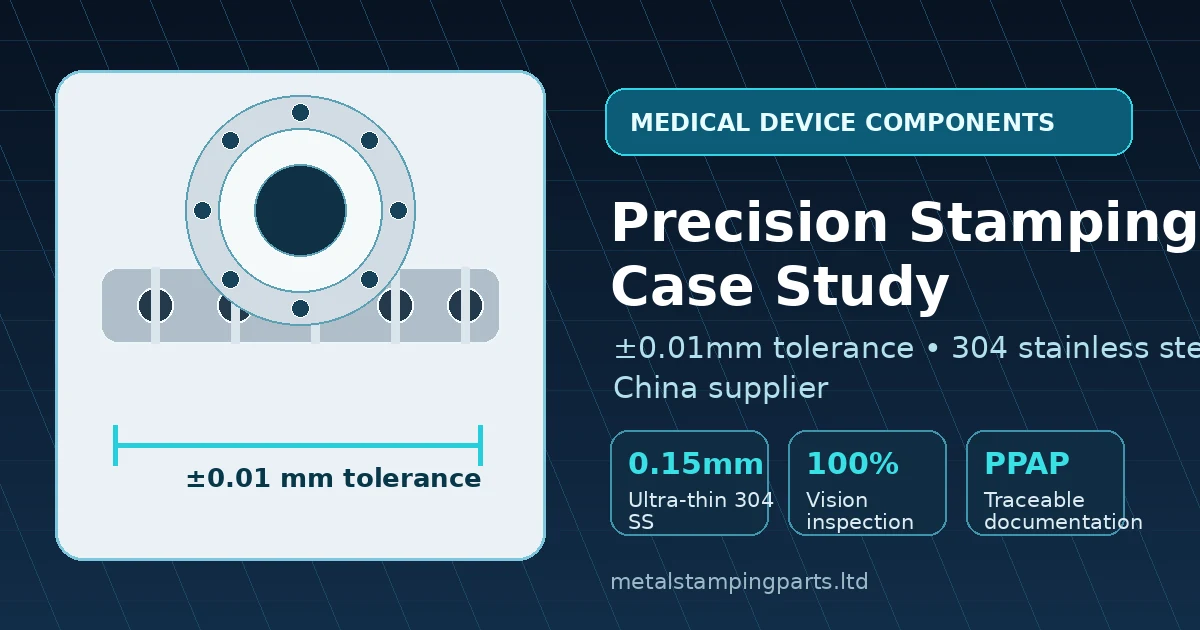
This case study details how MetalStampingParts.ltd engineered a complete manufacturing solution that reduced unit cost by 53%, compressed lead times from 14 weeks to 4 weeks, and achieved a 99.8% batch acceptance rate — all while maintaining a process capability index (Cpk) of ≥1.33 across every critical dimension.
1. Client Background
The client is a mid-sized, U.S.-based medical device company specializing in minimally invasive surgical instruments. Their flagship product line — a family of laparoscopic graspers, dissectors, and needle drivers — relies on a precision-stamped stainless steel handle linkage component that translates the surgeon’s finger movement into jaw actuation at the distal tip.
This component is deceptively simple in appearance but extraordinarily demanding in execution. It measures approximately 38mm × 12mm, is stamped from 0.15mm-thick AISI 304 stainless steel (full-hard temper), and features six critical features: two pivot holes, three interlocking tabs, and a spring-retention slot — all requiring dimensional accuracy within a ±0.01mm tolerance band.
Annual consumption stood at 500,000 units with projected growth to 750,000 within 18 months following anticipated FDA 510(k) clearance for a next-generation instrument platform.
The client’s procurement team was tasked with three objectives:
– Cost reduction — the incumbent European supplier’s $4.50/unit price was unsustainable at scale
– Lead time compression — 14-week lead times forced the client to carry 20+ weeks of safety stock
– Quality continuity — any new supplier had to match or exceed existing quality metrics and provide full FDA-compliant documentation, including material certifications, first article inspection reports (FAIR), and statistical process control (SPC) data per lot
2. The Challenge
2.1 Tolerance Requirements: True Micron-Level Precision
The ±0.01mm (10-micron) tolerance requirement placed this component in a class of difficulty that most metal stamping facilities cannot address. To put this in perspective:
– A human hair measures approximately 70–100 microns in diameter
– ±0.01mm is roughly one-seventh the thickness of a standard sheet of printer paper
– Thermal expansion of 304 stainless steel over a 5°C temperature swing can induce dimensional variation exceeding 2 microns on a 38mm feature — already consuming 20% of the total tolerance budget
The most demanding feature was the spring-retention slot: a 1.2mm-wide opening stamped into 0.15mm material, requiring ±0.01mm on width and ±0.01mm on position relative to Datum A (the primary pivot hole). Any deviation beyond tolerance would cause inconsistent spring tension, directly affecting the tactile feedback surgeons rely on during delicate procedures.
2.2 Material Challenges: 0.15mm Ultra-Thin 304 Stainless Steel
Stamping 0.15mm-thick 304 stainless steel at full-hard temper presents three compounding difficulties:
1. Springback variability — at this thickness-to-feature ratio, springback behavior is highly sensitive to subtle variations in material hardness, grain orientation, and residual stress from the rolling process. Uncontrolled springback on the interlocking tabs could easily consume the entire 10-micron tolerance.
2. Burr control — medical device components destined for surgical instruments must be burr-free. A burr exceeding 0.01mm on this component could create a particle-generation risk during instrument actuation, violating cleanliness requirements under ISO 13485. Achieving burr-free edges on 304 stainless at 0.15mm thickness requires precise control of punch-to-die clearance — typically 3–5% of material thickness, or roughly 4.5–7.5 microns in this case.
3. Strip feeding stability — ultra-thin material is prone to buckling, wrinkling, and inconsistent feeding through a progressive die. Maintaining positional accuracy across 10+ stations requires a precision-guided strip feeding system with pilot pins at every station.
2.3 Regulatory Documentation Burden
The client required full FDA CFR Title 21 Part 820 compliance documentation, including:
– Material certifications per ASTM A240/A240M with heat lot traceability
– First Article Inspection Reports (FAIR) per AS9102 (aerospace standard adopted for medical)
– Per-lot SPC data with X-bar and R charts for all critical dimensions
– Process FMEA and Control Plan documentation
– Certificate of Conformance with each shipment
This documentation burden alone eliminates the vast majority of metal stamping suppliers — particularly those without established quality management systems certified to ISO 13485.
2.4 Commercial Baseline (Incumbent European Supplier)
| Metric | Value |
| Unit Price | $4.50/pc |
|---|---|
| Lead Time | 14 weeks |
| Batch Acceptance Rate | 98.2% |
| Minimum Order Quantity | 25,000 pcs |
| Cpk (critical dims) | 1.10–1.25 |
The incumbent’s Cpk values hovering between 1.10 and 1.25 meant the process was marginally capable. At Cpk = 1.10, the expected defect rate is approximately 967 parts per million (PPM) — translating to roughly 483 defective pieces per 500,000-unit annual volume. While acceptable under the previous quality agreement, the client’s next-generation instrument platform specification demanded Cpk ≥1.33 across all critical dimensions.
3. Our Solution
3.1 Precision Progressive Die with In-Line Vision Inspection
MetalStampingParts.ltd designed and built a 12-station precision progressive die with the following engineering features:
– Tungsten carbide (WC-Co) punch and die inserts on all critical stations — delivering a tool life exceeding 2 million strokes before re-sharpening, compared to 300,000–500,000 strokes typical of D2 tool steel in this application. The carbide grade selected (submicron grain, 10% cobalt binder) provided an optimal balance of wear resistance and fracture toughness for ultra-thin stainless steel stamping.
– Pilot pin guidance at every station — precision-ground pilot pins (±0.002mm diameter tolerance) engage pre-pierced pilot holes at each progressive step, ensuring positional accuracy is maintained cumulatively rather than degraded.
– Punch-to-die clearance controlled at 4.5 ± 0.5 microns — achieved through wire EDM die plate machining followed by jig grinding of critical profiles. This clearance window minimizes burr formation while avoiding excessive punch wear from overly tight clearances.
– In-line 5-megapixel CCD vision inspection system — positioned after the final forming station and before the cutoff station. The system captures 12 images per stroke at 200 frames per second, performs automated edge detection on all critical features, and triggers an accept/reject gate within 50 milliseconds. Any out-of-tolerance part is automatically diverted to a reject bin, with dimensional data logged to the lot SPC database.
3.2 Temperature-Controlled Manufacturing Environment
Recognizing that thermal expansion alone could consume a significant fraction of the ±0.01mm tolerance budget, we dedicated a temperature- and humidity-controlled production cell:
– Ambient temperature: 20°C ± 2°C — maintained by a dedicated HVAC system with ±0.5°C control at the press bed level
– Relative humidity: 45% ± 10% — preventing condensation-related corrosion on ultra-thin material
– Material conditioning protocol — all coil stock is staged in the controlled environment for a minimum of 24 hours before production to ensure thermal equilibrium
– Continuous temperature monitoring at four points (coil, press bed, die set, inspection station) with automated alerts at ±1.5°C deviation
At 20°C, the coefficient of thermal expansion for 304 stainless steel is approximately 17.3 × 10⁻⁶ /°C. Over a 38mm feature length, each 1°C temperature change induces 0.66 microns of dimensional change — meaning the ±2°C control band limits thermal-induced variation to approximately ±1.3 microns, or 13% of the tolerance budget.
3.3 Quality Assurance and Documentation System
Every production lot is accompanied by a comprehensive quality data package:
| Document | Content | Standard |
| First Article Inspection Report | 100% dimensional inspection of first 5 pieces per cavity | AS9102 Form 3 |
|---|---|---|
| Material Certificate | Heat number, chemical composition, mechanical properties | ASTM A240/A240M |
| SPC Data Package | X-bar and R charts, Cpk calculations for 8 critical dimensions | ANSI/ASQ Z1.4 |
| Process Control Sheet | Shot-by-shot inspection data from in-line vision system | Internal QMS |
| Certificate of Conformance | Declaration of compliance to all specified requirements | ISO 13485 §4.2 |
All documentation is uploaded to a secure client portal within 24 hours of lot completion, enabling real-time quality review before shipment.
4. Implementation Timeline
| Phase | Duration | Key Activities |
| DFM & Tool Design | Week 1–2 | Design for Manufacturability analysis; 3D die design with forming simulation (AutoForm); DFM report delivered for client approval |
|---|---|---|
| Die Manufacturing | Week 3–8 | CNC machining, wire EDM, jig grinding, carbide insert fabrication; die assembly and bench verification |
| Die Tryout & Debug | Week 9–10 | Offline tryout on a 60-ton servo press; dimensional validation using CMM; die modification cycles (2 iterations) |
| FDA Documentation Prep | Week 1–10 (parallel) | Process FMEA, Control Plan, IQ/OQ/PQ protocols drafted in parallel with tooling |
| First Article Submission | Week 11 | 30-piece FAIR submitted with full dimensional data and capability study |
| Production Pilot Run | Week 12 | 5,000-piece pilot lot with 100% inspection; process capability confirmed Cpk ≥1.33 on all criticals |
| First Production Shipment | Week 12 | 25,000-piece initial order shipped with full quality documentation |
Total time from order to first shipment: 12 weeks — compared to 14 weeks for repeat orders with the incumbent supplier.
5. Results
5.1 Cost Performance
| Metric | Incumbent (Europe) | MetalStampingParts.ltd | Improvement |
| Unit Price | $4.50 | $2.10 | ↓ 53.3% |
|---|---|---|---|
| Tooling Amortization | Included | Included | — |
| Annual Spend (500K pcs) | $2,250,000 | $1,050,000 | ↓ $1,200,000 |
The $1.2 million annual savings represented a 53% reduction in component cost, directly improving the client’s gross margin on their surgical instrument product line by an estimated 8 percentage points.
5.2 Quality Performance
| Metric | Incumbent (Europe) | MetalStampingParts.ltd | Target |
| Batch Acceptance Rate | 98.2% | 99.8% | ≥99.5% |
|---|---|---|---|
| Cpk (pivot hole Ø) | 1.18 | 1.47 | ≥1.33 |
| Cpk (spring slot width) | 1.10 | 1.39 | ≥1.33 |
| Cpk (tab position) | 1.25 | 1.52 | ≥1.33 |
| Burr Height (max) | 0.015mm | 0.005mm | ≤0.01mm |
All eight critical dimensions achieved Cpk ≥1.33, with six of eight exceeding Cpk 1.40. At Cpk = 1.33, the expected defect rate is approximately 63 PPM — a 15× improvement over the incumbent’s marginal process.
5.3 Lead Time Performance
| Metric | Incumbent (Europe) | MetalStampingParts.ltd |
| Initial Order (incl. tooling) | 14 weeks (repeat order) | 12 weeks (new tooling) |
|---|---|---|
| Repeat Order Lead Time | 14 weeks | 4 weeks |
| Safety Stock Reduction | 120 days | 35 days |
The 4-week repeat order lead time enabled the client to reduce safety stock from 120 days to 35 days, freeing approximately $540,000 in working capital previously tied up in inventory.
6. Client Feedback
“We approached MetalStampingParts.ltd with what our internal engineering team considered a ‘nightmare tolerance stack’ — and they delivered. The Cpk data from the first pilot lot exceeded our expectations. Their documentation package was the most thorough we’ve received from any stamping supplier, domestic or international. The transition required meaningful upfront investment in communication and specification alignment, but the outcome — 53% cost reduction with measurably better quality — has made this one of the most successful supplier transitions in our company’s history.”
>
— VP of Global Sourcing, U.S. Medical Device Manufacturer (name withheld under NDA)
“From an engineering perspective, what impressed me most was their forming simulation work during the DFM phase. They identified a potential springback issue on the interlocking tabs before cutting steel, proposed a compensation geometry, and the first trial parts were within 0.005mm of nominal. That level of upfront engineering rigor is exactly what medical device manufacturing requires.”
>
— Principal Manufacturing Engineer, Client Company (name withheld under NDA)
7. Key Takeaways
🔗 See also: Automotive OEM Cost Reduction Case Study — How our 18-station progressive die solution cut per-part costs by 37% for a Tier 2 supplier, saving $134,000 annually.
For Procurement Professionals:
1. Precision metal stamping from China is a viable, cost-competitive alternative to European supply — but only when the supplier has demonstrated capability in micron-tolerance work, not just claims. Look for Cpk data, not just certificate wall art.
2. Documentation capability is a supplier selection gate, not a nice-to-have. In medical device manufacturing, the quality data package is as important as the physical parts. Verify that prospective suppliers have an established ISO 13485 QMS with a proven track record of FDA-compliant documentation before issuing an RFQ.
3. Total cost of ownership (TCO) extends beyond unit price. The client’s $1.2 million annual component cost savings were amplified by working capital reduction from shorter lead times and lower incoming inspection costs from superior process capability.
For Engineers:
1. Temperature control is not optional at the ±0.01mm tolerance level. A dedicated environmentally controlled production cell is a hard requirement, not a luxury. The physics of thermal expansion is unforgiving.
2. Carbide tooling is economically justified at these volumes. While carbide die inserts cost 2–3× more than tool steel, the 4–6× increase in tool life and the dimensional stability across 2 million+ strokes more than offset the upfront investment.
3. DFM with forming simulation is the difference between iterative trial-and-error and first-time-right engineering. Finite element simulation of the stamping process predicted springback to within 2 microns of actual results, enabling pre-compensated die geometry that dramatically compressed the tryout phase.
About MetalStampingParts.ltd
MetalStampingParts.ltd is an ISO 9001:2015 and ISO 13485:2016 certified precision metal stamping manufacturer based in China, serving medical device, automotive, aerospace, and electronics OEMs worldwide. Our 120,000-square-foot facility houses 40+ presses ranging from 25 to 300 tons, with dedicated Class 100,000 cleanroom production for medical and electronic components. We specialize in tight-tolerance stamping from 0.05mm to 6.0mm material thickness across ferrous and non-ferrous alloys.
Core Capabilities:
– Tolerance range: ±0.005mm achievable on select features
– Material thickness: 0.05mm – 6.0mm
– Progressive die stamping: up to 30 stations
– In-house tool design with forming simulation (AutoForm, SolidWorks)
– In-line vision inspection and SPC data acquisition
– Full FDA CFR 820 / ISO 13485 documentation support
© 2026 MetalStampingParts.ltd. All rights reserved. Client names have been withheld under non-disclosure agreements. All performance data verified by third-party dimensional inspection reports and SPC records available for qualified RFQ respondents.
Related Resources
- Medical Device Stamping Case Study — Case study: ±0.01mm tolerance medical device components from China.