
Steel stamping parts are metal components formed from flat steel sheet or coil by pressing, blanking, bending, or drawing in a stamping press. They appear in virtually every manufactured product — from automotive body panels and structural brackets to appliance housings and industrial equipment. Selecting the right steel grade is the single most important decision in steel stamping, because it determines formability, strength, cost, weldability, and surface finish.
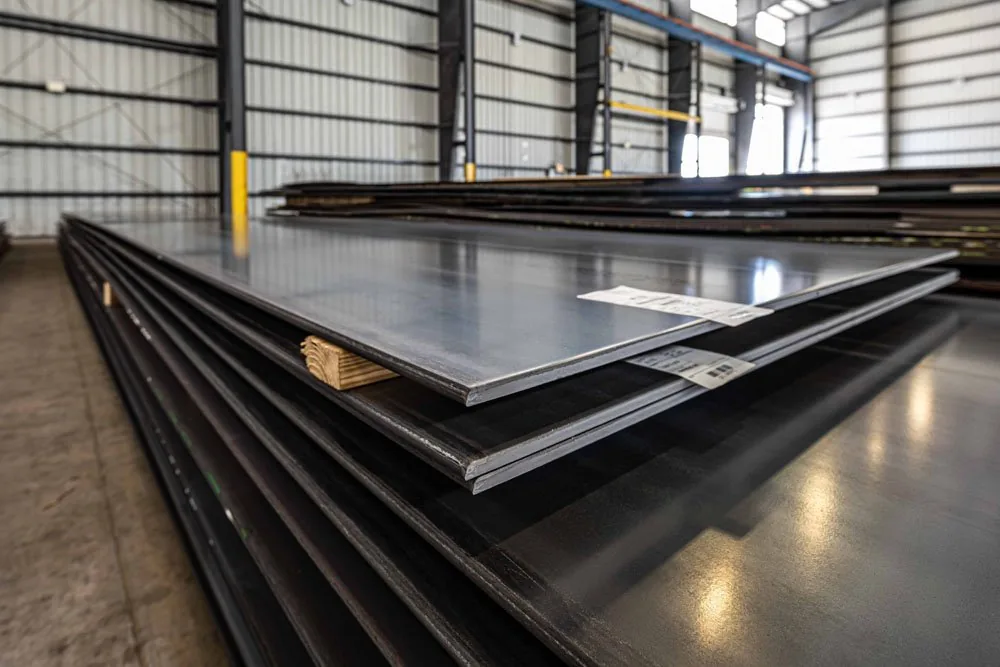
This guide walks through more than 20 common steel grades used in stamping, compares hot-rolled and cold-rolled sheet, addresses the challenges of high-strength steel, and covers surface treatment options and design-for-manufacturing (DFM) best practices. Metal Stamping Parts Ltd processes thousands of tons of steel annually across automotive, industrial, and consumer-product applications.
Steel Grade Selection for Stamping
Choosing the correct steel grade requires balancing mechanical properties, formability, surface quality, and cost. The tables below cover the most widely used grades in the global stamping industry.
Cold-Rolled Steel Grades (JIS / EN / ASTM)
| Grade (JIS) | EN Equivalent | ASTM Equivalent | C (%) | Mn (%) | Yield Strength (MPa) | Tensile Strength (MPa) | Elongation (%) | r-value | Application |
|---|---|---|---|---|---|---|---|---|---|
| SPCC | DC01 | A1008 CS Type B | ≤0.12 | ≤0.50 | 140–280 | 270–410 | ≥37 | — | General-purpose panels, brackets |
| SPCD | DC03 | A1008 CS Type A | ≤0.10 | ≤0.45 | 140–260 | 270–390 | ≥39 | ≥1.3 | Drawing applications, shallow draws |
| SPCE | DC04 | A1008 DS Type A | ≤0.08 | ≤0.40 | 120–240 | 270–370 | ≥41 | ≥1.6 | Deep drawing, automotive inner panels |
| SPCF | DC05 | A1008 DDS | ≤0.06 | ≤0.35 | 110–220 | 270–350 | ≥43 | ≥1.9 | Extra-deep drawing, complex shapes |
| SPCG | DC06 | A1008 EDDS | ≤0.02 | ≤0.25 | 100–200 | 270–330 | ≥45 | ≥2.1 | Ultra-deep drawing, exposed panels |
| SPFH490 | — | A1011 HSLA 50 | ≤0.12 | ≤1.60 | ≥325 | ≥490 | ≥23 | — | Structural parts, seat frames |
| SPFH540 | — | A1011 HSLA 60 | ≤0.12 | ≤1.80 | ≥355 | ≥540 | ≥20 | — | Chassis reinforcements |
Hot-Rolled Steel Grades
| Grade (JIS) | EN Equivalent | C (%) | Yield Strength (MPa) | Tensile Strength (MPa) | Elongation (%) | Application |
|---|---|---|---|---|---|---|
| SPHC | DD11 / HR1 | ≤0.15 | ≥205 | ≥270 | ≥27 | General forming, non-critical parts |
| SPHD | DD12 / HR2 | ≤0.10 | — | ≥270 | ≥30 | Drawing applications |
| SPHE | DD13 / HR3 | ≤0.06 | — | ≥270 | ≥33 | Deep drawing, automotive structural |
| SS400 | S235JR | ≤0.22 | ≥205 | 400–510 | ≥21 | Structural brackets, heavy-gauge parts |
| SS490 | S275JR | ≤0.25 | ≥245 | 490–610 | ≥19 | Heavy-duty structural components |
| SM490A | S355JR | ≤0.20 | ≥275 | 490–610 | ≥22 | Structural members requiring weldability |
Advanced High-Strength Steel (AHSS) Grades
| Grade | Type | Yield (MPa) | UTS (MPa) | Elongation (%) | Bend Radius (×t) | Application |
|---|---|---|---|---|---|---|
| DP590 | Dual Phase | 330–410 | ≥590 | ≥20 | 1.0 | Crash-resistant brackets, reinforcements |
| DP780 | Dual Phase | 440–560 | ≥780 | ≥14 | 1.5 | B-pillars, bumper beams |
| DP980 | Dual Phase | 600–740 | ≥980 | ≥10 | 2.5 | Structural reinforcements |
| DP1180 | Dual Phase | 850–1050 | ≥1,180 | ≥5 | 4.0 | Ultra-high-strength brackets |
| TRIP590 | TRIP | 380–460 | ≥590 | ≥24 | 1.0 | Energy-absorbing structures |
| TRIP780 | TRIP | 450–550 | ≥780 | ≥18 | 1.5 | Crash structures |
| CP780 | Complex Phase | 620–750 | ≥780 | ≥10 | 2.0 | Chassis reinforcements |
| CP1180 | Complex Phase | 900–1100 | ≥1,180 | ≥5 | 3.5 | Anti-intrusion beams |
| MS1200 | Martensitic | 950–1150 | ≥1,200 | ≥4 | 5.0 | Bumper reinforcements, door beams |
| FB590 | Ferrite-Bainite | 380–480 | ≥590 | ≥18 | 1.0 | Wheels, chassis parts |
| TWIP980 | TWIP | 400–500 | ≥980 | ≥50 | 0.5 | Future lightweight structures |
Stainless Steel Grades for Stamping
| Grade | Type | Yield (MPa) | UTS (MPa) | Elongation (%) | Magnetic? | Application |
|---|---|---|---|---|---|---|
| SUS304 | Austenitic | 205 | 520 | ≥40 | No | Appliance panels, food equipment |
| SUS301 | Austenitic | 205–510 | 520–1,270 | ≥40–10 | No | Springs, clips (work-hardens) |
| SUS430 | Ferrite | 205 | 450 | ≥22 | Yes | Decorative trim, exhaust components |
| SUS410 | Martensitic | 205 | 440 | ≥20 | Yes | Cutlery, valve parts |
| SUS316L | Austenitic | 175 | 480 | ≥40 | No | Marine, chemical, medical |
For more information on stainless steel stamping capabilities, see our stainless steel stamping page.
Hot-Rolled vs Cold-Rolled Steel: Which to Choose?
The rolling process fundamentally changes steel’s surface quality, dimensional accuracy, and mechanical behavior. The comparison below helps you select the right starting material for your steel stamping application.
| Property | Hot-Rolled (HR) | Cold-Rolled (CR) |
|---|---|---|
| Surface quality | Mill scale, rough (Ra 3–8 µm) | Smooth, clean (Ra 0.5–1.5 µm) |
| Thickness tolerance | ±0.10–0.15 mm | ±0.02–0.05 mm |
| Width tolerance | ±1.0–2.0 mm | ±0.2–0.5 mm |
| Typical gauge range | 1.6–12.0 mm | 0.4–3.2 mm |
| Yield strength | Lower (as-rolled) | Higher (work-hardened) |
| Elongation | Higher | Lower |
| Cost per ton | 15–25% lower | Higher |
| Best for | Structural parts, heavy brackets, non-visible components | Visible panels, precision parts, shallow-to-medium draws |
| Typical stamping operations | Blanking, bending, forming | Blanking, drawing, forming, piercing |
| Paint adhesion | Requires descaling | Excellent after cleaning |
Rule of thumb: Use cold-rolled for anything visible, dimensionally critical, or requiring drawing. Use hot-rolled for structural parts where surface finish is not critical and gauge exceeds 3 mm.
High-Strength Steel Stamping: Challenges and Solutions
As automotive lightweighting drives adoption of AHSS grades, stampers face new challenges that traditional mild-steel tooling and processes cannot handle.
Challenge 1: Excessive Springback
High-strength steels have yield-to-tensile ratios of 0.65–0.90 (vs. 0.50–0.60 for mild steel), causing significant elastic recovery after forming.
Solutions:
– Overbend by 2–5° depending on grade (trial-and-error or FEA-simulated compensation).
– Use rotary bending tools that control material flow through the bend zone.
– Apply servo presses with programmable dwell at bottom dead center to stress-relieve the part in the die.
– Design parts with stiffening beads or embossments to lock in shape.
Challenge 2: Accelerated Tool Wear
Hard microstructures (martensite, bainite) in AHSS abrade tool surfaces 3–10× faster than mild steel.
Solutions:
– Use D2 or DC53 tool steel with PVD coating (TiAlN or CrN) for moderate volumes.
– Switch to carbide inserts or PM (powder metallurgy) tool steels (ASP-23, VANADIS 4E) for high-volume production.
– Increase die clearance to 10–12% of material thickness (vs. 5–7% for mild steel).
– Apply dry-film or high-pressure lubricants to reduce friction.
Challenge 3: Welding Requirements
AHSS grades require careful welding parameter control to avoid heat-affected zone (HAZ) softening.
Solutions:
– Use resistance spot welding with adaptive current control.
– Optimize electrode force and hold time for each grade.
– Consider laser welding for butt joints where HAZ control is critical.
– Validate weld strength per AWS D8.1M or OEM-specific standards.
Challenge 4: Cracking at Tight Radii
DP and martensitic grades have limited elongation (4–14%), making tight-radius bends prone to cracking.
Solutions:
– Design minimum bend radius ≥ 2× material thickness for DP780; ≥ 4× for DP1180.
– Orient bends perpendicular to the rolling direction when possible.
– Use warm forming (200–300 °C) for the most demanding geometries.
– Consider tailored welded blanks — use AHSS only where strength is needed and mild steel in the formed zone.
Surface Treatment Options for Steel Stamping Parts
Surface treatment protects against corrosion, improves appearance, and enhances paint adhesion. The table below compares the four most common options for stamped steel parts.
| Treatment | Process | Coating Weight / Thickness | Salt Spray Resistance (hours) | Paint Adhesion | Weldability After Treatment | Relative Cost | Typical Application |
|---|---|---|---|---|---|---|---|
| Electro-galvanized (EG) | Electrodeposition of zinc | 5–15 µm | 200–500 | Excellent | Good | Low-Medium | Automotive exposed panels |
| Hot-dip galvanized (GI) | Immersion in molten zinc | 45–90 g/m² (both sides) | 300–1,000 | Good (after treatment) | Fair | Medium | Appliance panels, HVAC, construction |
| Phosphating (iron or zinc) | Chemical conversion | 1–3 µm | 50–150 | Excellent | Good | Very Low | Pre-paint treatment for all steel parts |
| Electro-coat (e-coat) | Electrophoretic paint | 15–25 µm | 500–1,000 | N/A (is the paint) | Poor | Medium | Automotive underbody, brackets |
| Dacromet / Geomet | Zinc-aluminum flake | 6–10 µm | 500–1,000+ | Fair | Fair | Medium-High | Fasteners, suspension parts, high-corrosion |
| Powder coat | Electrostatic spray + bake | 60–80 µm | 1,000+ | N/A (is the finish) | N/A | Medium | Outdoor equipment, furniture, enclosures |
Selection guide:
– For automotive Class A exposed surfaces: EG + e-coat + topcoat.
– For structural parts in corrosive environments: GI or Dacromet.
– For cost-sensitive interior brackets: phosphate + powder coat.
– For high-corrosion fasteners: Dacromet or Geomet.
DFM Tips for Steel Stamping Parts
Design-for-manufacturing principles reduce die cost, improve part quality, and shorten lead times. Apply these guidelines during the concept phase to avoid expensive die revisions later.
Geometry Rules
- Minimum bend radius: 0.5× material thickness for CR mild steel; 1.0–4.0× for AHSS (grade-dependent).
- Minimum hole diameter: ≥ material thickness; ≥ 2× thickness for holes in stretch-flanged areas.
- Minimum flange width: ≥ 3× material thickness + bend radius.
- Notch-to-bend distance: ≥ material thickness + bend radius to prevent distortion.
- Slot orientation: Perpendicular to the bend line to avoid tearing.
Tolerance Guidance
| Feature | Achievable Tolerance | With Additional Operations |
|---|---|---|
| Blanked profile | ±0.05–0.10 mm | ±0.02 mm (fine-blanking or shaving) |
| Hole position | ±0.05 mm | ±0.02 mm (post-machining) |
| Bend angle | ±1° | ±0.25° (press brake with CNC crowning) |
| Flatness | 0.2 mm/100 mm | 0.05 mm/100 mm (stamping + sizing) |
| Edge burr | ≤ 0.10 mm | ≤ 0.03 mm (deburring) |
Material and Cost Optimization
- Standardize gauge across parts in an assembly to reduce material inventory.
- Nest parts efficiently on strip layout — 60–75% material utilization is typical for progressive dies; below 55% warrants redesign.
- Consider combining multiple parts into a single stamped assembly to reduce part count and joining operations.
- Specify surface treatment only where needed — selective plating or localized coating saves cost.
- Use what is metal stamping fundamentals to choose between progressive die, transfer die, or tandem line based on volume and complexity.
Frequently Asked Questions
What is the difference between SPCC and SPCE steel for stamping?
SPCC is a general-purpose cold-rolled steel with a maximum carbon content of 0.12%, suitable for simple bends and shallow draws. SPCE has a lower carbon limit (≤0.08%), lower manganese (≤0.40%), and significantly higher elongation (≥41% vs. ≥37%), making it much better for deep drawing operations. SPCE also has a guaranteed r-value (plastic strain ratio) of ≥1.6, meaning it resists thinning during stretching. Use SPCC for brackets and flat parts; use SPCE when the part requires deep-draw or complex forming.
When should I use hot-rolled steel instead of cold-rolled steel for stamping?
Choose hot-rolled steel when the part is structural rather than cosmetic, the gauge exceeds 3.2 mm (beyond most cold-rolled availability), tight dimensional tolerances are not required, or cost is the primary driver. Hot-rolled steel costs 15–25% less per ton and has higher elongation, which helps in bending and forming thick sections. However, its mill-scale surface requires blasting or pickling before painting, and thickness tolerances are ±0.10–0.15 mm versus ±0.02–0.05 mm for cold-rolled.
How do I prevent cracking when stamping advanced high-strength steel?
Cracking in AHSS typically occurs at bend radii that are too tight for the grade’s elongation capability. For DP590, design bend radii ≥ 1× material thickness; for DP780, ≥ 1.5×; for DP980, ≥ 2.5×; and for martensitic grades (MS1200), ≥ 5× thickness. Orient bends perpendicular to the rolling direction, use high-pressure lubricants, and consider warm forming (200–300 °C) for the most demanding geometries. Running FEA simulation before die construction identifies cracking risks early.
What surface treatment is best for outdoor steel stamping parts?
For long-term outdoor exposure, hot-dip galvanizing (GI) provides the best cost-to-protection ratio with 300–1,000 hours of salt spray resistance depending on coating weight. For parts requiring a decorative finish, powder coating over a phosphated surface delivers excellent corrosion resistance (1,000+ hours salt spray) with color and texture options. Dacromet or Geomet zinc-aluminum flake coatings are ideal for fasteners and small parts where coating thickness uniformity and hydrogen-embrittlement risk are concerns.
What is a good material utilization rate for progressive die steel stamping?
A material utilization rate of 60–75% is considered good for progressive die stamping of steel parts. Rates below 55% suggest the part layout should be reviewed for nesting optimization — common improvements include rotating the part orientation, sharing trim lines between adjacent parts, or redesigning the carrier strip geometry. Above 75% utilization is achievable for simple rectangular parts. Any trim scrap should be evaluated for secondary-use blanking of smaller parts from the same strip.
Conclusion
Successful steel stamping starts with matching the grade to the application. Mild steel (SPCC–SPCE) handles most general-purpose parts cost-effectively, while AHSS grades (DP, TRIP, CP, MS) deliver the strength-to-weight ratios that automotive and industrial applications demand — at the expense of tighter process controls and harder tooling. Surface treatment selection, tolerancing, and DFM principles further determine whether a stamped steel part delivers reliable performance at competitive cost.
Ready to discuss your next steel stamping project? Contact Metal Stamping Parts Ltd for engineering support, material selection guidance, and a competitive production quote.