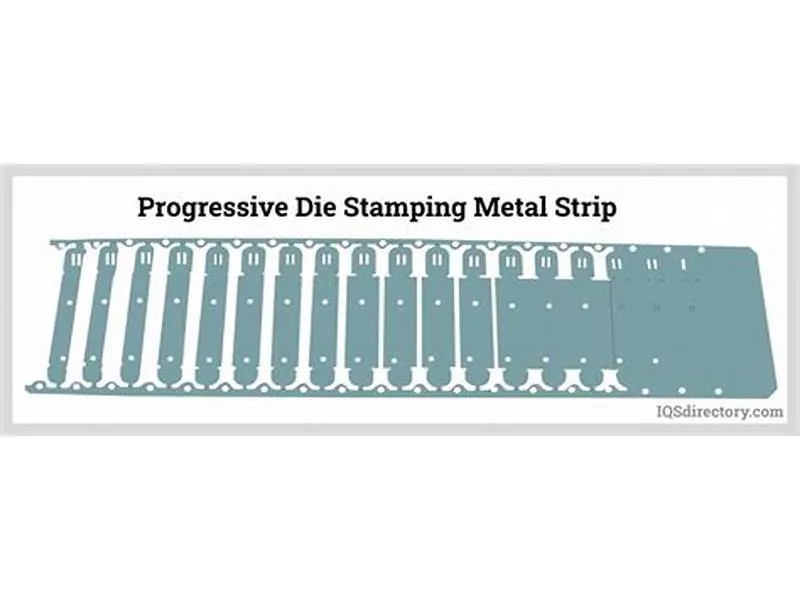
Progressive dies look efficient from the outside because the output appears simple: coil goes in, finished parts come out.
📖 Metal Stamping Process Overview — Read our metal stamping process overview to learn more about progressive die stamping.
What buyers do not always see is how much of that efficiency depends on invisible design logic inside the strip.
A progressive die does not succeed because it has many stations. It succeeds because those stations are arranged in a sequence that respects material flow, carrier strength, piloting control, feature timing, scrap evacuation, and how the part changes shape as it moves forward stroke by stroke. If that logic is wrong, the die may still run—but it will run with recurring maintenance, unstable dimensions, strip breakage, setup sensitivity, or slower throughput than the quote originally suggested.
That is why progressive die design is not only a toolmaker’s topic. It is a sourcing topic, a DFM topic, and often a cost topic.
If you need broader context first, see our overview of what is metal stamping. If you are evaluating whether a part belongs in this process at all, our pages on custom metal stamping, precision metal stamping, and metal stamping manufacturer explain how progressive tooling fits into commercial production capability.
What Is Progressive Die Design?
Progressive die design is the engineering of a multi-station stamping tool in which strip material advances through a sequence of operations, with each station performing a specific action until the final part is separated from the carrier.
The key word is sequence.
In a progressive die, the part is not made in one hit. It is built gradually through a planned progression of operations such as:
- piercing
- notching
- blank development
- embossing
- bending
- coining
- trimming
- cut-off
At every stroke, the strip moves one pitch forward. Multiple parts may be in process at the same time, each at a different stage of completion.
That arrangement can be extremely efficient—but only if the strip, stations, and carrier are designed to support it.
How a Progressive Die Actually Works
A progressive die line usually follows this logic:
- Coil stock feeds into the press.
- The strip is guided into the tool.
- The first stations create pilot features or early pierces.
- The strip advances one pitch at a time.
- Each station adds or changes features in sequence.
- The final station separates the finished part from the carrier strip.
That sounds straightforward. In reality, every one of those steps contains design tradeoffs.
For example:
- pierce too early, and later forming may distort the hole.
- form too early, and later stations may lose access.
- weaken the carrier too soon, and strip progression becomes unstable.
- place pilots poorly, and location control degrades.
- push too much geometry into too few stations, and the die becomes maintenance-heavy.
Progressive die design is the discipline of balancing all of that before the tool is built.
Why Progressive Die Design Matters So Much Commercially
A poor progressive die concept can still produce first samples. That is part of what makes it dangerous.
The real test is not whether the die makes parts once. The real test is whether it can run:
- at the intended speed
- with acceptable scrap
- with repeatable dimensions
- without constant strip instability
- with manageable maintenance intervals
- and with a cost structure that still matches the quote months later
This is why buyers evaluating progressive tooling should ask more than “Can you do progressive die stamping?” The better question is, “How are you deciding whether this part belongs in a progressive die, and what does the strip logic look like?”
Strip Layout: The Foundation of Progressive Die Design
If the strip layout is wrong, the rest of the die is already compromised.
Strip layout determines:
- pitch length
- material utilization
- carrier support
- station spacing
- piloting opportunities
- scrap flow
- overall die length
- access for punches and forms
A strip can look efficient on paper and still be weak in production. Material yield is important, but it is not the only objective.
Sometimes a slightly less aggressive nesting strategy creates:
- better carrier strength
- cleaner strip tracking
- more reliable feeding
- easier slug control
- less station interference
That tradeoff is often worth it.
What a Good Strip Layout Balances
A good strip layout tries to balance several competing demands:
- maximum material yield
- enough carrier width to support progression
- station-to-station process access
- reliable pilot location
- manageable scrap skeleton behavior
- proper part orientation for forming sequence
This is one reason progressive die design cannot be reduced to software nesting alone. The cheapest-looking strip is not always the most producible strip.

Carrier Design: The Strip Has to Survive the Whole Die
The part remains attached to a carrier until the final station. That carrier is not a passive detail. It is the control structure that keeps the strip registered and stable while operations are added.
If the carrier becomes too weak, too narrow, too interrupted, or too distorted during progression, the die may suffer:
- feed misalignment
- pitch inconsistency
- feature drift
- strip buckling
- premature strip breakage
- unstable final cut-off
Common Carrier Design Problems
These issues often appear when:
- too many holes are pierced before support is established
- tabs are too narrow for the material and geometry
- forming loads are introduced before the strip has enough strength
- asymmetrical features pull the strip unevenly
- scrap bridges are not controlled well
A strong progressive die concept protects carrier integrity until the part is ready to leave it.
Pilot Pins: Why Positional Control Depends on More Than the Feed
A common misunderstanding is that the feed system alone controls strip location.
In real progressive tooling, pilot pins play a critical role in correcting minor feed variation and establishing repeatable station-to-station position. Pilots engage pre-made holes or features in the strip and help ensure alignment before the tool fully closes.
That means pilot design affects:
- feature-to-feature accuracy
- hole position consistency
- station synchronization
- tolerance stability across the strip
Good Piloting Depends on Upstream Logic
Pilots are only as effective as the strip features they rely on.
If pilot holes are:
- poorly placed,
- distorted by later operations,
- too close to deformation zones,
- or created too late in the sequence,
then the piloting system loses reliability.
This is why pilot location is a strip-layout decision, not just a tooling detail.

Station Sequence: The Heart of the Die
Progressive die design is really a question of station sequence.
The designer must decide:
- which features should happen first,
- which features should happen later,
- which shapes need multiple steps,
- and which operations must wait until the part is better supported.
A poor sequence often causes more trouble than an individual feature does.
Typical Station Planning Logic
While every part is different, some general sequence logic often applies:
- establish pilot features early
- perform major internal piercing before heavy forming if hole integrity allows
- delay sensitive pierces if later forming would distort them
- build shape progressively rather than forcing all form in one hit
- keep carrier strength intact until near the end
- separate the part only when all carrier-dependent control is no longer needed
The exact sequence depends on geometry, material, tolerance structure, and press strategy.
Which Parts Are Good Candidates for Progressive Die Design?
Not every stamped part belongs in a progressive die.
Progressive dies are usually strongest when the part:
- can remain attached to a strip through most of the process
- does not become too spatially complex too early
- benefits from high production speed
- supports efficient strip nesting
- can tolerate a station-by-station buildup of features
- has demand high enough to justify the tooling investment
Typical good candidates include:
- terminals
- clips
- brackets with manageable formed geometry
- electrical contacts
- shields
- flat-to-moderately formed production parts
If the geometry becomes too deep, too asymmetrical, or too difficult to carry on strip, another process may be better.
When Progressive Die Design Is the Wrong Choice
This is where many programs make avoidable cost mistakes.
A progressive die is not automatically the premium solution. It is only the right solution when the part fits the method.
Warning Signs a Part May Not Belong in a Progressive Die
- the part requires large unsupported forms early in the process
- the geometry becomes too three-dimensional to stay on a carrier cleanly
- critical holes must be placed only after major forming
- strip skeleton strength collapses too soon
- part size creates poor pitch economics
- annual volume is too low to amortize the tool properly
In those cases, trying to force a progressive route may create a tool that is more expensive, more fragile, and less commercially effective than alternatives.
Common Progressive Die Design Mistakes
The same failure patterns appear again and again.
1. Chasing Yield Too Aggressively
An over-optimized strip layout may look efficient in material terms but leave the carrier too weak or the stations too crowded.
2. Performing Too Much Forming in One Station
This can create dimensional instability, cracked features, or excessive maintenance load.
3. Weak Piloting Strategy
If location control depends on fragile or distorted pilot features, the die may never run as predictably as intended.
4. Ignoring Scrap Behavior
Slug and scrap management is not optional. Poor evacuation logic can stop otherwise workable tooling from running cleanly.
5. Designing the Tool Around Final Geometry Only
The part has to survive the process sequence, not only exist at the end. Designs that ignore progression usually generate hidden station-level problems.
DFM Questions That Should Be Asked Before the Die Is Built
Before committing a part to progressive tooling, useful questions include:
- Can the part remain carrier-supported through the full sequence?
- Which features are most sensitive to operation order?
- Are critical holes safer before or after forming?
- Does the strip layout balance yield with carrier strength?
- Where will pilot features be established, and how will they behave later?
- Which stations are likely to drive maintenance risk?
- Is the production volume high enough to justify the tool concept?
- Would another process reduce overall program risk?
These are not abstract engineering questions. They directly affect quote quality, launch speed, and long-run output stability.
What Buyers Should Listen for When a Supplier Explains a Progressive Die Concept
A strong supplier usually talks about more than tonnage and station count.
They should be able to explain:
- why the part fits progressive production
- how the strip will be carried
- where pilots will be placed
- which features are sequenced early versus late
- what risks exist around forming, scrap, or maintenance
- how the die concept matches the customer’s real demand
If the explanation starts and ends with “we will make a progressive die because volume is high,” the process may not have been thought through deeply enough.
Final Takeaway
Progressive die design is not just about putting many operations into one tool. It is about creating a strip-based production system where carrier design, pilot control, station sequence, forming logic, and material yield work together without fighting each other.
That is why the best progressive dies often look less dramatic than people expect. Their value is not in visual complexity. Their value is in the fact that they run predictably.
For buyers and engineers, the key lesson is simple: do not judge a progressive die concept only by its promised speed or low theoretical unit cost. Judge it by whether the strip logic actually supports stable production over time.
If the answer is yes, progressive tooling can be one of the most efficient manufacturing routes available. If the answer is no, the die may spend its life proving how expensive “high efficiency” can become when the sequence was wrong from the start.
FAQ
What is progressive die design?
Progressive die design is the engineering of a multi-station stamping tool where strip material advances through a sequence of operations until the finished part is cut free. It involves strip layout, carrier design, pilot location, station planning, and process sequencing.
Why is strip layout so important in progressive dies?
Strip layout controls material yield, carrier strength, pitch, station spacing, piloting opportunities, and scrap behavior. If the strip layout is weak, the die may suffer from misfeeds, unstable dimensions, and reduced production reliability.
What do pilot pins do in a progressive die?
Pilot pins help correct small feed variation and position the strip accurately before each stroke fully closes. They improve repeatability by engaging pre-made strip features and supporting station-to-station alignment.
What types of parts are best for progressive die stamping?
Progressive dies are generally best for parts that can stay attached to a strip through most of the process, support efficient nesting, and justify the tooling investment through meaningful production volume. Terminals, clips, shields, and many brackets are common examples.
When should a part not be put into a progressive die?
A part may not suit progressive tooling if it becomes too three-dimensional too early, requires post-form critical piercing, weakens the carrier too much, or does not have enough production volume to justify the tool investment.
Frequently Asked Questions
What is progressive die design?
Progressive die design is a specialized manufacturing process used to create precise metal components. Our team has over 25 years of experience delivering high-quality results for global clients across automotive, aerospace, electronics, and construction industries.
What tolerances can you achieve for progressive die design?
We achieve standard tolerances of ±0.05mm, with precision tolerances down to ±0.02mm for critical applications. All parts are inspected using CMM equipment with Cpk≥1.33 process capability.
What materials do you work with for progressive die design?
We work with a wide range of materials including aluminum (1100-6061), stainless steel (301-430), carbon steel, copper, brass, phosphor bronze, and specialty alloys. Material thickness ranges from 0.1mm to 12mm.
What is your minimum order quantity for progressive die design?
We accept prototype orders starting from 1 piece. For production runs, we recommend starting at 1,000 pieces for cost efficiency, though we accommodate various volumes based on project requirements.
How do I get a quote for progressive die design?
Submit your drawings (DWG, DXF, STEP, IGES, or PDF) via our contact form or email. We provide DFM feedback and pricing within 24 hours. Our engineering team reviews every inquiry for optimal manufacturability.
What quality certifications do you have for progressive die design?
We maintain ISO 9001:2015 and IATF 16949 certifications with full traceability. Every shipment includes inspection reports, material certificates, and compliance documentation as required.