
Der beste Metallstanzlieferant für die Automobilindustrie vereint IATF 16949-Zertifizierung, eigene Folgeverbund- und Tiefziehfähigkeiten, Fehlerraten unter 50 PPM und nachgewiesene Erfahrung mit hochfesten Stählen (AHSS) und Aluminiumlegierungen.Automobil-OEMs und Tier-1-Käufer benötigen Lieferanten, die präzisionsgestanzte Teile in Mengen von 100.000 bis über 10 Millionen Einheiten pro Jahr liefern und dabei enge Toleranzen von ±0,02 mm einhalten können. Dieser Leitfaden behandelt die Bewertungskriterien, Zertifizierungen, Fähigkeiten und Kostenfaktoren, die Sie zur Auswahl des richtigenbenötigen Automobil-Stanzpartner.
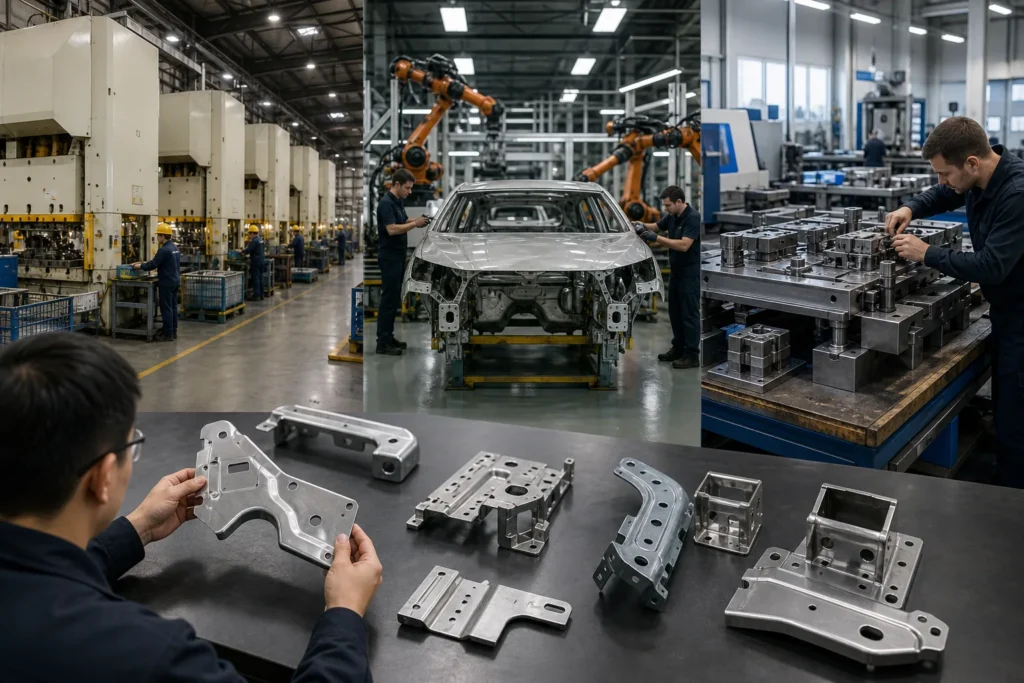
Was einen großartigen Automobilstanzlieferanten ausmacht
Das Automobilstanzen erfordert einen Lieferanten, der den gesamten Produktionslebenszyklus versteht – vonindividuelle MetallprägungDesign durch PPAP-Dokumentation und laufende Qualitätskontrolle. Der Unterschied zwischen einem guten und einem guten Lieferanten zeigt sich in der Ausschussquote, der pünktlichen Lieferung und der Fähigkeit, technische Änderungen ohne Produktionsverzögerungen zu bewältigen.
Hier sind die nicht verhandelbaren Qualitäten, die Beschaffungsteams überprüfen sollten:
- IATF 16949-Zertifizierung— der grundlegende Qualitätsstandard für Automobillieferketten
- Eigener Werkzeug- und Formenbau— schnellere Iteration, strengere Kontrolle über die Matrizenwartung
- Materialkompetenz— praktische Kenntnisse über AHSS, verzinkten Stahl, Aluminium der Serien 5000/6000
- PPAP-Bereitschaft— Komplette Level-3- oder Level-5-Dokumentation mit statistischer Prozesskontrolle
- Großvolumige Kapazität— Tonnagebereich von 25 bis 800+ Tonnen mit automatisierten Transferlinien
- Pipeline vom Prototyp zur Produktion— Fähigkeit, innerhalb von 8–12 Wochen vom Muster zur Massenproduktion überzugehen
Ein Lieferant, der alle sechs Kästchen ankreuzt, reduziert Ihr Lieferkettenrisiko und senkt die Gesamteinstandskosten über die Vertragslaufzeit.
Top-Bewertungskriterien für Automotive-Stanzungen
Die Gewichtung der richtigen Kriterien verhindert kostspielige Fehler bei der Beschaffung. Die folgende Tabelle zeigt, worauf es bei der Bewertung eines Metallstanzlieferanten für Automobilanwendungen am meisten ankommt.
| Kriterium | Gewicht | Worauf Sie achten sollten |
|---|---|---|
| Qualitätssystem | 25% | IATF 16949 + ISO 9001 Doppelzertifizierung, dokumentierte Kontrollpläne, Cpk ≥ 1,67 für kritische Abmessungen |
| Technische Leistungsfähigkeit | 20% | Folgeverbundmatrize, Transfermatrize undTiefziehprägungintern; Tonnage bis zu 800T |
| Materialkompetenz | 15% | AHSS bis 1500 MPa, Aluminium 5xxx/6xxx, verzinkter und galvangeglühter Stahl |
| Volumenkapazität | 15% | Spezielle Automobillinien, die rund um die Uhr in Betrieb sind; Jahreskapazität 100.000–10 Mio. Teile |
| Vorlaufzeit | 10% | Werkzeugbau 6–10 Wochen, Produktionsmuster 2–3 Wochen nach Werkzeugfreigabe |
| Kostenwettbewerbsfähigkeit | 10% | Transparente Preisgestaltung pro Teil mit Optionen zur Werkzeugamortisation |
| Logistik & Lieferung | 5% | Pünktlichkeitsrate ≥ 98 %, EDI-Integration, Exportverpackung nach Automotive-Standards |
Qualitätszertifizierungen, die wichtig sind
Automobillieferketten basieren auf Zertifizierungen. Ein Lieferant ohne die richtigen Lieferanten kann sich für die meisten RFQ-Prozesse nicht einmal qualifizieren.
IATF 16949ist der weltweite Standard für das Qualitätsmanagement im Automobilbereich. Es geht über ISO 9001 hinaus, indem es risikobasiertes Denken, Garantiemanagement und Produktsicherheitskontrollen erfordert. Jeder seriöse Automobilzulieferer muss über diese Zertifizierung verfügen.
ISO 9001:2015sorgt für die Grundlage. IATF 16949 baut darauf mit automobilspezifischen Anforderungen auf, darunter APQP, PPAP, FMEA, MSA und SPC – die fünf Kernwerkzeuge der Automobilqualität.
ISO 14001Dies wird immer wichtiger, da OEMs Umweltanforderungen in ihre Lieferanten-Scorecards aufnehmen. Beim Stanzen fallen Metallschrott, Schmiermittelabfälle und Energieverbrauch an – ein Umweltmanagementsystem zeigt Verantwortung.
Wenn Sie den Zertifizierungsstatus eines Lieferanten bewerten, überprüfen Sie die Zertifikate direkt beim ausstellenden Registrar. Abgelaufene oder ausgesetzte Zertifizierungen sind Warnsignale, die auf systemische Qualitätsprobleme hinweisen.
Vergleich der Stanzfunktionen für die Automobilindustrie
Unterschiedliche Automobilkomponenten erfordern unterschiedliche Stanzmethoden. Die besten Lieferanten bieten eine Reihe vonStempelmöglichkeitenSo können Sie das Volumen prozessübergreifend aus einer einzigen Quelle konsolidieren.
| Fähigkeit | Typische Teile | Lautstärkebereich | Toleranz | Materialstärke |
|---|---|---|---|---|
| Progressives Stanzen | Halterungen, Clips, Klemmen, kleine Strukturbauteile | 500.000–10 Mio.+/Jahr | ±0,02 mm | 0,3–6,0 mm |
| Tiefziehprägung | Gehäuse, Becher, Schalen, Sensorkörper | 100.000–5 Mio. /Jahr | ±0,05 mm | 0,5–4,0 mm |
| Transfer-Stanzen | Große Strukturteile, Türverkleidungen, Querträger | 100.000–2 Mio. /Jahr | ±0,10 mm | 0,8–3,0 mm |
| Tandemlinienprägen | Motorhaubenverkleidungen, Kotflügel, Dachverkleidungen | 50.000–500.000 /Jahr | ±0,15 mm | 0,6–1,2 mm |
| Feinschneiden | Getrieberohlinge, Sitzlehnenteile, ABS-Komponenten | 200.000–5 Mio. /Jahr | ±0,01 mm | 1,0–12 mm |
Der richtige Lieferant passt die Geometrie und das Volumen Ihrer Teile an den richtigen Prozess an. Das progressive Stanzen bietet die niedrigsten Stückkosten bei hohen Stückzahlen, während das Transfer-Stanzen größere, komplexere Geometrien bewältigt.
So bewerten Sie einen Automobilstanzlieferanten
Befolgen Sie diesen Schritt-für-Schritt-Prozess, um einen Stempellieferanten zu qualifizieren, bevor Sie einen Auftrag vergeben:
Schritt 1: Überprüfung der Vorqualifizierung
Bestätigen Sie die IATF 16949-Zertifizierung, überprüfen Sie die finanzielle Stabilität und überprüfen Sie Referenzen bestehender Automobilkunden. Fordern Sie eine Kundenliste an und kontaktieren Sie mindestens zwei Referenzen.
Schritt 2: Fähigkeitsbewertung
Überprüfen Sie den Tonnagebereich, die Werkzeugkonstruktionssoftware (CAD/CAM), die hausinternen Werkzeuge und sekundäre Vorgänge wie Schweißen, Gewindeschneiden und Plattieren. Fordern Sie Musterteile an, die Ihrem Bauteil ähneln.
Schritt 3: Vor-Ort-Audit
Besuchen Sie die Einrichtung. Inspizieren Sie die Presserei, den Werkzeugraum, das Qualitätslabor und den Versandbereich. Halten Sie Ausschau nach visuellen Verwaltungstafeln, SPC-Diagrammen an den Arbeitsplätzen und kontrollierten Kalibrierungsaufzeichnungen für Prüfgeräte.
Schritt 4: Probeproduktion
Erteilen Sie eine Pilotbestellung von 500–1.000 Teilen. Messen Sie die Abmessungen des ersten Artikels anhand Ihrer Zeichnungsspezifikationen. Führen Sie eine Fähigkeitsstudie durch (mindestens 1,33 Cpk bei kritischen Abmessungen, bevorzugt 1,67).
Schritt 5: PPAP-Einreichung
Erfordern ein vollständiges PPAP-Paket (mindestens Level 3). Überprüfen Sie den Kontrollplan, das Prozessflussdiagramm, die Messsystemanalyse und die Dimensionsergebnisse, bevor Sie die Produktionsfreigabe genehmigen.
Schritt 6: Laufende Überwachung
Verfolgen Sie monatliche Scorecards zu PPM, Lieferung, Kostensenkungsvorschlägen und Reaktionsfähigkeit auf technische Änderungen. Führen Sie jährliche Lieferantenaudits durch, um den Qualifikationsstatus aufrechtzuerhalten.
Zu vermeidende Warnsignale
Diese Warnzeichen weisen darauf hin, dass ein Zulieferer nicht für das Automobilgeschäft bereit ist:
- Keine IATF 16949— ISO 9001 allein reicht für Automobillieferketten nicht aus
- Ausgelagerte Werkzeuge— Lieferanten, die die Werkzeuge nicht selbst herstellen und warten können, haben keine Kontrolle über Qualität und Lieferzeit
- Vage Kapazitätsansprüche— Fordern Sie spezifische Presstonnagen, Schichtmuster und aktuelle Auslastungsraten an
- Fehlende SPC-Daten— Ein Lieferant, der keine Prozessfähigkeitsdiagramme vorweisen kann, verfolgt die Qualität wahrscheinlich nicht in Echtzeit
- Keine Automobilreferenzen— Allgemeine Industrieerfahrung lässt sich nicht auf Automobildisziplin übertragen
- Widerstand gegen Audits— Seriöse Lieferanten begrüßen Vor-Ort-Audits als Möglichkeit, ihre Leistungsfähigkeit nachzuweisen
Kostenfaktoren beim Automobilstanzen
Das Verständnis der Kostentreiber hilft Ihnen, Lieferantenangebote genau zu vergleichen. Die Hauptfaktoren, die die Gesamtkosten bestimmen:
WerkzeuginvestitionDie Preisspanne reicht von 5.000 US-Dollar für einfache Folgeverbundmatrizen bis zu über 150.000 US-Dollar für mehrstufige Transferwerkzeuge mit In-Matrizen-Abtastung. Bei den Werkzeugkosten handelt es sich um eine einmalige Investition, die sich über das Produktionsvolumen amortisiert. Klären Sie die Eigentums- und Wartungsverantwortung im Voraus.
Materialkostenmacht bei den meisten Automobil-Stanzteilen 40–60 % des Stückpreises aus. AHSS hat gegenüber Weichstahl einen höheren Preis, während Aluminium zwei- bis dreimal mehr pro Kilogramm kostet, aber Gewichtseinsparungen bietet, die OEMs im Hinblick auf Kraftstoffverbrauchsziele schätzen.
Sekundäroperationenwie Punktschweißen, PEM-Einfügung, Entgraten, Plattieren und Elektrobeschichten erhöhen die Kosten. Wenn Sie diese mit Ihrem Stanzlieferanten konsolidieren, reduzieren sich die Bearbeitungs- und Logistikkosten.
Ausschussratewirkt sich direkt auf die Stückkosten aus. Ein Lieferant, der mit 2 % Ausschuss gegenüber 5 % Ausschuss arbeitet, überweist Ihnen erhebliche Einsparungen bei Millionen von Teilen. Fordern Sie historische Schrottdaten nach Teilefamilie an.
Logistik und Verpackung— Für Automobilteile sind Mehrwegverpackungen, Trennblätter oder kundenspezifische Gestelle erforderlich. Hierbei handelt es sich in der Regel um Vermögenswerte im Besitz des Lieferanten, die in die Gesamtkosten des Programms einfließen.
Häufig gestellte Fragen
Was ist die Mindestbestellmenge für Automobil-Metallstanzungen?
Die meisten Automobilzulieferer verlangen jährliche Zusagen von mindestens 50.000 Teilen, um Werkzeuginvestitionen und Einrichtungskosten zu rechtfertigen. Beim Folgestanzen beginnen die typischen Mindestmengen bei 100.000 Teilen pro Jahr, obwohl einige Lieferanten geringere Mengen für Transferstanz- oder Prototypen-Werkzeugprogramme akzeptieren.
Wie lange dauert es, bis ich die ersten Produktionsmuster erhalte?
Rechnen Sie ab der Entwurfsfreigabe mit 6–10 Wochen für den Werkzeugbau, gefolgt von 2–3 Wochen für die Musterproduktion und die Maßberichterstattung. Die Gesamtzeit von der Bestellung bis zu den genehmigten Mustern beträgt bei einer neuen Teilenummer in der Regel 10–14 Wochen. Rush-Programme können diese Zeit gegen Aufpreis auf 6–8 Wochen verkürzen.
Welche Toleranzen können Automobil-Stanzteile erreichen?
Progressiv gestanzte Teile halten bei kritischen Abmessungen routinemäßig ±0,02 mm ein. Tiefziehteile erreichen typischerweise ±0,05 mm. Das Feinschneiden liefert engste Toleranzen von ±0,01 mm. Die tatsächliche Leistungsfähigkeit hängt vom Material, der Geometrie und dem Zustand der Matrize ab – fordern Sie für kritische Abmessungen immer eine Cpk-Studie an.
Benötige ich einen Lieferanten in China für Automobilstanzungen?
In China ansässige Lieferanten bieten 20–40 % Kostenvorteile bei Werkzeugen und Stückpreisen im Vergleich zu nordamerikanischen oder europäischen Quellen, ohne Einbußen bei der Qualität, wenn der Lieferant über die IATF 16949-Zertifizierung verfügt. Der Nachteil besteht in längeren Versandvorlaufzeiten (4–6 Wochen auf dem Seeweg) und der Notwendigkeit strengerer Eingangskontrollprotokolle. Viele globale OEMs und Tier-1-Zulieferer beziehen Stanzteile aus China für Programme, bei denen Gesamtkosten und Volumenökonomie die Logistik rechtfertigen.
Was ist PPAP und warum ist es wichtig?
PPAP (Production Part Approval Process) ist die standardisierte Methode der Automobilindustrie zur Bestätigung, dass der Produktionsprozess eines Zulieferers konsistent Teile produzieren kann, die den Anforderungen entsprechen. Es umfasst Dimensionsergebnisse, Materialzertifizierungen, Prozessfähigkeitsstudien und Kontrollpläne. Ohne eine vollständige PPAP-Einreichung genehmigen die meisten OEMs einen Lieferanten nicht für Produktionslieferungen.
Wie überprüfe ich die Qualitätszertifizierungen eines Stanzlieferanten?
Fordern Sie Kopien der IATF 16949- und ISO 9001-Zertifikate an und überprüfen Sie diese direkt beim ausstellenden Registrar (z. B. TÜV, SGS, BSI). Auf jedem Zertifikat sind eine Registrierungsnummer und die Kontaktinformationen des Registrars aufgeführt. Überprüfen Sie auch die Datenbank des International Automotive Oversight Bureau (IAOB) auf den aktuellen Zertifizierungsstatus.