
Mon-Sat 8:00-18:00 (GMT+8)

Sheet Metal Stamping: Complete Manufacturing Guide

Sheet Metal Stamping: Complete Manufacturing Guide

Sheet metal stamping is the backbone of modern manufacturing. Every car on the road, every appliance in your kitchen, every electronic device in your pocket contains stamped metal components. It is the most widely used high-volume metal forming process in the world — and for good reason: no other method transforms flat metal sheet into precision 3D parts faster, more consistently, or at lower per-piece cost.

📖 FDA-compliant medical device stamping from China — Discover how we delivered ±0.01mm tolerance for a US medical device company.

📖 our automotive progressive die success story — Learn how we helped a Tier 2 supplier achieve $134K annual savings.

📖 Metal Stamping Complete Guide — Read our metal stamping complete guide to learn more about sheet metal stamping.

Yet “sheet metal stamping” is not a single process. It is a family of operations — blanking, piercing, bending, drawing, forming, coining — that can be combined in almost unlimited configurations to produce everything from a simple bracket to a complex multi-feature automotive structural part.

This guide covers the full scope of sheet metal stamping: how each operation works, which materials respond best, what tolerances are achievable, and how to design parts that stamp efficiently from day one.


What Is Sheet Metal Stamping?

Sheet metal stamping is a cold-forming manufacturing process in which flat sheet metal — typically 0.1 mm to 12 mm thick — is placed between a punch and die set and formed, cut, or both, using the force of a mechanical or hydraulic press.

Three defining characteristics:

  1. Material starts as flat sheet or coil — not billet, bar, or tube
  2. Process is cold — no heating required (except warm forming for titanium or UHSS)
  3. High repeatability — once tooling is qualified, every part is identical

Sheet metal stamping can produce:

  • 2D flat parts (blanks, discs, brackets)
  • 2.5D parts (bent brackets, channels, enclosures)
  • 3D formed parts (drawn cups, embossed panels, complex formed shells)

Core Sheet Metal Stamping Operations

Modern stamped parts rarely involve just one operation. A typical progressive die might perform 8–14 operations in a single stroke sequence. Understanding each operation helps you design parts that can be made efficiently.

1. Blanking

What it does: Cuts a flat blank from sheet stock. The blank becomes the workpiece for subsequent operations, OR the blank itself is the finished part.

How it works: Punch shears through the sheet with a clearance of 5–15% of material thickness per side. The cut blank falls through the die, and the surrounding skeleton (“skeleton scrap” or “web”) continues through the press.

Key parameters:

  • Punch-to-die clearance: 5–10% × thickness (general); 4–6% (fine blanking)
  • Burr height: typically 5–15% of material thickness
  • Cut-edge perpendicularity: ±1–3° typical

Design tip: Minimize material waste — orient blanks on the strip to maximize nesting efficiency. A 10% improvement in material utilization can dramatically reduce part cost.

2. Piercing (Punching)

What it does: Creates holes, slots, or cutouts in the material. Identical to blanking except the slug (removed material) is scrap, not the part.

Minimum hole size:

  • Steel: diameter ≥ 1.2 × material thickness
  • Aluminum: diameter ≥ 1.0 × material thickness
  • Stainless: diameter ≥ 1.5 × material thickness

Minimum edge-to-hole distance: ≥ 1.5 × material thickness (to prevent distortion)

3. Bending

What it does: Deforms the metal along a straight line to a specific angle. The most common secondary operation in sheet metal stamping.

Types of bending:

TypeDescriptionTypical Application
V-bendingPunch forces metal into V-shaped dieGeneral brackets, panels
Air bendingPunch penetrates only partway — angle controlled by stroke depthFlexible angle setting
Bottoming (coining)Punch contacts full die surface — minimizes springbackHigh precision angles
Wipe bendingSheet wiped over a die edgeFlanges, hems
Roll bendingSheet passed between rolls to form radiusCylinders, cones

Minimum bend radius (to avoid cracking):

  • Soft aluminum: 0.5 × thickness
  • Low carbon steel: 1.0 × thickness
  • Stainless steel 304: 1.5–2.0 × thickness
  • High-strength steel (DP780): 2.5–4.0 × thickness

Springback compensation: All bent sheet metal springs back elastically after the punch retracts. Overbend by 2–5° (material-dependent) or use coining to eliminate springback.

4. Forming

What it does: Creates complex three-dimensional contours — ribs, bosses, offsets, louvers, lances — without separating material.

Common forming operations:

  • Embossing: Raised or recessed logos, patterns, stiffening ribs
  • Lancing: Partial cut leaving a tab for airflow or clearance
  • Extruding: Pushing material to form a collar around a hole (for threading)
  • Coining: High-pressure ironing that eliminates springback and improves surface finish
  • Flanging: Bending a narrow strip of material perpendicular to the part surface

5. Deep Drawing

What it does: Draws flat sheet into a cup, shell, or box using punch and blankholder. Covered in detail in the Deep Draw Stamping Guide.

6. Trimming and Notching

What it does: Removes excess material from the edge of a formed part (typical after deep drawing or progressive forming).


Types of Stamping Dies and Tooling

The die is the heart of every stamping operation. Die design directly determines part quality, cycle time, and cost per piece.

Simple Dies (Single-Operation)

One punch/die set performs one operation per press stroke. Highest flexibility, lowest tooling cost, but slowest production rate. Used for:

  • Short-run prototypes
  • Very large parts that don’t fit progressive die pitch
  • Operations too complex to combine (extreme draw ratios, very deep forms)

Tooling cost: $500–$8,000 per die

Typical cycle rate: 20–60 strokes/minute

Compound Dies

Blanking and piercing performed simultaneously in a single stroke. The part is blanked AND all internal holes are punched in one press stroke.

Advantages: Excellent flatness (part never moves between operations), faster than two single dies

Tooling cost: $3,000–$20,000

Progressive Dies

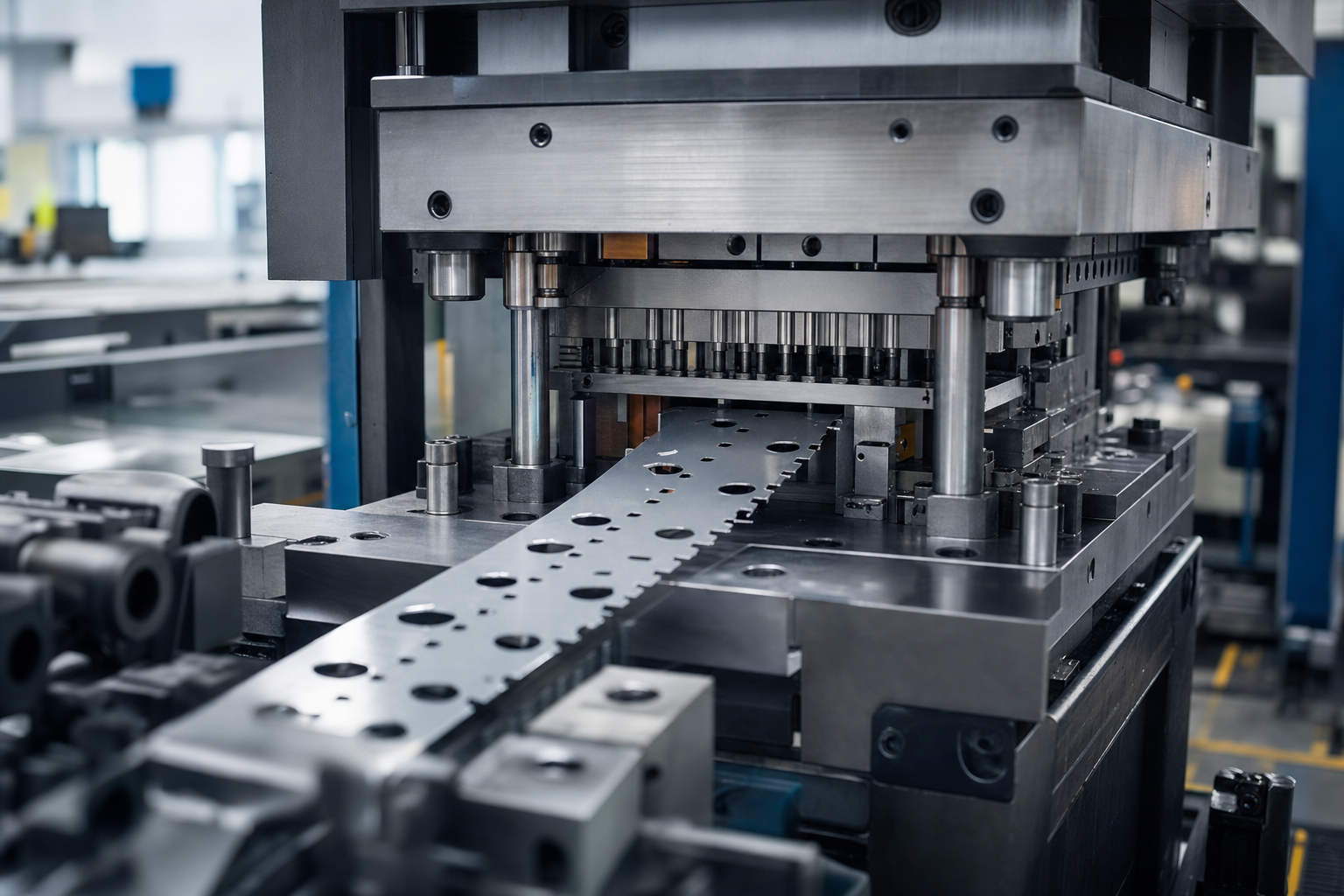
The workhorse of high-volume sheet metal stamping. A continuous strip of metal advances through a series of stations, with each press stroke performing a different operation (pierce, form, bend, draw, blank-off). The finished part is ejected with each stroke.

Progressive die characteristics:

  • 4–20+ stations in sequence
  • Cycle rate: 40–400 strokes/minute (up to 1,500 SPM for small precision parts)
  • Material runs as continuous coil — minimal handling
  • Typical part size: 5 mm–300 mm in largest dimension
  • Ideal for: high-volume parts (50,000+ per year), moderate complexity

Tooling cost: $15,000–$150,000+ depending on complexity

Per-piece cost (at volume): Very low — fractions of a cent to a few dollars

Transfer Dies

Similar to progressive dies, but individual blanks (not connected strips) are transferred between stations by mechanical fingers. Allows larger parts and deeper draws than progressive tooling.

Best for: Parts 100–800 mm in dimension, deep drawn parts, parts requiring complete separation before forming.

Tooling cost: $50,000–$500,000+


Sheet Metal Stamping Materials

Low Carbon Steel (Cold-Rolled / SPCC / DC01-DC05)

Most widely used stamping material. Excellent formability, consistent mechanical properties, low cost.

GradeYield StrengthUTSElongationBest Use
SPCC / DC01140–280 MPa270–410 MPa28–40%General stampings
DC04 (deep drawing)120–210 MPa270–350 MPa38–44%Deep drawn parts
DC06 (extra deep drawing)≤150 MPa270–330 MPa≥42%Complex deep draws

Thickness range: 0.4–12.0 mm for stamping; 0.3–3.0 mm most common for precision parts.

High-Strength Steel (HSLA / DP / TRIP)

Automotive structural applications — reduces weight while maintaining strength.

GradeUTSElongationSpringbackApplication
HSLA 340/440440–540 MPa22–28%ModerateStructural brackets
DP600600–700 MPa18–22%HighDoor beams, pillars
DP780780–900 MPa14–18%Very HighB-pillars, crash structures
TRIP780780–900 MPa20–24%HighComplex formed parts

Note: High-strength steels require more aggressive springback compensation and higher press tonnage. Tooling life is reduced vs. mild steel.

Stainless Steel

Corrosion resistance + strength. Work-hardens rapidly during forming — requires more force and more careful lubricant selection.

GradeKey PropertyFormabilityApplication
304Austenitic, general purposeGoodEnclosures, hardware, food equipment
316Marine/chemical gradeGoodMedical, marine, chemical
430Ferritic, lower costModerateAppliance trim, decorative
301High-strengthModerateSprings, clips, fasteners

Aluminum Alloys

Lightweight (density 1/3 of steel). Increasing adoption in automotive and electronics for weight reduction.

AlloyTemperFormabilityApplication
1100H14ExcellentPackaging, heat exchangers
3003H14Very GoodCookware, general formed parts
5052H32GoodMarine, structural panels
6061T4 (for forming)ModerateAutomotive, structural
5754H22GoodAutomotive body panels

Springback is typically 2–3× greater for aluminum than for steel at equivalent strength — must be compensated in tooling.

Copper and Brass

Electrical conductivity + formability. Used for connectors, terminals, lead frames, and decorative hardware.

AlloyApplicationFormability
C110 (ETP Copper)Electrical bus bars, terminalsExcellent
C26000 (Brass 70/30)Connectors, fasteners, hardwareExcellent
C17200 (Beryllium Copper)High-performance springs, contactsGood

Achievable Tolerances in Sheet Metal Stamping

Tolerance capability depends on operation type, material, thickness, and die quality:

Blanked / Pierced Dimensions

FeatureStandard ToleranceFine Blanking Tolerance
Hole diameter±0.05–0.10 mm±0.01–0.03 mm
Hole position±0.10–0.20 mm±0.03–0.05 mm
Blank outer dimension±0.05–0.15 mm±0.01–0.03 mm
Hole-to-edge distance±0.10 mm±0.03 mm

Bent Dimensions

FeatureAchievable Tolerance
Bend angle±0.5–1.0° (air bend) / ±0.25° (coin bend)
Flange length±0.15–0.30 mm
Flatness (after bending)±0.20 mm per 100 mm
Inside radius±15% of nominal

Formed / Drawn Parts

FeatureAchievable Tolerance
Emboss height±0.10 mm
Draw depth±0.25 mm
Wall thickness (drawn)±10–15% of nominal
Wall thickness (ironed)±0.01–0.02 mm

Sheet Metal Stamping vs. Other Metal Forming Processes

ProcessBest ForTooling CostUnit Cost (High Vol.)Min Order
Sheet metal stampingFlat/formed 2D–3D parts, high volumeMedium–HighVery Low1,000–10,000+
CNC machiningComplex 3D geometry, low volumeNoneHigh1+
Metal injection molding (MIM)Complex small parts, very high volumeHighLow10,000+
Die castingComplex 3D non-ferrous partsHighLow5,000+
Laser cuttingFlat parts, prototypes, low volumeNoneMedium1+
HydroformingHollow 3D shapes, tubesHighMedium500+
Roll formingConstant cross-section profilesMediumVery Low1,000+

Sheet metal stamping wins when:

  • You need high-volume flat or formed metal parts
  • Part geometry is achievable in 2.5D (with possible drawing for 3D features)
  • Per-piece cost must be minimized
  • Consistent, repeatable quality is required across large quantities

Design for Manufacturability (DFM) in Sheet Metal Stamping

1. Minimum Feature Sizes

FeatureMinimum Size
Hole diameter≥ 1.2 × material thickness
Slot width≥ 1.0 × material thickness
Slot length≥ 4 × slot width
Web between holes≥ 2 × material thickness
Distance hole to edge≥ 1.5 × material thickness
Distance hole to bend≥ 2 × material thickness + bend radius

2. Bend Relief

When bending adjacent to a notch or hole, add a bend relief to prevent tearing:

  • Relief width: ≥ material thickness
  • Relief depth: ≥ material thickness + bend radius

3. Grain Direction

Sheet metal has a rolling direction (grain). Bends perpendicular to grain direction achieve tighter radii without cracking vs. bends parallel to grain. Specify grain orientation on drawings for critical bends.

4. Symmetry

Symmetric parts simplify handling, strip layout, and tool balancing. Where possible, design to avoid asymmetric force loading on the progressive die.

5. Avoid Extremely Tight Tolerances Where Not Needed

Tolerances beyond ±0.05 mm require precision tooling, slower speeds, and frequent die maintenance. Apply tight tolerances only to functional mating surfaces — let other features use standard tolerances.

6. Design for Efficient Strip Layout

Material cost is typically 50–70% of total stamped part cost. A well-designed strip layout (nesting, scrap bridges, pilot hole placement) can reduce material cost by 10–25%.


The Sheet Metal Stamping Production Process

Stage 1: Engineering Review and DFM

Before tooling is quoted, the part design is reviewed for:

  • Formability (can all features be made in one die?)
  • Material suitability
  • Tolerance feasibility
  • Die layout and station sequence

Stage 2: Tooling Design and Simulation

Modern stamping shops use FEA simulation (AutoForm, DYNAFORM, LS-DYNA) to predict:

  • Material flow and thinning during draw operations
  • Springback magnitude and compensation
  • Blank optimization for minimum scrap

Critical: Simulation prevents expensive tooling corrections after build.

Stage 3: Tooling Fabrication

Progressive die tooling is machined from tool steel, EDM’d for precision, hardened, and assembled. Lead time: 4–14 weeks depending on complexity.

Stage 4: First Article Inspection (FAI)

A sample run produces first articles, which are fully inspected per the part drawing:

  • CMM measurement of all critical dimensions
  • Material certification review
  • Functional testing (fit check, assembly validation)
  • PPAP documentation for automotive customers

Stage 5: Production

Approved tooling is transferred to production press. Operator loads coil material, presses run at rated speed, and finished parts are collected, inspected (AQL sampling), and packaged.


Quality Control in Sheet Metal Stamping

MethodPurposeFrequency
First-piece inspectionValidate setup before full runEvery setup / coil change
In-process AQL samplingStatistical acceptanceHourly or per-lot
CMM measurementCritical dimension verificationPer batch or 100% for high-precision
Vision system (in-die)Detect missing features, tears100% automated
Load monitoring (tonnage)Detect tooling issues (dull punch)100% per stroke
Leak testing (drawn parts)Verify no cracks in drawn shells100% for pressure parts

Common Sheet Metal Stamping Applications

Automotive

  • Body panels (doors, hoods, fenders, roofs)
  • Structural parts (A/B-pillars, floor pans, cross-members)
  • Brackets, clips, fasteners (thousands of unique part numbers per vehicle)
  • Battery trays and cell enclosures (EV applications)

Electronics and Electrical

  • Connector shells and housings
  • Lead frames for integrated circuits
  • EMI shielding cans
  • Heat spreaders and thermal management components
  • Battery contacts and bus bars

Appliances

  • Outer casing panels (washer, dryer, refrigerator)
  • Internal structural brackets
  • Heating element supports
  • Motor mounting hardware

Medical Devices

  • Surgical instrument components
  • Device housings (stainless 316L)
  • Spring contacts and probe tips
  • Implant enclosures

Construction and Infrastructure

  • Structural brackets and connectors (joist hangers, post caps)
  • HVAC dampers and ductwork components
  • Lock and security hardware
  • Electrical panel components

Frequently Asked Questions

Q: What is the difference between sheet metal stamping and sheet metal fabrication?

A: Stamping uses dedicated tooling (dies) to produce high volumes of identical parts in a single press operation. Sheet metal fabrication uses general-purpose equipment (press brakes, laser cutters, rollers) for lower-volume custom work without part-specific tooling. Stamping has lower per-piece cost at volume; fabrication has lower setup cost for small quantities.

Q: What gauge (thickness) of sheet metal can be stamped?

A: Standard stamping covers 0.1 mm to 12 mm. The most common range for precision parts is 0.3–3.0 mm. Very thick material (6–12 mm) is possible but requires very high press tonnage and limits die geometry options.

Q: How long does stamping tooling last?

A: Properly maintained progressive die tooling for mild steel typically lasts 500,000 to 5,000,000 strokes. Abrasive materials (stainless, high-strength steel) reduce die life by 30–60%. Carbide tooling can achieve 5–10 million strokes for high-volume precision parts.

Q: Can stamping produce threads?

A: Yes — thread forming (extruding a collar and thread-forming without removing material) is commonly done in-die. Alternatively, PEM nuts or inserts can be pressed in during secondary assembly.

Q: What is the minimum order quantity for stamped parts?

A: This depends on tooling type. Simple tooling (single-operation dies) can be economical at 500–2,000 pieces. Progressive die tooling requires higher volumes (typically 10,000+ per year) to justify tooling investment. Some suppliers offer amortized tooling programs for lower initial quantities.


Conclusion

Sheet metal stamping is the foundation of high-volume precision metal parts manufacturing. From the simplest flat bracket to the most complex automotive body panel, the principles are consistent: efficient strip layout, appropriate tooling selection, correct material choice, and disciplined process control.

For engineers and procurement teams, understanding stamping fundamentals directly improves part designs, reduces DFM feedback cycles, and produces more competitive quotes from suppliers.

The most cost-effective stamped parts share three characteristics:

  1. Designed with process constraints in mind from the start
  2. Toleranced appropriately — tight only where it matters
  3. Produced in volumes that justify the tooling investment

When those three conditions are met, sheet metal stamping delivers unmatched cost-performance at scale.


Planning a new sheet metal stamping project? Request a quote — our engineering team will review your design, suggest DFM improvements, and provide a detailed cost breakdown within 24 hours.

Frequently Asked Questions

What is sheet metal stamping?

Sheet metal stamping is a specialized manufacturing process used to create precise metal components. Our team has over 25 years of experience delivering high-quality results for global clients across automotive, aerospace, electronics, and construction industries.

What tolerances can you achieve for sheet metal stamping?

We achieve standard tolerances of ±0.05mm, with precision tolerances down to ±0.02mm for critical applications. All parts are inspected using CMM equipment with Cpk≥1.33 process capability.

What materials do you work with for sheet metal stamping?

We work with a wide range of materials including aluminum (1100-6061), stainless steel (301-430), carbon steel, copper, brass, phosphor bronze, and specialty alloys. Material thickness ranges from 0.1mm to 12mm.

What is your minimum order quantity for sheet metal stamping?

We accept prototype orders starting from 1 piece. For production runs, we recommend starting at 1,000 pieces for cost efficiency, though we accommodate various volumes based on project requirements.

How do I get a quote for sheet metal stamping?

Submit your drawings (DWG, DXF, STEP, IGES, or PDF) via our contact form or email. We provide DFM feedback and pricing within 24 hours. Our engineering team reviews every inquiry for optimal manufacturability.

What quality certifications do you have for sheet metal stamping?

We maintain ISO 9001:2015 and IATF 16949 certifications with full traceability. Every shipment includes inspection reports, material certificates, and compliance documentation as required.

Related Resources:

Request a Quote

Get a Free Quote
Scroll to Top