
If you are evaluating a stamped part and the first manufacturing conversation jumps straight to tooling price, you are probably discussing the wrong variable first.
The real decision is process fit. A part that runs efficiently in a progressive die can become unnecessarily expensive in a transfer die. But the opposite is also true: when the geometry requires free forming, multiple draw stages, or unsupported shape transitions, trying to force the part into a progressive strip often creates a tool that is complicated, fragile, and less economical than buyers expect.
That is where transfer die stamping enters the conversation.
This guide explains how transfer die stamping works, how it differs from progressive die stamping, what part geometries it is best suited for, and when engineering and sourcing teams should deliberately avoid it.
What Is Transfer Die Stamping?
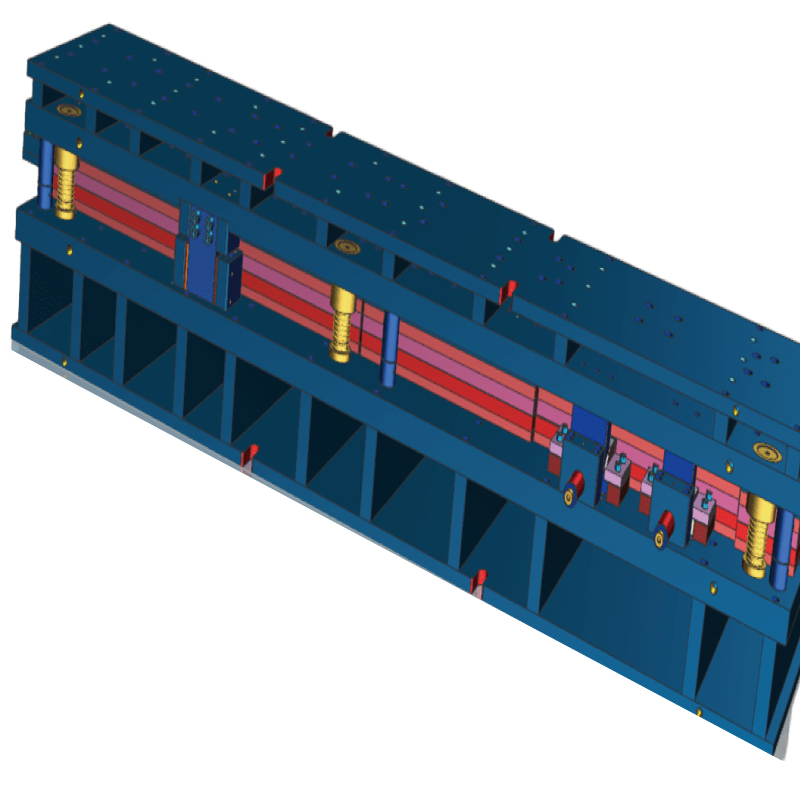
Transfer die stamping is a multi-station stamping process in which the workpiece is cut free from the strip early in the cycle and then mechanically transferred from station to station for subsequent forming, drawing, piercing, trimming, or restriking operations.
Unlike a progressive die, where the part remains attached to a carrier strip until the final station, a transfer die handles each blank as an individual part moving through the tool.
That difference sounds simple. In practice, it changes almost everything about how the part can be designed and how the tooling performs.
In transfer die production, the typical sequence looks like this:
- Coil or blank stock feeds into the line.
- A blanking operation creates the part blank or preform.
- Transfer fingers, rails, or mechanical feeders pick up the blank.
- The blank is moved station by station through the die set.
- Each station performs one controlled operation—draw, flange, pierce, restrike, trim, or form.
- The finished part exits as a discrete component, not as a strip-carried profile.
For buyers new to the process, the key point is this: transfer die stamping separates part transport from material strip geometry. That makes it far more flexible for certain shapes.
If you need a broader foundation first, our overview of what metal stamping is explains how blanking, forming, drawing, and die-based production fit together.
How Transfer Die Stamping Actually Works on the Press Floor
A transfer die line is built around synchronized motion. The press opens, transfer fingers move in, grip or support the part, index it to the next station, release it, and retract before the next stroke. Every movement has to stay timed to the press cycle and matched to the part’s shape and stability.
That matters because once the part has been separated from the strip, it loses the natural positional control a progressive carrier provides. The process now depends on transfer mechanics, station nesting, part support, and repeatable handoff from one operation to the next.
A typical transfer die program may include:
- Blanking or pre-piercing of the initial flat blank
- Redraw or forming stations that progressively change shape
- Trim stations to remove excess flange or draw stock
- Piercing after forming for holes that would distort if punched earlier
- Restrike stations to correct geometry, sharpen corners, or improve dimensional repeatability
- Final cutoff or discharge into collection or downstream handling
For complex shapes, this is often more stable than trying to perform every action while the part is still tethered to a narrow strip.
Transfer tooling is especially common when the part needs room to move in three dimensions between stations. If the form becomes tall, boxed, cup-like, asymmetrical, or difficult to carry on a strip, transfer handling starts to make more sense.
Transfer Die vs. Progressive Die: The Difference That Actually Matters
The textbook distinction is easy: progressive dies move a strip; transfer dies move individual parts.
But for engineering and sourcing decisions, the more useful distinction is this:
- Progressive die stamping is usually optimized for high-speed, strip-fed, highly repeatable parts that can stay attached to a carrier throughout most of the process.
- Transfer die stamping is usually optimized for parts whose geometry becomes too complex, too deep, too unsupported, or too spatially awkward to remain on that strip efficiently.
Our custom metal stamping work often starts with this exact comparison, because the best process depends more on part geometry and annual volume than on any single rule of thumb.
Side-by-Side Comparison
| Factor | Transfer Die Stamping | Progressive Die Stamping |
|---|---|---|
| Part movement | Individual blank transferred station to station | Strip advances through stations |
| Carrier strip required | No | Yes |
| Best for geometry | Deeper forms, irregular parts, multi-directional forming | Flat-to-moderately formed parts with strip-friendly layout |
| Press speed | Usually lower | Usually higher |
| Tooling complexity | High transfer/mechanical complexity | High strip-layout/station complexity |
| Material utilization | Sometimes lower, sometimes better depending on blank | Often excellent for strip-nestable parts |
| Hole/pierce timing flexibility | High, especially after forming | More constrained by strip sequence |
| Part stability during forming | Better for unsupported 3D shapes | Better for parts that stay stable on carrier |
| Ideal volume range | Medium to high volume | High to very high volume |
| Risk if process is misapplied | Transfer system cost may not be justified | Strip breakage, station interference, unstable forming |
If your team is actively comparing the two, read our dedicated page on progressive die stamping alongside this article. The tradeoff is rarely about which process is “better” in general. It is about which process fits the part without forcing bad compromises.
When Transfer Die Stamping Is the Better Choice
Transfer die stamping tends to be the right answer when the part geometry becomes the dominant constraint.
1. The Part Cannot Realistically Stay Attached to a Strip
Some parts simply stop behaving well once forming begins. After a few draw or flange stages, the remaining carrier may become too weak, too distorted, or too awkward to maintain registration. In those cases, progressive strip logic starts working against the process.
Transfer dies avoid that problem by separating the blank and moving it as an individual workpiece.
Typical examples include:
- deep or semi-deep drawn shells
- structural brackets with significant vertical walls
- parts with large offset forms
- asymmetrical stampings that twist during sequential strip forming
- components requiring access from multiple directions after initial forming
2. The Part Needs Multiple Forming or Drawing Stages With Free Space Around It
As a part grows upward or downward from the plane of the strip, station interference becomes a real issue. The strip itself can limit where punches, draw beads, cams, or forming details are placed.
Transfer die layouts provide more room around the part at each station. That makes them useful for:
- redraw operations
- deep flanging
- shape correction through restrike
- trimming after draw growth
- forming sequences that require open access around the perimeter
This is one reason transfer tooling is often associated with more complex metal forming operations rather than simple flat blanking.
3. Critical Features Need to Be Pierced After Forming
Punching holes before forming is often convenient, but it is not always correct. If a hole sits near a draw wall, bend transition, or flange edge, forming can distort it. The result may be an out-of-round hole, shifted location, or inconsistent edge condition.
Transfer die stamping gives engineers more freedom to place piercing later in the sequence, after the main geometry is established.
That is a major advantage when:
- hole position is critical relative to the formed shape
- drawn features would elongate pre-punched holes
- the final geometry needs secondary calibration before piercing
- trim and pierce operations need access to already-formed walls
4. The Blank Shape Is Efficient, but the Strip Layout Is Not
Some parts look reasonable as blanks but waste material badly when forced into a progressive strip arrangement. The bridge widths, pilots, carrier tabs, and station pitch needed to keep the strip stable may erase the theoretical productivity advantage.
In those cases, a transfer process using discrete blanks can sometimes improve the overall economics, especially for larger parts or irregular outlines.
This is why experienced sourcing teams should compare total conversion cost, not just strokes per minute.
What Geometries Are Well Suited to Transfer Die Stamping?
Transfer dies are not only for deep-drawn cups. That is a common oversimplification.
They are generally best for parts with one or more of the following geometric traits:
Deep or Semi-Deep Drawn Features
When material must flow significantly to create depth, multiple draw stages and trim control become more important than strip speed. Transfer dies are commonly used for housings, shells, covers, and cup-like parts where drawing progression has to be carefully managed.
Large Formed Brackets With Vertical Walls
A bracket that begins flat but ends with tall flanges, offsets, ribs, and directional forms may be technically possible in a progressive die. The question is whether it remains economical, stable, and maintainable there.
Transfer dies become attractive when the finished shape is too spatially developed for a strip carrier to support cleanly.
Asymmetrical Parts
Asymmetry is not automatically a transfer-die part, but it often pushes the process in that direction. Uneven mass distribution, one-sided flanges, offset embosses, or localized draw features can create handling and forming imbalances in progressive layouts.
Transfer handling gives the tool designer more freedom to support the part where it actually needs support.
Parts Requiring Post-Form Trimming or Piercing
If the final datum condition only exists after drawing or forming, post-form operations become easier to manage in transfer tooling. This is common in parts where edge shape, hole position, or final flange profile depends on the formed geometry rather than the original blank.
Larger Parts
As part size increases, progressive strip width, feed accuracy, scrap handling, and press tonnage constraints become more difficult to optimize together. Transfer systems can be a more practical choice for medium-to-large stampings where the finished part footprint is substantial.
When You Should Not Use Transfer Die Stamping
This is the section buyers often skip, and it is where cost mistakes happen.
Transfer die stamping is not a premium option simply because it is more complex. In many projects, it is the wrong tool.
1. The Part Is Flat or Only Lightly Formed
If the part is mostly 2D with modest bends and strip-friendly geometry, a progressive die usually wins on throughput and piece price. Introducing transfer mechanics into a simple part adds complexity without solving a real manufacturing problem.
For terminals, clips, washers, flat brackets, lead frames, and many connector-style parts, progressive production is usually the more rational path.
2. Annual Volume Is Too Low to Justify the Tooling
Transfer die tooling can be capital intensive. Even if the process is technically suitable, low annual demand may not support the investment.
For low-volume programs, other routes may make more sense:
- short-run tooling
- line dies
- turret punching plus secondary forming
- laser cutting plus press brake operations
- hybrid fabrication before volume scales up
The right answer depends on required tolerances, material, and expected production maturity—not on process prestige.
3. The Part Needs Extreme Press Speed to Reach Target Piece Price
Progressive dies often run faster because strip feeding is highly efficient and the part remains indexed by the carrier. If the geometry allows progressive processing, the higher stroke rate can be decisive.
Transfer systems generally involve more motion per cycle and more handling sensitivity. For commodity parts at very high annual volumes, that difference matters.
4. The Part Is Too Small or Too Delicate for Reliable Transfer Handling
Very small blanks, very thin sections, or unstable intermediate forms may be difficult to transfer reliably without marring, mispick, or positional inconsistency. Sometimes the part is easier to control while attached to a strip than as a discrete workpiece.
This is especially true for miniature precision parts where strip registration is one of the process’s biggest advantages.
5. The Required Accuracy Is Misunderstood
Transfer die stamping can support tight dimensional control, but it is not automatically more precise than progressive tooling. In some cases, separating the part from the strip earlier introduces more handling variables, not fewer.
If a drawing’s critical dimensions depend on hole-to-feature positional accuracy across a flat strip part, progressive piloting may actually provide the better control strategy.
Cost Tradeoffs: What Buyers Should Evaluate Beyond Tool Price
Transfer die decisions are often distorted by a single number: tooling cost.
That number matters, but it does not tell you enough.
A better sourcing evaluation looks at five cost layers:
1. Tooling Investment
Transfer dies often require:
- more elaborate station design
- transfer rails or finger systems
- more open die space for formed part movement
- more setup and tryout work
- more tuning around handoff stability
So initial tool cost can be high. But a progressive die forced to accommodate an unsuitable geometry can also become very expensive. Buyers should compare functional tooling cost, not assume progressive is always the cheaper tool.
2. Material Utilization
Progressive dies often have excellent material efficiency when parts nest well in strip form. But if the strip requires wide carriers, nonproductive bridges, or awkward pitch spacing, the scrap burden increases quickly.
Transfer production based on optimized blanks may be more competitive than expected. Material modeling should be part of the quote review.
3. Press Rate and Conversion Cost
All else equal, progressive tooling usually has the throughput advantage. Higher strokes per minute spread labor and machine cost over more parts.
Transfer systems typically run slower, especially when part geometry or handling sensitivity limits speed. That can raise conversion cost even if the process is more technically stable.
4. Maintenance and Uptime
A process that looks cheaper on paper can become expensive if it is maintenance-heavy in production.
A progressive die carrying a difficult 3D part may suffer from:
- strip instability
n- carrier breakage
- station interference
- accelerated wear at difficult form stations
- frequent adjustment to keep geometry in tolerance
A well-designed transfer die may run more predictably on that same geometry. The comparison should include expected uptime, die life, and maintenance burden.
5. Scrap and Quality Risk
If a part is marginal for progressive processing, the hidden cost often appears as scrap, sorting, unstable dimensions, or downstream assembly issues.
In sourcing terms, the cheapest per-piece quote is not the lowest-cost program if quality variation forces containment later.
Precision, Tolerances, and Process Capability
Transfer die stamping can produce highly repeatable parts, but tolerance capability depends on what kind of feature you are discussing.
In general:
- Blanked and pierced features are easiest to control when tooling condition is stable.
- Drawn shapes and formed walls depend on material flow, springback, and station consistency.
- Feature location after forming may improve in transfer tooling because piercing can occur later in the sequence.
- Part-to-part repeatability depends heavily on transfer positioning, station support, and die maintenance.
This means buyers should ask a more precise question than “What tolerance can transfer die hold?”
The better question is: Which feature, measured from which datum, after which forming stage?
For example:
- a post-form pierced hole may hold excellent positional consistency relative to a formed wall
- a drawn height may vary more because of material flow behavior
- a trimmed edge after redraw may be highly repeatable if final trimming occurs in a stabilized station
Good suppliers will separate these tolerance discussions by feature type rather than quoting one blanket number for the entire part.
Transfer Die Tooling Considerations Engineers Should Think About Early
If a part may require transfer die stamping, the drawing review should happen earlier than usual. Tooling flexibility does not eliminate DFM constraints; it just changes them.
Important engineering considerations include:
Blank Development
The starting blank shape matters. Material flow during drawing and forming must be balanced, especially for asymmetric shapes or parts with uneven flange demand.
Part Support Between Stations
How will the intermediate part be held? A shape that is stable at the finished stage may be unstable halfway through the sequence. Transfer fingers need predictable grip or support locations.
Piercing Sequence
Which holes should be pierced flat, and which should wait until after forming? This decision affects both geometry accuracy and punch access.
Trim Allowance
Drawn or heavily formed parts often need extra stock that is removed later. Engineers should expect trim logic to be part of the process, not an afterthought.
Datum Strategy
If the critical inspection dimensions are all referenced to the final formed shape, post-form restrike and post-form piercing may be necessary. That should be aligned with the quality plan from the start.
A supplier that offers both transfer and progressive process development is usually in a better position to recommend the right path objectively. This is often part of a broader custom metal stamping engineering review rather than a quote-only conversation.
How to Decide Between Transfer Die and Progressive Die
For sourcing and engineering teams, the simplest decision framework is this:
Choose Progressive Die When:
- the part remains strip-friendly through the process
- forms are modest and accessible within the strip layout
- annual volume is high enough to prioritize stroke speed
- material utilization is strong in strip nesting
- critical features are easier to control while the part stays piloted on the strip
Choose Transfer Die When:
- the part geometry becomes too developed for stable strip carrying
- multiple draw or form stages need open access around the part
- post-form piercing or trimming is important to final quality
- the strip layout becomes wasteful or mechanically unstable
- process stability matters more than theoretical maximum stroke rate
Reconsider Both When:
- annual volume is too low for dedicated hard tooling
- the part is still evolving and design changes are likely
- fabrication or soft tooling can cover the early program phase more economically
A good manufacturing review does not start from process preference. It starts from geometry, volume, tolerance logic, and program economics.
Questions Buyers Should Ask a Supplier Before Approving Transfer Tooling
Before you commit to transfer die tooling, ask these questions directly:
- Why is transfer die recommended instead of progressive die for this part?
The answer should reference geometry, sequencing, and production stability—not vague statements about complexity.
- At what annual volume does the transfer process become economical?
Ask for the volume break-even point against progressive or other alternatives.
- Which features are formed before piercing, and which are pierced after forming?
This reveals whether the supplier is thinking through actual dimensional control.
- What is the expected press speed and output rate?
Buyers need realistic throughput, not just tooling theory.
- How is material utilization being calculated?
Ask to compare blank yield with a hypothetical strip layout if progressive is under consideration.
- What are the likely maintenance points in the tool?
Transfer fingers, trim stations, redraw areas, and restrike features all affect long-run cost.
- Which dimensions are most sensitive to process variation?
Serious suppliers will identify the real quality risks upfront.
FAQ
What is the main advantage of transfer die stamping?
The main advantage of transfer die stamping is that it allows individual blanks to move independently between stations, which makes it better suited to deep, irregular, or heavily formed parts that are difficult to carry through a progressive strip.
Is transfer die stamping more expensive than progressive die stamping?
Not always. Transfer die stamping often has higher tooling and handling complexity, but it can be the lower-cost option when a part’s geometry makes progressive strip layout unstable, wasteful, or difficult to maintain in production.
What types of parts are best for transfer die stamping?
Transfer die stamping is best for parts with deep draws, tall walls, asymmetrical forms, post-form piercing requirements, or shapes that need multiple forming stages with open access around the part.
When should transfer die stamping be avoided?
Transfer die stamping should usually be avoided for flat or lightly formed parts, low-volume programs, very small components that are hard to transfer reliably, or applications where progressive tooling can achieve the target quality at much higher speed.
Can transfer die stamping hold tight tolerances?
Yes, but tolerance capability depends on the specific feature. Post-form pierced features and trimmed profiles can be controlled well, while drawn depths and formed geometry depend more on material flow, springback, station support, and tooling maintenance.
How do I decide between transfer die and progressive die?
Start with part geometry, annual volume, feature sequencing, and quality requirements. If the part remains strip-friendly, progressive die is often better. If the part becomes difficult to carry on a strip or needs post-form operations, transfer die may be the better process.
Yoast SEO Metadata
Related reading: Progressive Die Stamping · Custom Metal Stamping · Metal Forming · What Is Metal Stamping?
Learn how our precision metal stamping services can benefit your production. Contact us for a quote on custom metal stamped parts.
Frequently Asked Questions
What is transfer die stamping?
Transfer die stamping is a specialized manufacturing process used to create precise metal components. Our team has over 25 years of experience delivering high-quality results for global clients across automotive, aerospace, electronics, and construction industries.
What tolerances can you achieve for transfer die stamping?
We achieve standard tolerances of ±0.05mm, with precision tolerances down to ±0.02mm for critical applications. All parts are inspected using CMM equipment with Cpk≥1.33 process capability.
What materials do you work with for transfer die stamping?
We work with a wide range of materials including aluminum (1100-6061), stainless steel (301-430), carbon steel, copper, brass, phosphor bronze, and specialty alloys. Material thickness ranges from 0.1mm to 12mm.
What is your minimum order quantity for transfer die stamping?
We accept prototype orders starting from 1 piece. For production runs, we recommend starting at 1,000 pieces for cost efficiency, though we accommodate various volumes based on project requirements.
How do I get a quote for transfer die stamping?
Submit your drawings (DWG, DXF, STEP, IGES, or PDF) via our contact form or email. We provide DFM feedback and pricing within 24 hours. Our engineering team reviews every inquiry for optimal manufacturability.
What quality certifications do you have for transfer die stamping?
We maintain ISO 9001:2015 and IATF 16949 certifications with full traceability. Every shipment includes inspection reports, material certificates, and compliance documentation as required.