
Progressive Die vs Transfer Die Stamping: Complete Comparison Guide 2026
When your stamped part requires multiple operations — piercing, forming, bending, drawing — you face a critical process decision: progressive die stamping or transfer die stamping. Both technologies move parts through sequential operations, but they differ fundamentally in how the workpiece is transported between stations. Choosing the wrong approach can inflate tooling costs by 50-100% or reduce throughput by 30-50%. This guide provides a data-driven framework to help you make the right call.
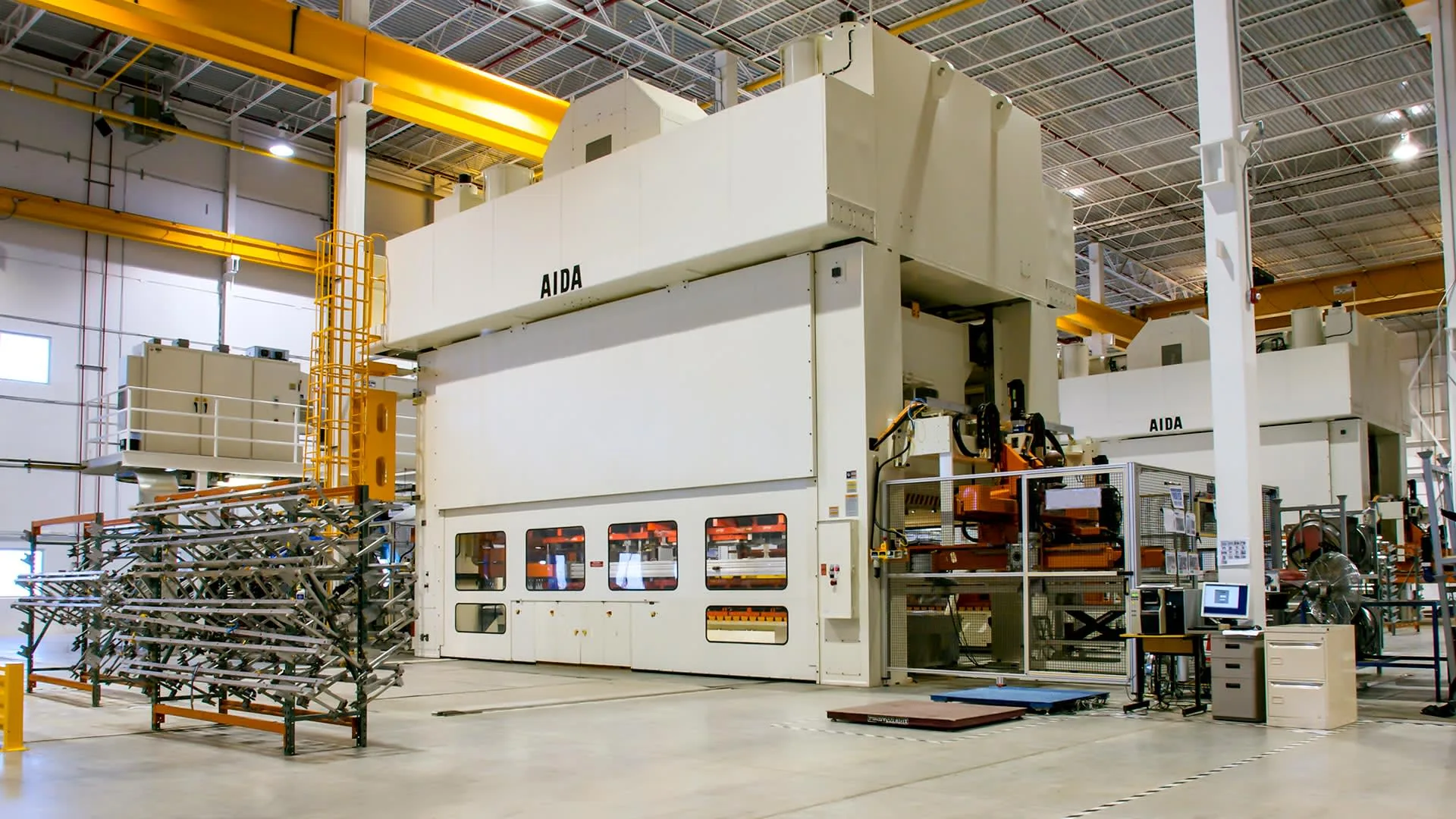
What Is Progressive Die Stamping?
In progressive die stamping, the workpiece is fed as a continuous metal strip (coil) through a single die set containing multiple stations. Each press stroke advances the strip one pitch, and at each station, a different operation is performed — piercing at station 1, forming at station 2, bending at station 3, and blanking (separation from the strip) at the final station. The part remains attached to the strip via small carrier tabs until the final cutoff operation.
Progressive dies are the dominant technology for high-volume production of small-to-medium parts (typically under 300mm in any dimension). Press speeds range from 30-1,200 strokes per minute (SPM), with each stroke producing one finished part. At 200 SPM, a progressive die produces 12,000 parts per hour — making it the most productive stamping technology for qualifying parts.
Key advantage: the strip itself serves as the transfer mechanism, eliminating the need for a separate part-handling system. This simplicity translates to faster setup, lower maintenance, and higher reliability compared to transfer systems.
What Is Transfer Die Stamping?
In transfer die stamping, the part is first blanked from the strip at the initial station, then mechanically transferred between individual, physically separate die stations by a transfer system — a set of gripper rails or fingers that pick up the part and move it to the next station between press strokes. Unlike progressive stamping, the part travels independently through the dies, completely detached from the original strip.
Transfer dies excel at producing large, complex parts that are impractical in progressive dies due to strip width limitations, material cost (large carrier webs waste material), or the need to rotate/reorient the part between operations. Transfer presses typically operate at 15-60 SPM — slower than progressive presses because of the mechanical transfer motion overhead — but can handle parts up to 2 meters in length.
Key advantage: freedom from the carrier strip allows the part to be rotated, flipped, or reoriented between stations, enabling complex 3D geometries that are impossible in progressive tooling. Transfer dies also permit the use of individual cushion/pressure systems at each station for precise draw control.
Head-to-Head Comparison: Progressive Die vs Transfer Die
| Factor | Progressive Die | Transfer Die |
|---|---|---|
| Part Size | Up to ~300mm length | Up to ~2,000mm length |
| Production Speed | 30-1,200 SPM | 15-60 SPM |
| Tooling Cost | $8,000-$80,000 (single die set) | $15,000-$150,000 (multiple die sets) |
| Material Utilization | 60-80% (carrier web consumes material) | 75-90% (no carrier web needed, though blanking scrap still exists) |
| Part Complexity | 2D/2.5D operations; limited rotation | Full 3D operations; part can be rotated/flipped |
| Setup Time | 1-4 hours (single die set) | 4-12 hours (multiple die alignment + transfer timing) |
| Ideal Volume | 50,000 – 10M+ pcs/year | 10,000 – 500,000 pcs/year |
| Die Maintenance | Moderate (wear concentrated in one die) | Higher (multiple die sets to maintain) |
| Press Requirement | Standard mechanical press | Press with integrated transfer system or dedicated transfer press |
When to Choose Progressive Die Stamping
Progressive die stamping is the optimal choice when:
- Part size is under 300mm — the strip width required to carry the part plus carrier web stays within standard coil widths (typically 600-1,000mm max).
- Annual volume exceeds 50,000 pieces — high volume justifies the upfront investment in a precision progressive die, and the speed advantage (up to 1,200 SPM) maximizes ROI.
- Operations are primarily 2D or 2.5D — piercing, blanking, bending, forming, and simple drawing can all be accommodated in progressive tooling without the need for part reorientation.
- Material is thin and strip-fed — material thickness of 0.1-6.0mm works well in progressive dies, and strip (coil) feeding is standard. Visit our progressive die stamping page for detailed capabilities.
- Part design is relatively stable — modifying a progressive die is significantly more expensive than modifying individual transfer die stations because changes propagate through the entire die set.
Common progressive die applications include: electrical terminals and contacts (often running at 500-800 SPM), automotive brackets and clips, electronic connector components, spring steel parts, and small appliance components.
When to Choose Transfer Die Stamping
Transfer die stamping becomes the better choice when:
- Part size exceeds 300mm — large automotive body panels, structural brackets, and appliance housings are impractical in progressive tooling. Transfer dies handle parts up to 2 meters.
- Part requires rotation or flipping between operations — deep-drawn shells that need piercing from both sides, or parts requiring forming on multiple faces, benefit from transfer die flexibility.
- Material is thick (6mm+) — thick materials require larger die clearances and higher tonnage; transfer presses with individual die cushion control provide better forming precision for heavy-gauge parts.
- Annual volume is 10,000-500,000 pieces — the speed penalty of transfer presses (15-60 SPM vs. 200+ SPM progressive) is offset by lower initial tooling investment and better material utilization for large parts.
- Part design may evolve — modifying or replacing individual die stations in a transfer system is faster and cheaper than modifying a single integrated progressive die. This is valuable for products with annual design refreshes.
Common transfer die applications include: automotive body panels and structural members, large appliance housings (washer/dryer panels), heavy truck frame components, large deep-drawn shells, and aerospace structural brackets. For more details, see our transfer die stamping page.
Cost Comparison and ROI Analysis
The choice between progressive and transfer die stamping is fundamentally an economic decision. Here’s a representative comparison for a medium-complexity bracket (150mm × 80mm, 2.0mm steel, 4 operations) at varying annual volumes:
- 50,000 pcs/year: Progressive die ~$0.38/piece (amortized over 2-year die life), Transfer die ~$0.62/piece. Progressive wins — speed advantage outweighs higher tooling cost.
- 200,000 pcs/year: Progressive die ~$0.18/piece, Transfer die ~$0.30/piece. Progressive maintains its lead.
- 500,000 pcs/year: Progressive die ~$0.12/piece (approaching material cost floor), Transfer die ~$0.22/piece. Progressive is clearly dominant for this part.
However, for a large part (400mm × 250mm), the calculation shifts dramatically because the material waste from the progressive carrier web eliminates its cost advantage:
- 50,000 pcs/year: Transfer die ~$1.85/piece, Progressive die ~$2.40/piece — the material savings (20% better utilization for the large part) make transfer die cheaper despite slower speed.
- 200,000 pcs/year: Transfer die ~$0.90/piece, Progressive die ~$1.35/piece — transfer die’s material efficiency advantage grows with volume.
The critical decision variables are: part size (determines carrier web material waste), production volume (determines speed premium value), and geometric complexity (determines whether progressive tooling can accommodate all operations). Our engineering team can provide a detailed cost analysis comparing both approaches for your specific part — typically within 24 hours of receiving your drawing.
For general guidance on stamping processes, see our Metal Stamping Complete Guide. For volume-specific strategies, visit high-volume stamping or low-volume stamping.
Frequently Asked Questions
What is the main difference between progressive and transfer die stamping?
The fundamental difference is how the part moves between operations. In progressive die stamping, the part remains attached to a continuous metal strip (carrier web) that advances through all stations in a single die set. In transfer die stamping, the part is blanked first and then mechanically transferred (gripped and moved) between physically separate die stations. This distinction drives decisions about part size limits, production speed, tooling cost, and geometric complexity.
Which process is faster?
Progressive die stamping is significantly faster, operating at 30-1,200 strokes per minute versus 15-60 SPM for transfer presses. At 200 SPM, a progressive die produces parts in 0.3 seconds — the transfer mechanical motion alone in a transfer press takes 0.5-1.0 seconds per cycle. The speed advantage makes progressive stamping the clear choice for small, high-volume parts.
Can progressive dies handle deep drawing?
Yes — progressive dies can incorporate shallow to moderate deep drawing operations (draw ratios up to ~1.6 in a single progressive station). However, deep drawing with multi-stage redraws and inter-stage annealing is better suited to transfer dies because each die station can have independent cushion pressure control, and the part can be removed from the line for annealing between stages if needed. See our deep drawing guide for more details on process selection.
Why are transfer dies more expensive in tooling?
Transfer dies require multiple individual die sets (one per station) plus a transfer mechanism (rails, grippers, timing control), whereas a progressive die contains all stations in a single integrated die set. Additionally, each transfer die station needs its own die shoe, guide pins, and alignment system. However, for large parts, the material savings from eliminating the carrier web often more than offset the higher tooling investment over the production life.
How do I decide which process is right for my part?
Start with your part’s size and annual volume. If the part is under 300mm and volume exceeds 50,000/year, progressive stamping is almost always the better choice. If the part exceeds 300mm or requires rotation/flipping between operations, transfer stamping becomes the preferred option. For borderline cases, submit your drawing to our engineering team for a comparative quote covering both progressive and transfer tooling — we’ll provide cost models and a recommendation based on your specific geometry and volume forecast.