
Every metal stamping operation encounters defects — burrs, cracks, wrinkles, springback, and surface scratches are part of the process. The difference between a profitable production run and a scrap pile is how quickly you diagnose the root cause and implement corrective action. At Metal Stamping Parts, our quality team has documented over 200 defect patterns across 20+ years of progressive die, transfer die, and deep draw stamping. This guide shares the most common defects, their root causes, and proven corrective actions.
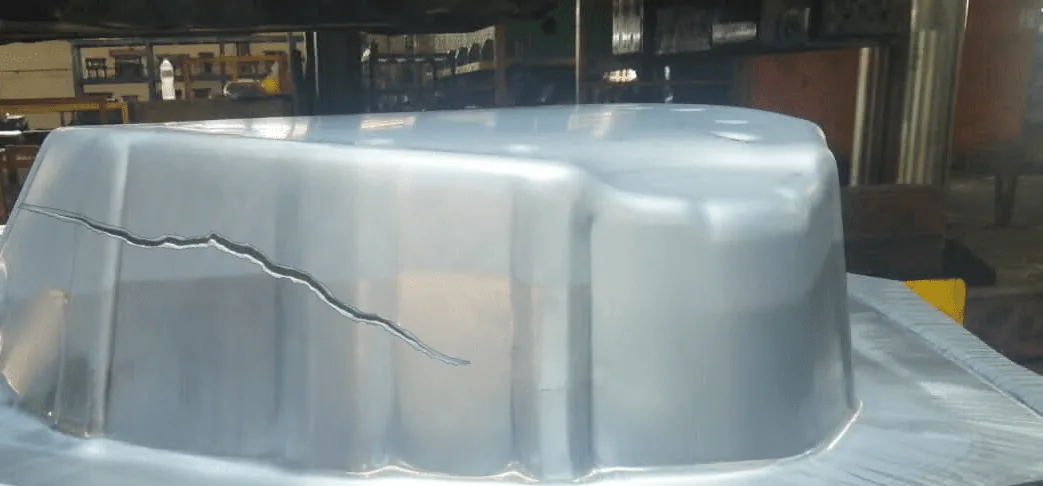
Stamping defect is any deviation from the specified dimensional, surface, or functional requirements of a stamped part, caused by material properties, die condition, press parameters, or lubrication issues during the forming process.
Common Metal Stamping Defects Overview
Stamping defects fall into five categories based on where they originate. Understanding the category narrows the troubleshooting scope:
- Material defects — inconsistent hardness, thickness variation, inclusions, grain direction issues
- Die defects — worn edges, chipped inserts, misaligned stations, incorrect clearance
- Press defects — tonnage variation, slide misalignment, speed inconsistency, cushion pressure
- Lubrication defects — insufficient lubricant, wrong viscosity, contamination, uneven application
- Design defects — tight radii, insufficient draw ratio, poor blank development, missing reliefs
Burr Formation and Edge Quality Issues
Burrs are the most common stamping defect — nearly every blanking and piercing operation produces some level of burr. The question is whether the burr height exceeds the specification.
Root Causes of Excessive Burrs
- Worn punch or die edges — the #1 cause. Punch edges dull progressively with each stroke. Carbon steel tooling loses sharpness after 500,000–1,000,000 hits; carbide maintains edge quality for 5,000,000+ hits.
- Incorrect clearance — clearance that is too tight or too wide produces different burr patterns. Optimal clearance is 5–8% of material thickness per side for general blanking, 3–5% for precision work.
- Material hardness variation — incoming material harder than specified requires more shearing force, producing rollover and burr. Verify incoming coil hardness against the die design specification.
- Off-center loading — asymmetric parts or poorly centered blanks cause uneven punch-to-die engagement, concentrating wear on one side.
Corrective Actions
| Symptom | Root Cause | Fix |
|---|---|---|
| Burr increases gradually over time | Edge wear | Regrind punch/die; establish preventive maintenance interval |
| Burr on one side only | Off-center loading or misalignment | Check die alignment, pilot engagement, strip layout |
| Burr from first stroke | Clearance too wide or too tight | Measure clearance; re-shim or re-grind to spec |
| Intermittent burr on random parts | Material hardness variation | Verify incoming material; tighten incoming inspection |
Cracking and Fracture During Forming
Cracks occur when the applied strain exceeds the material’s elongation capacity. This is the most expensive defect category — cracked parts are 100% scrap.
Common Crack Types
- Edge cracking — cracks starting at the cut edge of the blank, propagating into the formed area. Caused by burr-induced stress concentration, edge condition from prior shearing, or material with low edge stretchability (AHSS grades).
- Radius cracking — cracks on the outer surface of a bend or draw radius. Caused by radius too tight for the material’s minimum bend radius, or bending parallel to the rolling direction.
- Wrinkle-to-crack transition — in deep drawing, excessive blank holder pressure prevents wrinkling but over-thins the wall, causing fracture at the die radius.
- Corner cracking — cracks at corners of rectangular draws where material stretches in two directions simultaneously. Requires draw beads or addendum geometry to control metal flow.
Prevention Strategies
- Verify material elongation — incoming material must meet the specified minimum elongation (e.g., ≥37% for SPCC, ≥41% for SPCE). Request mill test reports with each coil.
- Respect minimum bend radii — annealed 304 stainless: 1.0T; 6061-T6 aluminum: 3.0T; DP780 steel: 1.5T. Design radii ≥ the minimum for your alloy and temper.
- Orient bends perpendicular to grain direction — bending parallel to rolling direction reduces available elongation by 20–40%.
- Use FEA simulation — forming simulation software (AutoForm, PAM-STAMP, LS-DYNA) predicts thinning, cracking, and wrinkling before die construction. A $5,000 simulation can prevent a $50,000 die rework.
Wrinkling in Deep Drawn Parts
Wrinkling in deep drawing occurs when compressive hoop stress in the flange exceeds the material’s buckling resistance, causing the flange to fold into radial wrinkles during the drawing stroke.
Wrinkling is the counterpart to cracking — too little blank holder pressure allows wrinkles; too much causes cracking. Finding the optimal window is the central challenge of deep draw die development.
Root Causes
- Insufficient blank holder force — the most common cause. Increase cushion pressure incrementally until wrinkles disappear without causing thinning.
- Excessive draw ratio — single-draw limit is ~2.0 for steel, ~1.8 for stainless and aluminum. Exceeding this requires multi-stage drawing with intermediate annealing.
- Uneven lubrication — excess lubricant on one side reduces friction locally, allowing that area to feed faster and buckle.
- Blank shape — round blanks for round cups; non-circular blanks need optimized shapes (developed from FEA or tryout) to equalize metal flow.
Corrective Actions
- Increase blank holder force in 5–10% increments until wrinkles are eliminated
- Add draw beads to control metal flow in specific zones
- Switch from flat blank holder to stepped or contoured blank holder profile
- If draw ratio exceeds single-stage limit, add a redraw station
- Reduce lubricant viscosity or switch to higher-friction lubricant on the blank holder side
Springback Dimensional Errors
Springback is the elastic recovery that occurs after the forming load is removed, causing the part to partially return toward its original shape. It is the largest single source of dimensional error in stamped bends.
Springback affects every bent or formed part. The magnitude depends on material yield strength, bend radius-to-thickness ratio (R/T), and bend angle. High-strength steels (AHSS) and aluminum alloys exhibit significantly more springback than mild steel.
Quantifying Springback
- Mild steel (SPCC): 0.5–1.5° springback at 90° bend, R/T = 1
- Stainless 304: 2–4° springback at same conditions
- DP780 AHSS: 4–8° springback — requires aggressive compensation
- 6061-T6 aluminum: 3–5° springback
Compensation Methods
- Overbending — design the die angle to overbend by the predicted springback amount. Most effective for simple bends.
- Bottoming / coining — use extreme force to plastically set the bend, reducing springback to near zero. Requires 5–10× the air-bending tonnage.
- Variable R/T — tighter punch radius reduces springback but increases cracking risk. Find the minimum radius that doesn’t crack.
- Hot forming — for AHSS grades above 980 MPa, warm forming at 200–300°C dramatically reduces springback while maintaining strength after quenching.
Surface Defects: Scratches, Galling, and Pickup
Surface defects during stamping come from die-workpiece interaction. Metal transfer (galling), abrasive scratches, and die pickup create visible marks that are unacceptable for cosmetic or functional surfaces.
Galling and Metal Transfer
Galling occurs when microscopic welding between the workpiece and die surface transfers material to the die, creating progressively worse scratches on subsequent parts. Austenitic stainless steel (304, 301) is the worst offender due to its work-hardening tendency and adhesive nature.
- Prevention: use coated tooling (TiN, TiAlN, DLC), increase die surface hardness to ≥60 HRC, apply high-pressure lubricants with EP (extreme pressure) additives, reduce forming speed.
- Die maintenance: polish die surfaces every 10,000–50,000 strokes; re-coat when coating shows wear.
Die Marks and Stamping Lines
- Die lines — raised lines on the part surface corresponding to die radius transitions. Polish die radii to Ra ≤ 0.2 µm for cosmetic parts.
- Stretch lines (Lüders bands) — visible lines on low-carbon steel surfaces from discontinuous yielding. Eliminate by specifying skin-passed (temper-rolled) steel or by pre-straining the blank 2–3%.
- Pickup — aluminum and copper alloys can deposit material on die surfaces. Use chrome-plated or polished carbide dies with appropriate lubricant.
Dimensional Non-Conformance
Beyond springback, several other factors cause dimensional failures in stamped parts:
- Material thickness variation — ±10% thickness variation in incoming coil translates directly to ±10% variation in formed part dimensions. Specify tight thickness tolerances (±0.05 mm for precision parts) and verify incoming material.
- Die wear — progressive die stations wear at different rates. The first few blanking stations typically wear faster than forming stations. Track dimensional trends to predict when regrinding is needed.
- Thermal expansion — high-speed stamping (600+ SPM) generates heat in the die, causing thermal growth. In precision work, use temperature-controlled coolant and design dies with thermal compensation.
- Strip feeding accuracy — progressive die pitch accuracy depends on feed roll condition and pilot pin engagement. Worn feed rolls cause ±0.1–0.3 mm pitch error, accumulating across stations.
Material-Related Defects
Inclusions and Laminations
Non-metallic inclusions (oxides, sulfides) in the steel microstructure act as stress concentrators, causing cracks during forming or premature fatigue failure in service. Inclusions above ASTM E45 rating Type A 2.0 or Type B 1.5 should trigger material rejection for critical parts.
Edge Cracking in AHSS
Advanced high-strength steels (DP, TRIP, CP grades) have significantly lower edge stretchability than mild steel. A sheared edge that survives forming in SPCC may crack in DP780. Mitigation: use laser-cut or milled edges instead of sheared edges for stretch-flange applications; specify edge quality on the drawing (burr height, rollover depth).
Orange Peel Surface
Excessive grain growth (from annealing at too high a temperature or for too long) produces a visible “orange peel” texture on formed surfaces. Control annealing temperature ±10°C and specify maximum grain size (ASTM E112 grain size number ≥ 6 for cosmetic parts).
Troubleshooting Quick Reference
| Defect | First Check | Second Check | Third Check |
|---|---|---|---|
| Burr | Edge sharpness (regrind) | Clearance (measure) | Material hardness |
| Crack (radius) | Radius vs minimum spec | Grain direction | Material elongation |
| Crack (edge) | Edge condition (burr) | Material grade (AHSS) | Edge-to-bend distance |
| Wrinkle | Blank holder force | Draw ratio | Lubrication |
| Springback | R/T ratio | Material yield strength | Die compensation |
| Scratch/galling | Die surface condition | Lubricant type | Die coating |
| Dimensional out | Material thickness | Die wear station | Feed accuracy |
Preventive Maintenance for Defect Prevention
The most cost-effective approach to stamping defect management is prevention through systematic die maintenance:
- Every shift: visual inspection of first and last parts; check for burrs, cracks, and surface marks
- Every 10,000–25,000 strokes: measure critical dimensions on sample parts; check edge quality
- Every 50,000–100,000 strokes: detailed die inspection; measure punch-to-die clearance; check guide pins and bushings
- Every 200,000 strokes: full die teardown, cleaning, edge regrinding, and component replacement
- Track SPC data — dimensional trends reveal developing problems before they produce scrap. A Cpk drop from 1.5 to 1.2 signals that die maintenance is needed.
Frequently Asked Questions
What is the most common cause of burrs in metal stamping?
Worn punch and die edges are the root cause of 70–80% of burr complaints. Punch edges dull progressively with each stroke — carbon steel tooling needs regrinding every 500,000 to 1,000,000 hits, while carbide tooling maintains edge quality for 5,000,000+ hits. Establishing a preventive regrinding schedule based on part quality data eliminates most burr issues before they reach the customer.
How do I prevent cracking when stamping advanced high-strength steel (AHSS)?
AHSS grades (DP590, DP780, DP980, MS1200) have lower elongation and edge stretchability than mild steel. Key prevention measures: (1) design bend radii ≥ 1.0T for DP590, ≥ 1.5T for DP780, ≥ 2.5T for DP980; (2) orient bends perpendicular to rolling direction; (3) use laser-cut or milled edges instead of sheared edges for stretch-flange features; (4) specify high-pressure lubricants with EP additives; (5) consider warm forming (200–300°C) for the most demanding geometries.
What causes springback and how do I compensate for it?
Springback is elastic recovery after forming — the part partially returns toward its original shape. It increases with higher yield strength, larger R/T ratio, and smaller bend angle. Compensation methods include overbending (design die angle 2–8° past target depending on material), bottoming/coining (5–10× air-bending tonnage), and using tighter punch radii. For AHSS above 980 MPa, hot forming at 200–300°C provides the most reliable springback control.
How do I troubleshoot wrinkling in deep drawing?
Wrinkling results from insufficient blank holder pressure, excessive draw ratio, or uneven lubrication. Start by increasing blank holder force in 5–10% increments. If wrinkles persist at maximum cushion pressure, add draw beads to restrict metal flow in specific zones. If the draw ratio exceeds 2.0 (steel) or 1.8 (aluminum), add a redraw station. Uneven lubricant application can also cause asymmetric wrinkling — ensure consistent lubricant coverage across the blank.
What surface defects are caused by the stamping die itself?
The three most common die-induced surface defects are: (1) galling — microscopic welding transfers metal from the workpiece to the die, creating progressive scratches. Most common with stainless steel and aluminum. Prevent with TiN/DLC-coated tooling and EP lubricants. (2) Die marks — raised lines at die radius transitions. Polish die radii to Ra ≤ 0.2 µm. (3) Stretch lines (Lüders bands) — visible discontinuous yielding marks on low-carbon steel. Specify skin-passed (temper-rolled) material to eliminate.
How often should stamping dies be inspected and maintained?
Minimum inspection intervals: every shift (visual check of first/last parts), every 10,000–25,000 strokes (dimensional measurement), every 50,000–100,000 strokes (die component inspection), and every 200,000 strokes (full teardown with regrinding). For high-speed stamping (>600 SPM) or abrasive materials (stainless steel, high-carbon), halve these intervals. SPC monitoring of critical dimensions provides the most reliable trigger for maintenance — a Cpk drop below 1.33 signals that die attention is needed.
Conclusion
Stamping defects are inevitable — but they are manageable. The key is systematic diagnosis: identify the defect category (material, die, press, lubrication, design), apply the root cause checklist, and implement corrective action before scrap accumulates.
At Metal Stamping Parts, our quality team uses SPC monitoring and preventive die maintenance to keep defect rates below 500 PPM on production programs. Every new die undergoes tryout with documented first-article inspection before production release.
Need help with a stamping quality issue? Contact our engineering team for troubleshooting support or learn about our quality systems.