
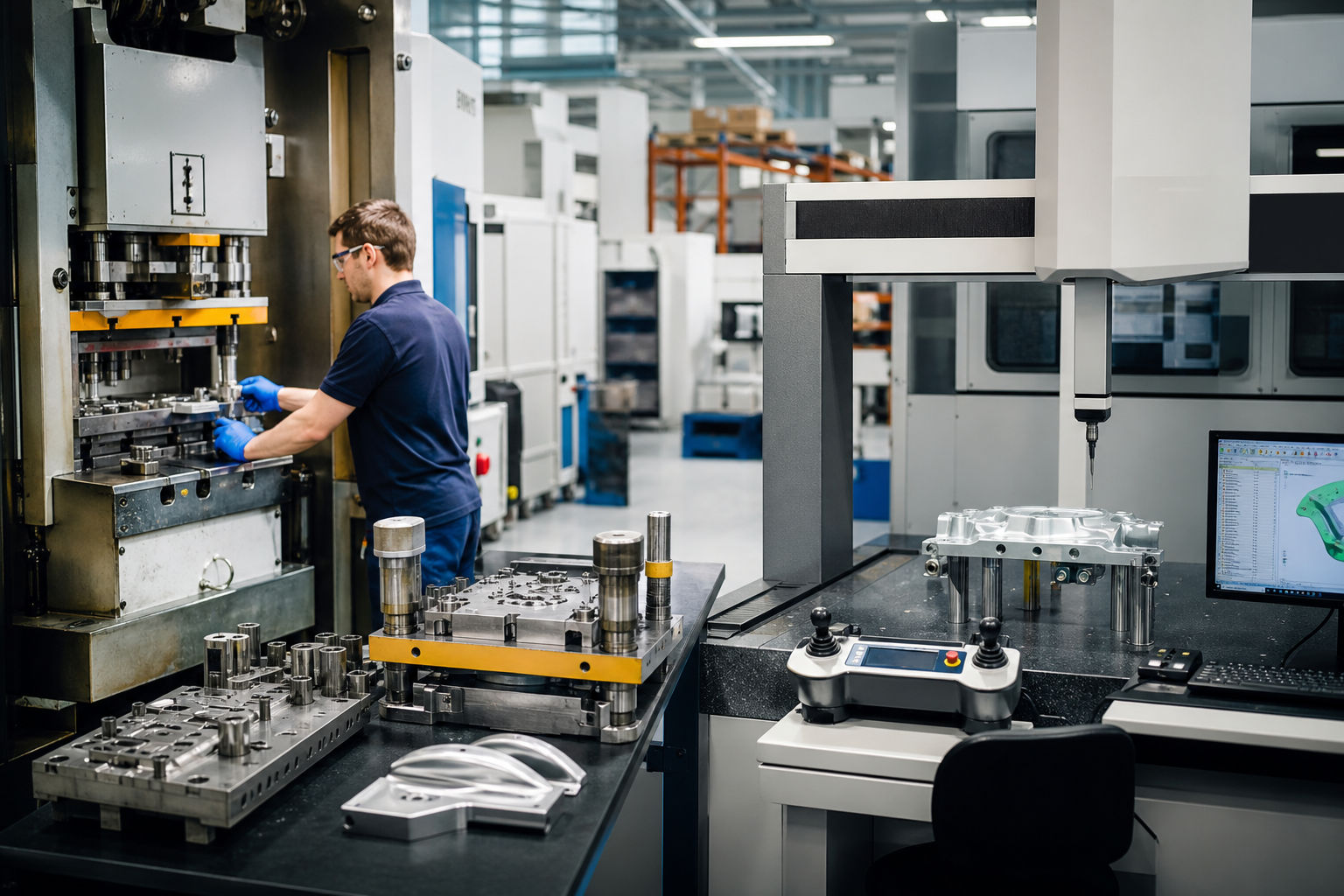
A full-service metal stamping manufacturer serving global OEM buyers — in-house tooling, progressive die stamping, deep draw, surface finishing, and sub-assembly.
Request a Quote →Who We Are
We are a China-based metal stamping company with over 15 years of experience supplying precision stamped components to OEMs and Tier 1 buyers in the United States, Europe, Japan, and Australia. Our integrated facility combines in-house progressive die design and manufacturing, a 42-press production floor, full-service finishing (plating, powder coat, anodizing), and sub-assembly capabilities under one roof.
We are ISO 9001:2015 certified and IATF 16949 capable, with quality systems built for consistent, auditable production — not just inspection. Every production order includes CMM-verified first articles, SPC monitoring, and full traceability from raw material to shipped part.
What We Do
Progressive Die Stamping
High-speed coil-fed stamping in multi-station progressive dies. Up to 600 SPM on our servo presses. Part weights from 1g to 2kg. Ideal for connectors, brackets, clips, terminals.
Deep Draw Stamping
Seamless cups, shells, enclosures from flat sheet. Draw depths up to 300mm. Materials: steel, stainless, aluminum, copper. No welding — one-piece structural integrity.
Transfer Die Stamping
Large and complex parts requiring multi-stage repositioning. Panel sizes up to 800×600mm. AHSS and dual-phase steel capable.
In-House Tooling
Our tooling team designs and builds progressive dies, compound dies, and transfer dies in-house. Lead time: 20–30 days production tooling; 7–10 days prototype soft tooling.
Surface Finishing
Zinc plating, nickel plating, powder coating, e-coat, anodizing, passivation. All in-house — no outsourcing delays.
Assembly & Kitting
Sub-assembly, spot welding, riveting, hardware insertion, and custom packaging. Ship ready-to-use assemblies directly to your production line.
Our Certifications
- ISO 9001:2015 — Quality Management System
- IATF 16949 capability (PPAP, FMEA, control plans)
- RoHS compliant materials and surface finishes
- REACH compliant substance management
Production Capabilities
| Parameter | Range |
|---|---|
| Press tonnage | 20T – 800T |
| Material thickness | 0.1mm – 12mm |
| Stamping speed | Up to 600 SPM |
| Standard tolerance | ±0.05mm |
| Precision tolerance | ±0.01mm |
| Annual capacity | 200M+ pieces |
| MOQ | 500 pcs (production); 1 pc (prototype) |
How We Work With Buyers
- RFQ submission — Send your CAD drawings (STEP, DXF, DWG) and annual volume forecast
- DFM review — Our engineers check for stampability, tolerance feasibility, and material selection within 24 hours
- Quotation — Itemized quote covering tooling cost, unit price at your target volume, and lead time
- Tooling approval — You review and approve die design before machining starts
- First article (FAI) — 100% dimensional inspection with CMM report; PPAP for automotive
- Production — SPC-monitored runs with in-line inspection at set intervals
- Delivery — DDP or FOB shipping with full quality documentation
Ready to Work With a Reliable Metal Stamping Company?
Send us your drawings and volume requirements. We’ll respond with a DFM review and quote within 24 hours.
Frequently Asked Questions About Our Company
Q: Where is your metal stamping factory located?
A: Our manufacturing facility is located in Huizhou, Guangdong, China — within the Pearl River Delta manufacturing hub. We have convenient access to Shenzhen and Hong Kong international ports, enabling efficient global shipping via sea and air freight.
Q: How many years of experience does your company have in metal stamping?
A: We were founded in 2004 and have over 20 years of experience in precision metal stamping. Our team has delivered thousands of stamped part programs for OEM and Tier 1 customers across automotive, electronics, medical, and industrial sectors worldwide.
Q: What industries do you serve?
A: We serve a broad range of industries including automotive (IATF 16949 capable), electronics/electrical, home appliances, aerospace, medical devices, battery/energy storage (EV & ESS), construction, telecommunications, and general industrial manufacturing. Each industry follows its specific quality and documentation requirements.
Q: Do you ship internationally? What are your shipping terms?
A: Yes, we ship worldwide. We offer flexible Incoterms including FOB Shenzhen/Hong Kong, CIF to destination port, and DDP (delivered duty paid) door-to-door to the US, EU, UK, Japan, Australia, and other major markets. Both air freight (5–10 days) and sea freight (20–35 days) options are available.
Q: How do you ensure consistent quality across production batches?
A: Quality is ensured through a multi-layer system: incoming material inspection with mill cert verification, in-process SPC monitoring at each press, CMM-verified first article inspection for every production run, hourly dimensional spot checks, final QC inspection before packaging, and full lot traceability from raw material to shipped parts.
Learn more about Metal Stamping vs Die Casting.
Learn more about Bending in Metal Stamping.
Learn more about Deep Drawn Parts Design.