
Fourslide vs progressive die stamping comes down to part geometry and production volume. Fourslide stamping excels at complex wire forms and flat parts requiring multiple bends from multiple angles, handling 3–6 bend axes in a single cycle. Progressive die stamping delivers higher output speeds—up to 300+ strokes per minute—for flat or shallow-drawn parts with tighter dimensional tolerances (±0.005 mm typical). The right choice depends on your part geometry, required volume, tolerance range, and budget.
This comparison breaks down how each process works, when to use each one, and how costs compare at various production volumes.
What Is Fourslide Stamping?
Fourslide stamping (also called four-slide or multi-slide stamping) uses four horizontal slides mounted at 90° intervals around a central die. Each slide carries a forming tool that strikes the workpiece from a different angle. The machine feeds wire or strip stock from a coil, cuts a blank, then forms the part through sequential hits from each slide.
How the Fourslide Mechanism Works
A fourslide machine operates in four stages:
- Feed — Wire or strip stock advances into the machine from a coil.
- Cutoff — A shear cuts the blank to the required length.
- Transfer — A transfer finger moves the blank into the forming zone.
- Form — Four slides strike sequentially or simultaneously, bending the part from multiple directions in one press cycle.
The slides can move in different sequences, enabling compound bends, loops, offsets, and twisted features that would require multiple secondary operations on a progressive die stamping press.
Fourslide Specifications
- Wire diameter range: 0.3 mm – 8.0 mm
- Strip width range: 6 mm – 80 mm
- Strip thickness: 0.2 mm – 3.0 mm
- Strokes per minute (SPM): 80 – 400
- Bend axes: 4 (expandable to 6+ with attachments)
- Tolerance: ±0.1 mm typical (forming dependent)
- Materials: Spring steel, stainless steel, copper, brass, aluminum, titanium
Fourslide machines handle small to medium part sizes and excel when the geometry demands bends in multiple planes—clips, contacts, springs, brackets, and wire forms.
What Is Progressive Die Stamping?
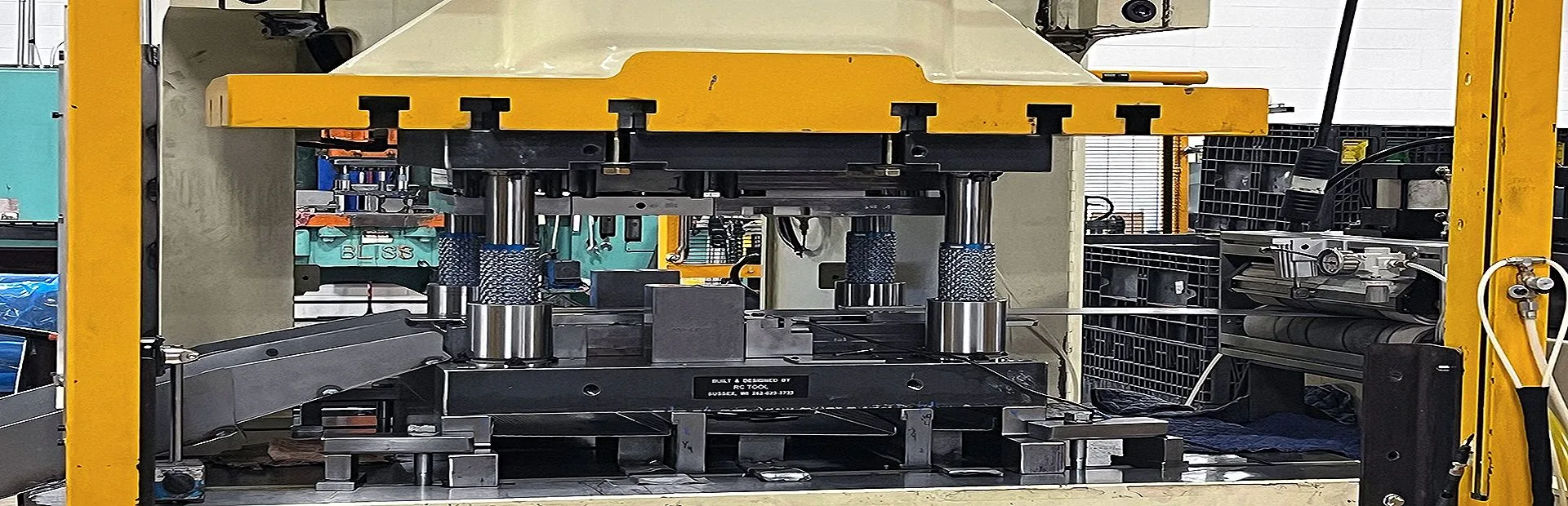
Progressive die stamping uses a series of stations arranged in a single die set, mounted on a mechanical or servo press. The strip stock feeds through each station in sequence. Each station performs one operation—cutting, bending, drawing, coining, or piercing—before the strip advances to the next station.
How Progressive Die Stamping Works
A progressive die operates in a linear sequence:
- Strip feed — Metal strip advances through pilot holes.
- Station-by-station processing — Each station performs one operation (blank, pierce, form, draw, coin).
- Final cutoff — The finished part separates from the carrier strip at the last station.
Every stroke of the press produces one finished part. The cycle repeats continuously, making progressive die stamping the standard for high-volume flat and shallow-formed parts.
Progressive Die Specifications
- Strip thickness range: 0.1 mm – 6.0 mm
- Strip width range: 10 mm – 500 mm
- Strokes per minute (SPM): 50 – 1,500
- Station count: 2 – 30+ stations per die
- Tolerance: ±0.005 mm achievable (die-ground features)
- Materials: Steel, stainless steel, aluminum, copper alloys, titanium
Progressive die stamping handles parts from metal stamping parts such as electrical connectors, brackets, terminal pins, EMI shields, and deep-drawn housings.
Fourslide vs Progressive Die: Key Differences
The table below highlights the core technical differences between fourslide and progressive die stamping:
| Factor | Fourslide Stamping | Progressive Die Stamping |
|---|---|---|
| Forming method | 4 slides from multiple angles | Linear station sequence on one axis |
| Bend directions | Up to 6 axes per cycle | Primarily vertical (up/down) |
| Stock type | Wire or flat strip | Flat strip only |
| Typical SPM | 80 – 400 | 50 – 1,500 |
| Dimensional tolerance | ±0.1 mm | ±0.005 mm |
| Part complexity | High for multi-bend wire forms | High for multi-feature flat/drawn parts |
| Minimum part size | ~3 mm wire length | ~2 mm strip feature |
| Maximum part size | ~150 mm length | 500+ mm strip width |
| Tooling lifespan | 50M–100M strokes | 50M–500M strokes |
| Secondary operations | Usually none required | Often needed for complex bends |
Cost Comparison: Fourslide vs Progressive Die Stamping
Tooling cost is the main differentiator at low volumes. At high volumes, per-part cost favors whichever method runs at higher SPM for the specific geometry.
| Cost Element | Fourslide Stamping | Progressive Die Stamping |
|---|---|---|
| Tooling cost (single cavity) | $3,000 – $15,000 | $10,000 – $80,000+ |
| Tooling lead time | 2 – 4 weeks | 4 – 12 weeks |
| Per-part cost at 10K units | $0.03 – $0.15 | $0.05 – $0.30 |
| Per-part cost at 1M units | $0.005 – $0.08 | $0.002 – $0.05 |
| Die maintenance cost/year | $500 – $2,000 | $1,000 – $8,000 |
| Scrap rate | 1% – 3% | 3% – 8% (carrier strip waste) |
Fourslide tooling costs 50–80% less than progressive die tooling for comparable part complexity. At volumes above 500,000 parts, progressive die per-part cost often drops below fourslide rates due to higher SPM and longer tooling life.
When to Choose Fourslide Stamping
Fourslide stamping is the better choice when the part has:
- Multiple bends in different planes — Clips, springs, and wire forms that bend at 90° and 180° in different directions.
- Low to medium volume — 10,000 to 500,000 parts per year where tooling budget matters.
- Wire-based geometry — Round wire, square wire, or flat wire parts that progressive dies cannot form.
- No secondary operations desired — Fourslide completes all bends in one cycle, eliminating deburring, forming, and assembly steps.
- Tight timeline — Tooling lead time is 2–4 weeks vs 4–12 weeks for progressive dies.
Typical fourslide parts: electrical contacts, battery springs, automotive clips, medical wire forms, furniture hardware, antenna elements, and custom metal stamping brackets.
When to Choose Progressive Die Stamping
Progressive die stamping is the better choice when the part has:
- Tight dimensional tolerances — ±0.005 mm features such as precision holes, slots, and edges.
- High volume requirements — 500,000 to 10,000,000+ parts per year where SPM and tooling longevity drive economics.
- Flat or shallow-drawn features — Parts that are primarily flat with pierced, coined, or shallow-formed details.
- Mixed operations — Parts that combine piercing, forming, drawing, and coining in sequence.
- Large part envelope — Strip widths up to 500 mm with complex multi-station features.
Typical progressive die parts: EMI shields, connector pins, lead frames, automotive brackets, motor laminations, heat sinks, and deep-drawn enclosures.
Quick Decision Guide: Fourslide vs Progressive Die Stamping
Use this table to match your part requirements to the right process:
| Your Requirement | Best Choice | Why |
|---|---|---|
| Multi-plane wire bends | Fourslide | 4+ bend axes per cycle, no secondary ops |
| Tolerance under ±0.01 mm | Progressive die | Die-ground features deliver ±0.005 mm |
| Volume under 100K/year | Fourslide | 50–80% lower tooling cost |
| Volume over 1M/year | Progressive die | Higher SPM and longer tooling life |
| Wire stock (round/square) | Fourslide | Progressive dies cannot feed wire |
| Deep draw or shallow draw | Progressive die | Dedicated draw stations in sequence |
| Need parts in under 4 weeks | Fourslide | 2–4 week tooling lead time |
| Part over 150 mm length | Progressive die | Wider strip capacity, larger die stations |
Frequently Asked Questions
What is the main difference between fourslide and progressive die stamping?
Fourslide stamping forms parts using four slides that strike from multiple angles, enabling complex multi-plane bends in a single cycle. Progressive die stamping processes strip stock through a linear series of stations, each performing one operation. The main difference is forming direction: fourslide handles multi-axis bends, while progressive dies handle vertical operations in sequence.
Which process is cheaper for low-volume production?
Fourslide stamping is cheaper for low-volume production. Tooling costs $3,000–$15,000 compared to $10,000–$80,000+ for progressive dies. At volumes under 100,000 parts per year, fourslide typically costs 50–80% less in tooling and delivers competitive per-part pricing.
Can fourslide stamping handle high-volume production?
Yes. Fourslide machines run at 80–400 SPM and support high-volume runs of 500,000+ parts per year. However, progressive die stamping reaches 1,500 SPM and offers longer tooling life (up to 500 million strokes), making it more cost-effective above 1 million parts per year.
What tolerances can fourslide and progressive die stamping achieve?
Fourslide stamping achieves ±0.1 mm typical tolerances on formed features. Progressive die stamping achieves ±0.005 mm on die-ground features such as holes, slots, and edges. Parts requiring sub-0.01 mm tolerances should use progressive die stamping.
Can fourslide stamping replace progressive die stamping?
Fourslide stamping can replace progressive die stamping when the part is a wire form or flat blank with multiple bends in different planes. It cannot replace progressive die stamping for deep-drawn parts, precision-pierced flat parts, or features requiring sub-0.01 mm tolerances.
What parts are best suited for fourslide stamping?
Fourslide stamping is best for clips, springs, contacts, wire forms, antenna elements, and brackets that require bends in multiple directions. Typical industries include automotive (clips, fasteners), electronics (battery contacts, springs), medical (wire forms), and consumer hardware.
Need help deciding between fourslide and progressive die stamping for your project? Contact our engineering team for a free DFM review and cost comparison.