The surface finish you specify on a stamped metal part affects its corrosion resistance, electrical conductivity, appearance, and total cost — often by 15–40% of the part price. Choosing the wrong finish means premature field failure, paint adhesion problems, or unnecessary expense. At Metal Stamping Parts, surface finish selection is one of the first questions our engineering team raises during DFM review, because it influences die design, material selection, and secondary operation planning from day one.
This guide covers every major surface finish option for stamped metal components — electroplating, conversion coatings, organic coatings, mechanical treatments, and anodizing — with specifications, cost ranges, and selection criteria to help engineers and buyers make the right choice.
Surface finish refers to any secondary treatment applied to a stamped part after forming to modify its surface properties — including corrosion protection, wear resistance, electrical conductivity, solderability, or visual appearance.
Why Surface Finish Matters for Stamped Parts
Stamped parts rarely stay in their as-formed condition. The stamping process leaves shear burrs, die marks, lubricant residue, and micro-scratches that affect both function and aesthetics. A properly specified surface finish serves three purposes:
- Functional protection — corrosion resistance, wear resistance, and electrical performance. A zinc-plated steel bracket lasts 5–10× longer in outdoor environments than an unplated one.
- Aesthetic quality — consumer-facing products (appliance panels, automotive trim, electronics housings) require consistent color, gloss, and texture.
- Assembly compatibility — some finishes improve solderability (tin plating), reduce friction (PTFE coating), or prevent galling (electropolishing stainless steel).
The cost impact is significant. A simple zinc plating adds $0.02–0.08 per part, while hard chrome plating can add $0.50–2.00. Specifying the right finish — not over-specifying — is essential for cost control.
Electroplating Options for Stamped Metal
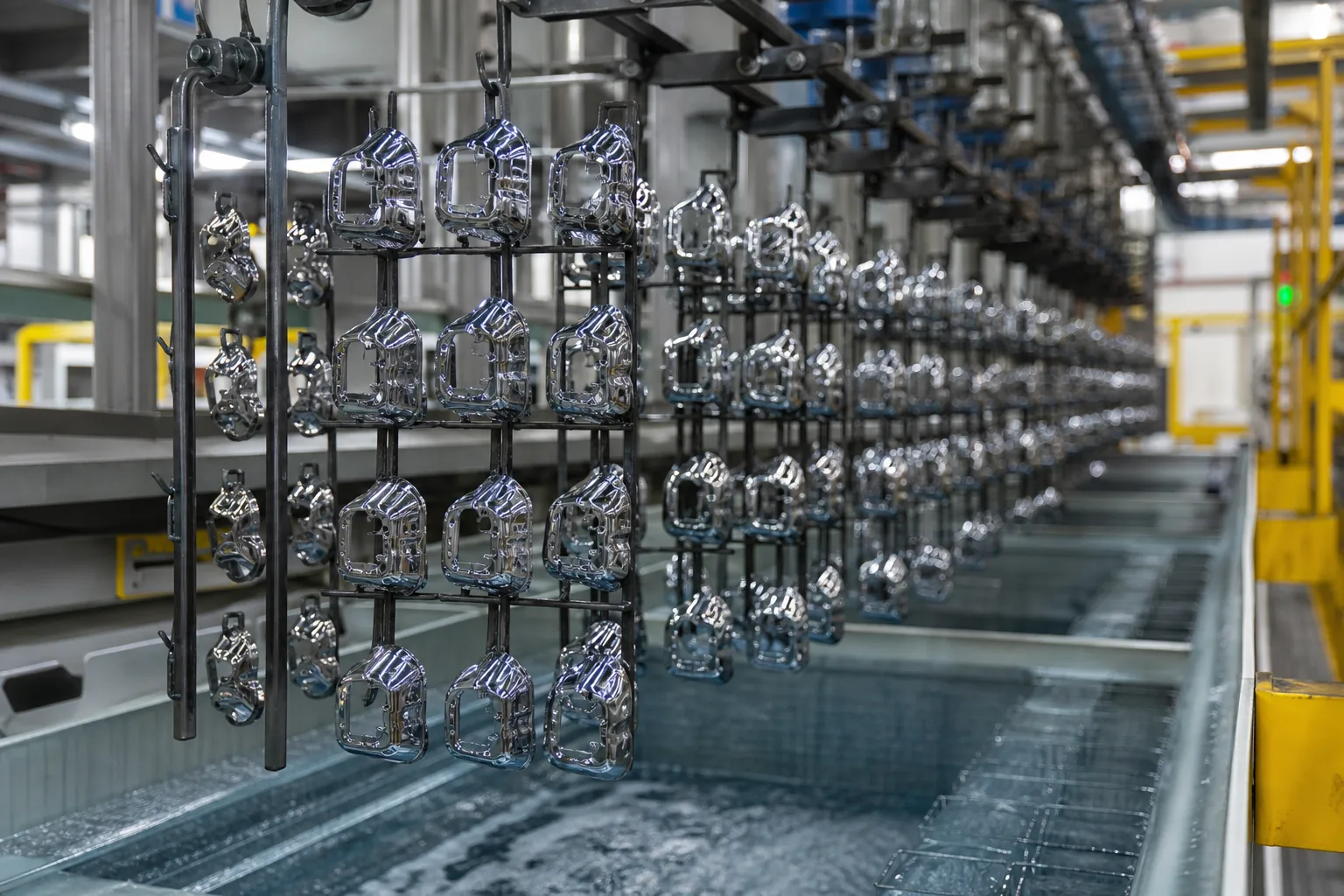
Electroplating deposits a thin metal layer onto the part surface using an electric current in an electrolyte bath. It is the most common surface treatment for stamped parts, offering excellent thickness control and uniform coverage even on complex geometries.
Zinc Plating (Galvanizing)
Zinc plating is the workhorse finish for carbon and low-alloy steel stamped parts. It provides sacrificial corrosion protection — the zinc corrodes preferentially, protecting the base steel even when the coating is scratched.
- Thickness: 5–25 µm (ASTM B633, Fe/Zn 5 to Fe/Zn 25)
- Salt spray resistance: 96–500 hours to white rust depending on chromate conversion topcoat
- Cost: $0.02–0.08 per small part (brackets, clips, terminals)
- Best for: automotive brackets, hardware, fasteners, electrical enclosures
- Limitations: not suitable for high-temperature applications (>150°C); hydrogen embrittlement risk on high-strength steel (>1000 MPa UTS)
Nickel Plating
Electrodeposited nickel provides a harder, more wear-resistant coating than zinc. It is widely used for decorative and functional applications where a bright, corrosion-resistant finish is required.
- Thickness: 5–50 µm (ASTM B689)
- Hardness: 150–600 HV depending on bath chemistry
- Cost: $0.05–0.25 per small part
- Best for: appliance trim, hardware, food-contact surfaces, underlayer for chrome
- Limitations: magnetic (problematic for some sensor applications); nickel allergy concern for skin-contact parts
Tin Plating
Tin plating is the standard finish for electrical terminals and solderable contacts. It provides excellent solderability, low contact resistance, and good corrosion protection in mild environments.
- Thickness: 2.5–10 µm (ASTM B545)
- Contact resistance: 10–50 mΩ
- Cost: $0.03–0.12 per terminal
- Best for: electrical connectors, fuse box terminals, PCB contacts, lead-free soldering
- Limitations: tin whisker growth risk on bright tin; matte tin preferred for reliability applications
Chrome Plating
Hard chrome provides extreme hardness (65–70 HRC) and wear resistance. Decorative chrome (typically over nickel) provides a bright, reflective finish for visible consumer products.
- Thickness: 0.2–0.5 µm (decorative) or 20–500 µm (hard chrome)
- Cost: $0.50–5.00 per part depending on area and thickness
- Best for: high-wear surfaces, premium appliance trim, hydraulic components
- Limitations: expensive; hexavalent chromium faces RoHS/REACH restrictions; trivalent chrome alternatives available
Gold Plating
Gold plating is reserved for premium electrical contacts where zero-failure contact reliability is required over 15+ year service life — automotive airbag connectors, aerospace avionics, and medical device contacts.
- Thickness: 0.5–5 µm hard gold (ASTM B488)
- Contact resistance: <5 mΩ, stable over lifetime
- Cost: $0.10–1.00+ per contact depending on gold thickness
- Best for: safety-critical electrical connectors, aerospace contacts, medical device terminals
Conversion Coatings
Conversion coatings modify the existing metal surface through a chemical reaction rather than depositing a new metal layer. They are thinner, lower-cost, and often serve as a base for paint or powder coating.
Chromate Conversion (Alodine / Chem Film)
Chromate conversion coating (also called chemical film, Alodine, or iridite) creates a thin chromium-based protective layer on aluminum, zinc, and cadmium surfaces. It provides moderate corrosion protection while maintaining electrical conductivity.
- Thickness: 0.5–3 µm
- Standard: MIL-DTL-5541 Type I (hexavalent) and Type II (trivalent, RoHS-compliant)
- Salt spray: 336–1000 hours depending on class
- Cost: $0.01–0.05 per small part
- Best for: aluminum enclosures, EMI shielding, grounding surfaces, paint base
Phosphate Coating
Phosphate conversion creates a crystalline zinc, iron, or manganese phosphate layer that absorbs paint and lubricants. It is widely used as a paint base and as a break-in coating for moving parts.
- Thickness: 5–25 µm
- Standard: ASTM D2092 (zinc phosphate), MIL-DTL-16232 (manganese phosphate)
- Cost: $0.01–0.04 per part
- Best for: paint base coat, fastener lubrication, anti-galling on steel parts
Black Oxide
Black oxide (hot black oxide for steel, room-temperature black oxide for copper) creates a thin magnetite (Fe₃O₄) layer that provides a uniform black appearance with mild corrosion protection when waxed or oiled.
- Thickness: 0.5–1.5 µm (dimensionally neutral)
- Standard: MIL-DTL-13924 Class 1 (hot alkaline)
- Cost: $0.01–0.03 per part
- Best for: tools, weapons, decorative hardware, light-absorbing enclosures
- Limitations: minimal standalone corrosion protection; requires supplementary wax or oil
Organic Coatings
Organic coatings — powder, e-coat, and wet paint — provide thicker barrier layers with excellent corrosion protection and virtually unlimited color options.
Powder Coating
Powder coating is an electrostatically applied dry powder (typically polyester, epoxy, or hybrid) that is cured at 180–200°C to form a tough, uniform finish 60–120 µm thick.
Powder coating is the most popular organic finish for stamped steel and aluminum parts. It offers excellent corrosion resistance (1000+ hours salt spray), impact resistance, and color consistency at a lower cost than wet painting for most applications.
- Thickness: 60–120 µm
- Salt spray: 500–3000 hours depending on pretreatment and powder type
- Cost: $0.05–0.30 per small part; $0.50–2.00 for large panels
- Colors: RAL/Pantone matched, textured, matte, gloss, metallic
- Best for: appliance panels, outdoor enclosures, automotive brackets, furniture hardware
- Limitations: minimum bend radius — coating can crack at tight bends if applied after forming
E-Coating (Electrophoretic Coating)
E-coating (electrodeposition coating) immerses the part in a paint bath and uses electric current to deposit a uniform organic coating. It excels at coating complex shapes, internal cavities, and recessed areas that spray methods miss.
- Thickness: 15–35 µm
- Salt spray: 500–1500 hours
- Cost: $0.03–0.15 per part
- Best for: automotive body panels, complex assemblies, parts with hidden surfaces
- Limitations: limited color range (mostly black, gray); requires large bath volume — not practical for small batches
Painting / Wet Spray
Wet spray painting offers the widest color and finish options including metallic, pearlescent, and specialty textures. It is the standard for automotive exterior panels and premium consumer products where specific color matching is critical.
- Thickness: 25–75 µm (primer + topcoat)
- Cost: $0.10–1.00+ per part depending on complexity and color
- Best for: automotive exterior, premium appliances, custom color matching
- Limitations: higher VOC emissions; overspray waste (60–70% transfer efficiency vs 95%+ for powder)
Mechanical Surface Treatments
Mechanical treatments modify the part surface through physical force rather than chemical or electrochemical processes. They are often used as pre-treatment steps before plating or coating.
Polishing and Electropolishing
Mechanical polishing uses abrasive belts or wheels to achieve a specified surface roughness (Ra value). Electropolishing removes material electrochemically, producing an ultra-smooth, passive surface ideal for stainless steel medical and food-contact parts.
- Mechanical polish: Ra 0.2–0.8 µm; cost $0.05–0.30/part
- Electropolish: Ra 0.05–0.4 µm; cost $0.15–1.00/part
- Best for: medical devices (ISO 13485), food processing equipment, semiconductor components
- Key benefit: electropolishing removes micro-cracks and embedded contaminants, improving corrosion resistance by 20–30× over mechanical polish alone
Shot Peening and Blasting
Shot peening bombards the surface with small spherical media (steel, glass, or ceramic beads) to induce compressive residual stress. This dramatically improves fatigue life — critical for springs, clips, and structural brackets subject to cyclic loading.
- Fatigue life improvement: 30–100% increase in cycle life
- Standard: SAE J442 (Almen strip verification), SAE AMS 2430
- Cost: $0.02–0.15 per part
- Best for: springs, clips, brackets under cyclic stress, automotive safety components
Tumbling and Vibratory Finishing
Mass tumbling (rotary or vibratory) deburrs and finishes large batches of small stamped parts simultaneously. Media ranges from aggressive ceramic (for heavy deburring) to gentle walnut shell (for final polishing).
- Batch size: 100–10,000+ parts per load
- Cost: $0.005–0.05 per part (economies of scale)
- Best for: high-volume small parts (connectors, washers, clips), edge rounding, pre-plate preparation
Anodizing for Stamped Aluminum Parts
Anodizing is an electrochemical process that converts the aluminum surface into a hard, porous aluminum oxide (Al₂O₃) layer 5–150 µm thick, providing excellent corrosion resistance, wear resistance, and dye capability.
Anodizing is the standard surface finish for aluminum stamped parts. The oxide layer is integral to the base metal (not a coating), so it cannot chip or peel. Type II (sulfuric acid) anodizing is most common; Type III (hard anodizing) produces thicker, harder layers for wear applications.
- Type II: 5–25 µm, 200–400 HV hardness; cost $0.05–0.25/part
- Type III (hard): 25–150 µm, 400–600 HV; cost $0.15–1.00/part
- Standard: MIL-A-8625 Type II / Type III; ASTM B580
- Salt spray: 336–1000+ hours (Type II sealed)
- Colors: natural (clear), black, red, blue, gold, custom dye
- Best for: electronics enclosures, aerospace brackets, consumer product housings, heat sinks
- Limitations: only works on aluminum and titanium alloys; not suitable for dissimilar-metal assemblies without masking
How to Choose the Right Surface Finish
Selecting a surface finish depends on four factors: environment, function, material, and budget. The table below compares the most common options:
| Finish | Material | Corrosion Protection | Hardness | Cost/Part | Lead Time |
|---|---|---|---|---|---|
| Zinc plating | Steel | Good (96–500h salt spray) | Moderate | $0.02–0.08 | 2–3 days |
| Nickel plating | Steel, copper | Very good | 150–600 HV | $0.05–0.25 | 3–5 days |
| Tin plating | Copper, steel | Moderate | Low | $0.03–0.12 | 2–3 days |
| Powder coating | Steel, aluminum | Excellent (1000+h) | Moderate | $0.05–0.30 | 3–5 days |
| E-coating | Steel | Very good (500–1500h) | Moderate | $0.03–0.15 | 3–5 days |
| Anodizing Type II | Aluminum | Excellent (336–1000h) | 200–400 HV | $0.05–0.25 | 3–5 days |
| Hard anodizing | Aluminum | Outstanding | 400–600 HV | $0.15–1.00 | 5–7 days |
| Black oxide | Steel | Minimal (with oil) | Neutral | $0.01–0.03 | 1–2 days |
| Chromate (Alodine) | Aluminum, zinc | Moderate | Low | $0.01–0.05 | 1–2 days |
Selection Decision Framework
Use this quick decision tree for common stamped part applications:
- Steel bracket, outdoor use → zinc plating + chromate or powder coating
- Aluminum enclosure, electronics → anodizing (Type II) or chromate conversion
- Copper/brass electrical terminal → tin plating or gold plating for high-reliability
- Steel part, cosmetic appearance → powder coating (color-matched)
- Stainless steel, medical/food → electropolishing
- High-cycle spring or clip → shot peening + zinc plating
- Cost-sensitive, indoor use → black oxide or zinc plate (thin)
Surface Finish Specifications and Standards
Always reference applicable standards when specifying surface finishes on engineering drawings. The most commonly used standards for stamped parts include:
| Standard | Scope | Key Parameters |
|---|---|---|
| ASTM B633 | Zinc electrodeposited on steel | Fe/Zn class (5–25 µm), chromate type |
| ASTM B689 | Electroplated nickel | Thickness class, undercoat requirements |
| ASTM B545 | Tin electrodeposited coatings | Thickness, solderability class |
| MIL-A-8625 | Anodizing on aluminum | Type II / III, class (sealed/unsealed) |
| MIL-DTL-5541 | Chromate conversion | Type I (Cr6) / Type II (Cr3), class 1A/3 |
| ASTM D2092 | Phosphate coating | Weight per area, crystal size |
| ISO 4042 | Electroplated fasteners | Thickness, salt spray hours |
| ASTM A967 | Stainless steel passivation | Citric / nitric acid methods, copper sulfate test |
When writing callouts on drawings, follow the standard format. For example: ASTM B633 Fe/Zn 8, SC2 (clear chromate) specifies zinc plating 8 µm thick with a supplementary chromate treatment for moderate corrosion protection.
Cost Comparison of Surface Finishes
Surface finish cost depends on part size, batch volume, and process complexity. Below is a cost comparison based on typical high-volume stamped parts (10,000+ pieces):
- Lowest cost ($0.01–0.05/part): black oxide, phosphate, chromate conversion — minimal material and energy
- Medium cost ($0.03–0.15/part): zinc plating, tin plating, e-coating — standard electrochemical processes
- Higher cost ($0.10–0.50/part): nickel plating, powder coating, anodizing — thicker coatings, longer cycle times
- Premium cost ($0.50–5.00+/part): hard chrome, gold plating, electropolishing — precious metals or complex processes
Cost-saving tip: At Metal Stamping Parts, we often recommend combining finishes — for example, zinc plating + chromate conversion provides 80% of the corrosion protection of powder coating at 30% of the cost. Discuss your application requirements with our engineering team during the DFM phase to identify the most cost-effective finish.
Frequently Asked Questions
What is the most common surface finish for steel stamped parts?
Zinc electroplating with chromate conversion is the most widely specified finish for carbon steel stamped parts. It provides sacrificial corrosion protection (96–500 hours salt spray depending on chromate type), costs $0.02–0.08 per small part, and has a 2–3 day processing lead time. ASTM B633 Fe/Zn 8 with clear or yellow chromate covers the majority of industrial and automotive bracket applications.
How does powder coating compare to e-coating for stamped parts?
Powder coating offers thicker protection (60–120 µm vs 15–35 µm), unlimited color options, and better UV resistance, making it ideal for visible exterior parts. E-coating provides superior coverage of complex shapes and internal cavities at lower cost per part, making it preferred for automotive body components. For parts with hidden surfaces or tight tolerances, e-coating’s thinner film and uniform deposition often make it the better choice.
Can I anodize steel stamped parts?
No. Anodizing only works on aluminum, titanium, and magnesium alloys. For steel parts requiring similar corrosion resistance and hardness, consider zinc-nickel alloy plating (ASTM B841) or zinc flake coatings (Dacromet/Geomet). These provide comparable protection to anodized aluminum in steel-compatible processes.
What surface finish is best for electrical connectors?
Tin plating (2.5–5.0 µm matte tin over 1.0–2.0 µm nickel) is the standard for most commercial electrical connectors, providing solderability and 10–15 mΩ contact resistance. For automotive safety systems (airbag, ADAS) requiring zero-failure reliability over 15 years, specify gold-over-nickel (0.5–1.25 µm hard gold per ASTM B488). Phosphor bronze or beryllium copper base material with tin plating covers 90% of connector applications.
How do I prevent hydrogen embrittlement during plating?
High-strength steel parts (UTS >1000 MPa, hardness >40 HRC) are susceptible to hydrogen embrittlement during acid pickling and electroplating. Prevention measures include: (1) baking at 190–210°C for 4–23 hours within 1 hour of plating (per ASTM B850), (2) using alkaline zinc baths instead of acid zinc, (3) specifying mechanical cleaning instead of acid pickling when possible, and (4) limiting plating thickness. Always inform your plating supplier of the substrate hardness.
What is the typical lead time for surface finishing stamped parts?
Simple conversion coatings (black oxide, chromate, phosphate) require 1–2 days. Electroplating (zinc, tin, nickel) typically takes 2–5 days. Powder coating and anodizing require 3–7 days including cure time. Complex multi-layer finishes (decorative chrome over nickel over copper) can take 7–10 days. At Metal Stamping Parts, we coordinate finishing schedules with production to avoid adding lead time to your delivery.
Conclusion
Surface finish selection is a critical engineering decision that affects performance, appearance, and cost. The right finish protects your stamped parts in their operating environment while keeping per-part costs within budget. Over-specifying wastes money; under-specifying leads to field failures.
At Metal Stamping Parts, our engineering team reviews surface finish requirements during every DFM evaluation. We coordinate with qualified plating and coating suppliers to deliver finished parts — not just bare stampings — so you receive components ready for assembly.
Need help selecting the right surface finish for your stamped parts? Request a free quote or learn more about our custom metal stamping services.