
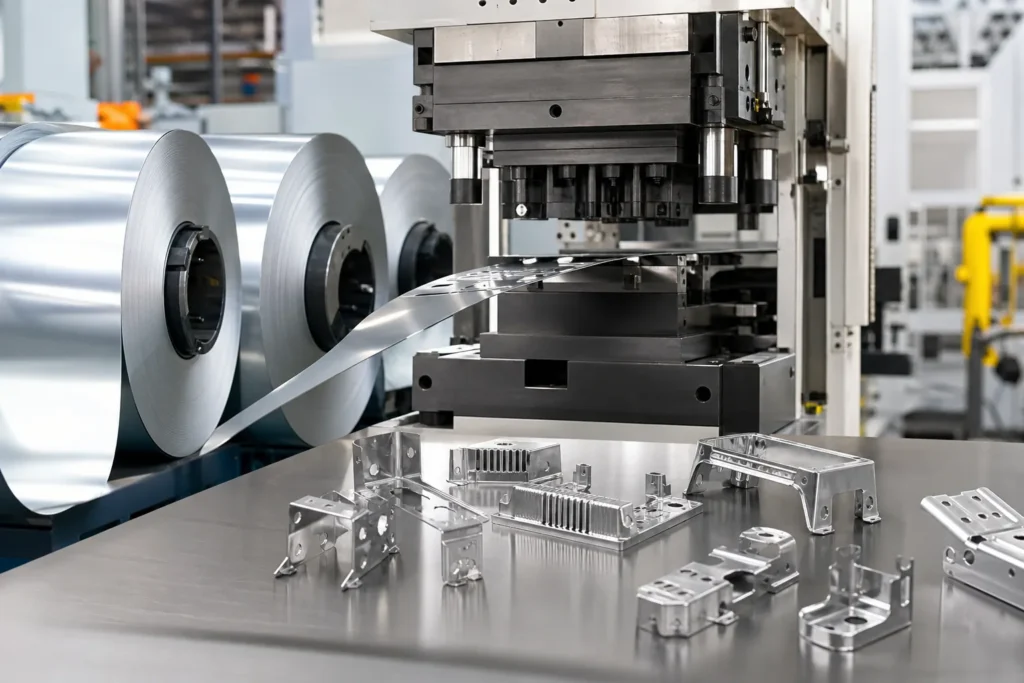
Short answer: A good stainless steel tëggin parts defarkat should understand stainless grades, springback, burr control, tool wear, surface protection, passivation or plating requirements, and inspection needs. The right joxekat should review drawings for manufacturability, explain tolerance risks, protect cosmetic surfaces when needed, and quote tooling and production based on material grade, thickness, volume, and finish.
Stainless steel pièces yu ñu tëgg are common in medical devices, appliances, electronics, oto hardware, food equipment, energy products, and industrial assemblies. They are chosen for corrosion resistance, strength, appearance, and cleanliness, but they also require careful tooling and forming review.
If you need a quote, send drawings through the RFQ form. Include grade, thickness, tolerance, annual volume, finish, and inspection requirements.
What to look for in a stainless steel tëggin defarkat
| Màndarga | Why it matters | What to ask |
|---|---|---|
| Material knowledge | 304, 316, 301, 430, and other grades behave differently during forming. | Can you review grade, temper, and thickness before tooling? |
| Tooling control | Stainless can increase tool wear and springback compared with mild steel. | How will bend angles, burrs, and wear areas be controlled? |
| Surface handling | Cosmetic or clean surfaces may need film, tray packing, or scratch control. | How are visible surfaces protected during tëggin and packing? |
| Finishing support | Passivation, polishing, deburring, cleaning, and plating may affect final use. | Which finish and cleaning options are available? |
| Baaxaay documentation | Stainless parts often need material traceability and dimensional checks. | Can you provide material certificate, FAI, and dimensional report? |
Common stainless steel grades for pièces yu ñu tëgg
The grade should be selected based on corrosion resistance, forming behavior, strength, appearance, and cost. If the drawing only says “stainless steel”, the joxekat may need clarification before quoting.
- 304 stainless steel: Common general-purpose stainless grade with good corrosion resistance and formability.
- 316 stainless steel: Used when corrosion resistance is more demanding, especially in harsh or chloride environments.
- 301 stainless steel: Often used where spring properties or higher strength are needed after work hardening.
- 430 stainless steel: Ferritic stainless used in some appliance, decorative, and cost-sensitive applications.
- Custom or customer-specified grades: Should be quoted against the exact standard, thickness, and temper.
Related service page: stainless steel tëggin metal ci matris.
Design factors that affect manufacturability
Stainless steel can be harder on tooling than low-carbon steel. Springback, galling, burr formation, and surface marking should be reviewed before production tooling is built.
- Minimum bend radius relative to thickness and grade.
- Hole-to-edge and hole-to-bend distance.
- Critical bend angle or bend height requirements.
- Flatness and distortion after forming.
- Burr direction and maximum burr height.
- Cosmetic side and surface protection requirement.
- Welding, riveting, tapping, or assembly after tëggin.
A DFM review can often identify a small design change that lowers forming risk. For a broader checklist, see the tëggin metal ci matris RFQ checklist.
Tooling considerations for stainless steel parts
Tooling choices depend on part complexity and volume. A simple bracket may use single-stage tooling or short-run tooling. A high-volume terminal, clip, or shield may justify matris bu dox ndànk tëggin. Stainless material may require careful clearance, punch material selection, lubrication, and maintenance planning.
Ask the joxekat how they will handle:
- Tool wear in high-volume production.
- Springback control for formed features.
- Surface scratches and handling marks.
- Burr control and edge direction.
- Sample approval and first article inspection.
- Maintenance of punches, inserts, and forming stations.
For tooling cost planning, see metal jumtukaayi matris cost guide and jumtukaayi matris defarkat.
Finish, cleaning, and passivation
Stainless parts are often chosen because the surface matters. The RFQ should state whether the part needs raw finish, deburring, brushing, polishing, passivation, ultrasonic cleaning, protective film, or special packaging.
Surface requirements should be linked to the actual use. A hidden bracket may only need burr control and corrosion resistance. A visible appliance trim part may require cosmetic handling. A medical or food-equipment component may require cleaning and material documentation.
Typical stainless steel pièces yu ñu tëgg
Stainless steel tëggin is used for parts where corrosion resistance, clean appearance, or stable strength is more important than the lowest raw material cost. The same defarkat may quote different tooling routes depending on whether the part is a simple bracket, a cosmetic trim, or a precision jokkoo component.
- Mounting brackets, clips, clamps, and retainers.
- Appliance panels, trim pieces, covers, and structural supports.
- Medical device plates, shields, housings, and small formed components.
- Electronics shields, springs, contacts, and connector parts.
- Food equipment hardware, small frames, and corrosion-resistant covers.
- oto and industrial hardware exposed to moisture or cleaning chemicals.
When sending an RFQ, explain the working environment and whether the surface is visible after assembly. That information helps the joxekat choose the right material condition, handling method, finishing route, and inspection plan.
Baaxaay checks for stainless pièces yu ñu tëgg
The inspection plan should match the functional risk. Common checks include material certificate, thickness verification, dimensional sampling, bend angle checks, flatness checks, burr inspection, surface inspection, and first article report.
For critical parts, ask whether the joxekat can support:
- FAI report with key dimensions.
- CMM or fixture inspection for formed geometry.
- Lot traceability and material certificate.
- Surface inspection standard.
- Packaging inspection for scratch-sensitive parts.
- PPAP-like documents when required by the customer program.
RFQ checklist for stainless steel tëggin parts
Yonnee these details for a faster and more accurate quote:
- 2D drawing and 3D STEP file.
- Stainless grade, thickness, temper, and surface condition.
- Critical dimensions, tolerances, burr direction, and cosmetic side.
- Prototype quantity, first order quantity, annual volume, and project life.
- Finish, passivation, deburring, cleaning, or packaging requirement.
- Inspection documents and material certificate needs.
- Target sample date and production schedule.
FAQ
Which stainless steel grade is best for tëggin?
There is no single best grade. 304 is common for general corrosion resistance, 316 is used for harsher environments, 301 can be useful for spring properties, and 430 may fit some appliance or decorative uses. The right choice depends on function and forming risk.
Is stainless steel harder to stamp than carbon steel?
Often yes. Stainless can have higher work hardening, more springback, and greater tool wear. The exact difficulty depends on grade, thickness, temper, part geometry, and production volume.
What causes scratches on stainless pièces yu ñu tëgg?
Scratches can come from coil handling, die jokkoo, part ejection, secondary processing, bulk packaging, or transport. Cosmetic surfaces should be identified in the drawing or RFQ.
Do stainless steel pièces yu ñu tëgg need passivation?
Some applications require passivation to improve corrosion resistance after fabrication. It depends on the grade, process, customer standard, and working environment.
Can stainless steel parts be made with progressive dies?
Yes, when volume and geometry support it. Progressive tooling can be efficient for repeated production, but springback, wear, burrs, and surface protection should be reviewed during die design.
What should I send for a stainless tëggin quote?
Yonnee drawings, 3D files, grade, thickness, tolerance notes, annual volume, finish, surface requirement, inspection documents, and target diiru joxe.
Request a stainless steel tëggin quote
For stainless brackets, clips, shields, housings, terminals, appliance parts, medical components, or industrial hardware, send your drawings through the RFQ form. Include grade, thickness, finish, quantity, and inspection needs so the tooling and production review can be practical from the first round.