
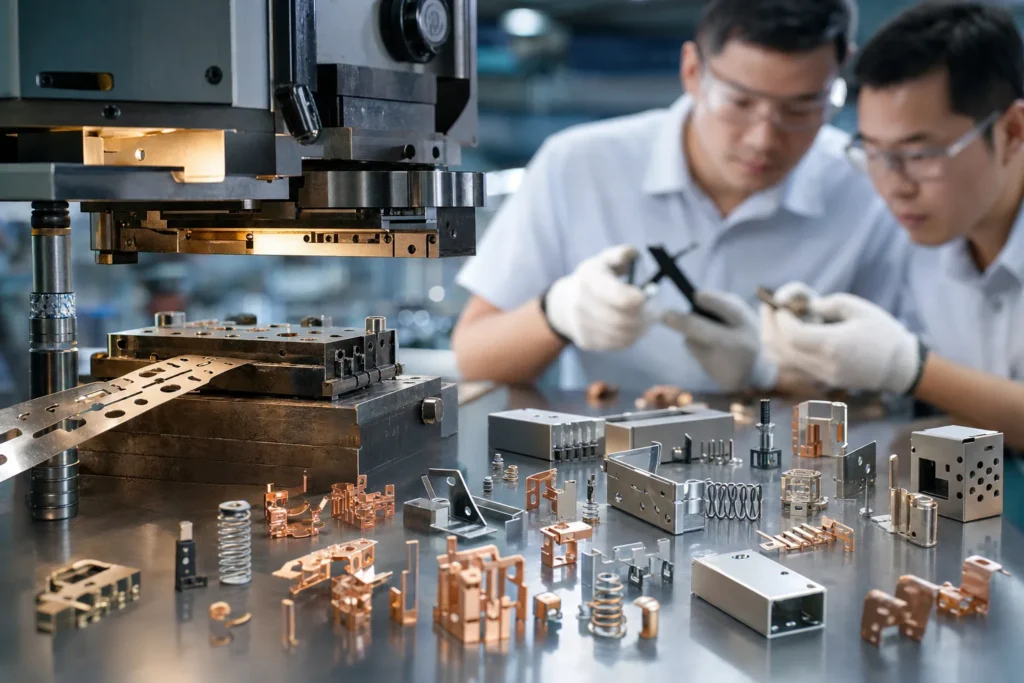
Short answer: die cutting uses a steel-rule blade to blank flat parts from a metal strip, while tëggin uses a precision-ground die in a press to cut, form, coin, and pierce in progressive operations. tëggin gives tighter tolerances, better edge quality, formed features, and higher volume capability. Die cutting costs less in tooling but works best for simple flat geometries at lower volumes.
This comparison is for engineers and purchasers choosing between die-cut and stamped electrical contacts, terminals, busbar laminations, gaskets, or thin shims. The right process depends on part volume, edge quality, tolerance, whether formed features are needed, and commercial constraints like tooling budget and diiru joxe.
Yonnee drawings with material, thickness, tolerance, quantity, and needed features through the RFQ form. For existing jokkoo tëggin projects, see terminal and jokkoo tëggin design guide and the electrical terminal tëggin issues guide.
Process comparison table
| Pàcc | Die cutting | tëggin |
|---|---|---|
| Tooling cost | Low ($200–$1,500 per part) | Moderate to high ($1,500–$15,000+) |
| Typical volume | 100–50,000 pcs | 5,000–10,000,000+ pcs |
| Tolerance (flat parts) | ±0.10–0.25 mm typical | ±0.025–0.10 mm typical |
| Edge condition | Slight rollover, some burr | Clean shear zone, burr direction controlled |
| Formed features | Not possible (flat only) | Bends, forms, embossments, coining, threads |
| Material thickness | Up to ~3 mm | Up to ~8 mm (thicker with heavy presses) |
| diiru joxe (tooling) | 3–7 days | 2–6 weeks |
| Setup change time | 10–30 minutes | 30–90 minutes (matris bu dox ndànk) |
When to choose die cutting
Die cutting makes sense when the jokkoo is flat, the volume is under 50,000 pieces, tolerance requirements are moderate, and tooling cost must stay low. It is common for prototype runs, small-lot production, gaskets, shims, thin flat terminals, and brass or copper laminations where edge quality is secondary to dimensional fit.
Lead times are short because steel-rule dies are simpler to build. If the design changes, a new die costs a fraction of a tëggin die change. Die cutting also works well for thin materials under 0.5 mm where tëggin might cause feeding or buckling issues without specialized tooling.
For more on low-volume options, see prototype tëggin metal ci matris and short run tëggin metal ci matris.
When to choose tëggin
tëggin is the right choice when the jokkoo needs formed features such as spring bends, coined jokkoo surfaces, embossments, lance-and-form terminals, or precision burr direction on the mating side. It also wins at higher volumes where the per-part cost saving offsets the tooling investment, and when tolerance must stay within ±0.05 mm or tighter.
Progressive dies allow multiple operations in one press pass: blanking, piercing, forming, coining, tapping, and cutoff. This reduces handling and secondary operations. Transfer dies or compound dies can handle larger, more complex geometries that do not fit a progressive strip layout.
See high volume tëggin metal ci matris for volume economics and precision tëggin metal ci matris for tighter tolerance guidance.
Edge quality comparison
Die-cut edges show a small rollover zone on the punch-entry side and a burr on the exit side. The shear zone is typically about one-third of material thickness. For thin contacts under 0.3 mm, the rollover can be a visible percentage of total thickness, which may affect jokkoo mating surfaces.
Stamped edges from a sharp, well-maintained die produce a cleaner shear zone, less rollover, and a smaller, more predictable burr. Burr direction can be specified on the drawing (burr up or burr down) and controlled through die clearance and maintenance schedules. For high-reliability contacts, specify allowable burr height and direction on the RFQ drawing.
For deeper edge quality and burr standards, review tëggin metal ci matris tolerances guide.
Material considerations
Both processes handle copper, brass, phosphor bronze, beryllium copper, stainless steel, cold-rolled steel, galvanized steel, aluminum, nickel, and nickel alloys. tëggin can handle harder tempers more reliably because the die is ground to the exact material thickness and temper, while die cutting relies on the steel rule cutting through the strip. Very hard or spring-tempered materials may cause faster wear on steel-rule dies.
For nickel and copper alloys used in contacts, see phosphor bronze and beryllium copper jokkoo tëggin.
Cost comparison
Die cutting has a lower entry cost but a higher per-part cost at volume. At 10,000 pieces, a simple flat terminal might cost $0.08–$0.15 each with die cutting versus $0.03–$0.08 each with tëggin, assuming tooling is amortized. At 500,000 pieces, tëggin is usually the cheaper option by a wide margin.
However, jumtukaayi matris takes longer to build and modify. If the jokkoo design is still in development with likely changes, die cutting keeps the prototyping phase cheaper and faster. For tooling cost details, see metal jumtukaayi matris cost guide.
RFQ checklist for contacts
- Drawing with flat pattern and formed views (2D DXF or 3D STEP preferred).
- Material grade, temper, thickness, and plating specification.
- Annual volume, order quantity, and expected schedule.
- Tolerance callouts, especially for mating dimensions and jokkoo surfaces.
- Burr direction and maximum burr height (if there is a specific electrical jokkoo requirement).
- Surface finish, plating, or passivation requirements.
- Packaging method (tape and reel, tube, bulk, trays, ESD).
- Target price or budget range for tooling and per-part cost.
Submit your drawings through the jokkoo and RFQ page. For related reading, see the tëggin metal ci matris RFQ checklist for RFQ preparation.