
Sheet Metal Gauge Chart: Thickness Guide for Steel, Stainless, and Aluminum
Choosing the wrong sheet metal thickness is one of the fastest ways to blow a project budget. A part that’s too thin bends under load; one that’s too thick wastes material and drives up tooling costs. A reliable sheet metal gauge chart eliminates the guesswork.
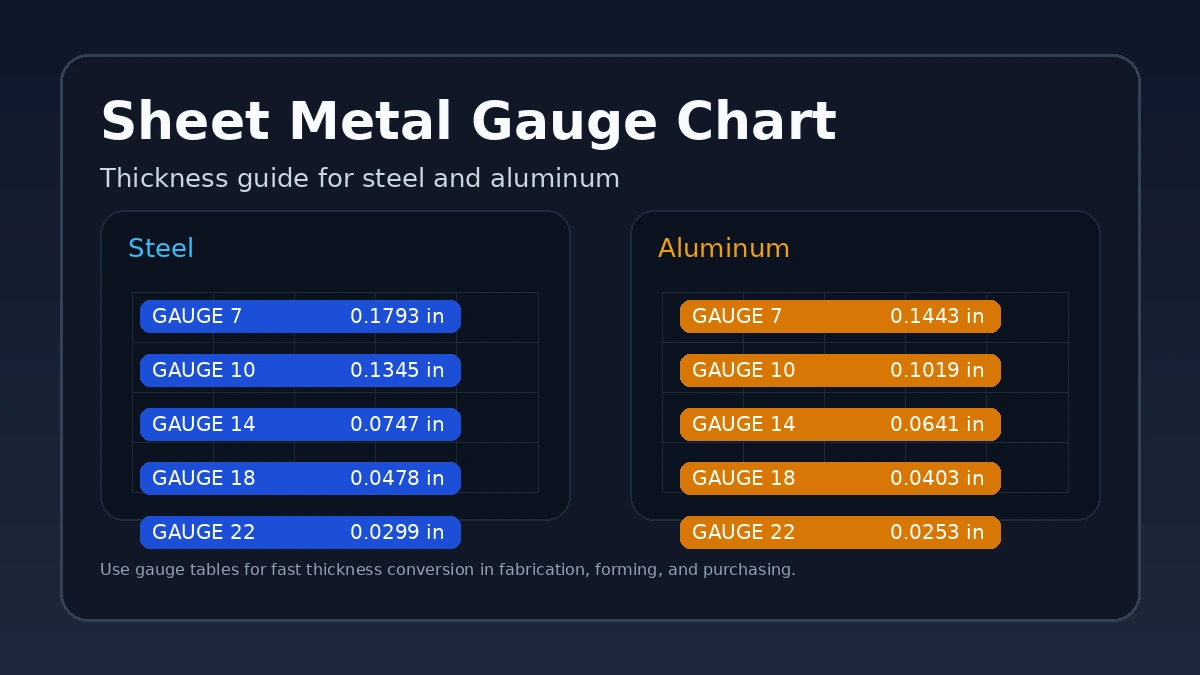
Gauge numbers work inversely to thickness — the higher the gauge, the thinner the sheet. Critically, a single gauge number does not produce the same thickness across all materials. For example, 20-gauge steel measures 0.953 mm (0.0375″), while 20-gauge aluminum is 1.016 mm (0.0400″) — a 6.6% difference. At lighter gauges the gap widens further. Using the wrong column in a generic table can introduce significant error in wall thickness.
This guide provides the definitive sheet metal gauge chart for carbon steel, stainless steel, and aluminum — covering gauges 7 through 30 in both millimeters and inches — along with practical application notes, material selection criteria, and industry tolerance standards.
Complete Sheet Metal Gauge Chart: Steel, Stainless Steel, and Aluminum
The table below lists nominal thickness values based on industry standards. Carbon steel values follow ASTM A1011 and manufacturer gauge tables. Stainless steel follows ASTM A480 specifications. Aluminum values are based on ASTM B209 and Aluminum Association standards.
Gauge 7–18 (Heavy to Medium Gauge)
| Gauge | Carbon Steel (mm) | Carbon Steel (in) | Stainless Steel (mm) | Stainless Steel (in) | Aluminum (mm) | Aluminum (in) |
|---|---|---|---|---|---|---|
| 7 | 4.762 | 0.1874 | 4.762 | 0.1874 | 5.258 | 0.2070 |
| 8 | 4.191 | 0.1650 | 4.191 | 0.1650 | 4.699 | 0.1850 |
| 9 | 3.746 | 0.1475 | 3.746 | 0.1475 | 4.191 | 0.1650 |
| 10 | 3.416 | 0.1345 | 3.569 | 0.1405 | 3.658 | 0.1440 |
| 11 | 3.035 | 0.1195 | 3.175 | 0.1250 | 3.264 | 0.1285 |
| 12 | 2.657 | 0.1046 | 2.779 | 0.1094 | 2.908 | 0.1145 |
| 13 | 2.299 | 0.0905 | 2.380 | 0.0937 | 2.540 | 0.1000 |
| 14 | 1.984 | 0.0781 | 1.984 | 0.0781 | 2.223 | 0.0875 |
| 15 | 1.745 | 0.0687 | 1.786 | 0.0703 | 1.905 | 0.0750 |
| 16 | 1.511 | 0.0595 | 1.588 | 0.0625 | 1.651 | 0.0650 |
| 17 | 1.359 | 0.0535 | 1.427 | 0.0562 | 1.473 | 0.0580 |
| 18 | 1.270 | 0.0500 | 1.270 | 0.0500 | 1.270 | 0.0500 |
Gauge 19–30 (Medium to Light Gauge)
| Gauge | Carbon Steel (mm) | Carbon Steel (in) | Stainless Steel (mm) | Stainless Steel (in) | Aluminum (mm) | Aluminum (in) |
|---|---|---|---|---|---|---|
| 19 | 1.105 | 0.0435 | 1.113 | 0.0438 | 1.107 | 0.0436 |
| 20 | 0.953 | 0.0375 | 0.914 | 0.0360 | 1.016 | 0.0400 |
| 21 | 0.851 | 0.0335 | 0.813 | 0.0320 | 0.930 | 0.0366 |
| 22 | 0.759 | 0.0299 | 0.711 | 0.0280 | 0.874 | 0.0344 |
| 23 | 0.678 | 0.0267 | 0.635 | 0.0250 | 0.795 | 0.0313 |
| 24 | 0.607 | 0.0239 | 0.559 | 0.0220 | 0.711 | 0.0280 |
| 25 | 0.538 | 0.0212 | 0.508 | 0.0200 | 0.635 | 0.0250 |
| 26 | 0.478 | 0.0188 | 0.457 | 0.0180 | 0.574 | 0.0226 |
| 27 | 0.437 | 0.0172 | 0.406 | 0.0160 | 0.508 | 0.0200 |
| 28 | 0.396 | 0.0156 | 0.356 | 0.0140 | 0.455 | 0.0179 |
| 29 | 0.356 | 0.0140 | 0.305 | 0.0120 | 0.389 | 0.0153 |
| 30 | 0.318 | 0.0125 | 0.254 | 0.0100 | 0.320 | 0.0126 |
Key Insight: At gauge 18, all three materials share a nominal thickness of 1.27 mm (0.050″). Below gauge 18, stainless steel sheets become progressively thinner than carbon steel at the same gauge number, while aluminum sheets become thicker. Always verify against the correct material column.
How Sheet Metal Gauge Works
The sheet metal gauge system originated in the early 19th century as a wire-drawing standard. Each gauge number originally represented the number of drawing dies a wire had passed through — more passes meant a thinner product. When the system was adopted for sheet metal, manufacturers standardized the gauge-to-thickness relationships, but different materials received different scales.
This is why a sheet metal thickness chart is essential: you cannot assume gauge 16 means the same thing for steel and aluminum. In practice:
- Carbon steel and galvanized steel share the same gauge-to-thickness mapping (ASTM A1011 / A653).
- Stainless steel uses a separate scale (ASTM A480) that diverges from carbon steel at several points.
- Aluminum uses its own scale (Aluminum Association standard) with the thickest dimensions at each gauge number.
Sheet Metal Gauge by Application
Selecting the right gauge depends on structural requirements, forming complexity, and cost. Below is a practical guide to common gauges and their typical industrial uses.
Heavy Gauge (7–10) — Structural and Heavy-Duty Applications
| Gauge | Typical Applications |
|---|---|
| 7 | Heavy structural brackets, mining equipment guards, bridge components |
| 8 | Truck frames, heavy machinery housings, agricultural equipment |
| 9 | Trailer beds, heavy enclosures, structural reinforcements |
| 10 | Heavy-duty brackets, industrial equipment bases, pressure vessels |
Heavy-gauge sheet metal requires higher-tonnage press brakes and punches. At these thicknesses, stamping die design must account for increased forming forces and springback.
Medium Gauge (11–16) — General Fabrication
| Gauge | Typical Applications |
|---|---|
| 11 | Automobile frames, structural supports, heavy shelving |
| 12 | Electrical enclosures, HVAC ductwork, machine guards |
| 13 | Automotive body panels (inner), appliance housings |
| 14 | Automobile body panels, storage tanks, medium enclosures |
| 15 | Metal furniture, light enclosures, signage |
| 16 | Roofing panels, light brackets, decorative trim |
Gauges 14–16 represent the sweet spot for most metal stamping projects — thick enough for structural integrity, thin enough for efficient high-volume production.
Light Gauge (17–22) — Precision and Lightweight Parts
| Gauge | Typical Applications |
|---|---|
| 17 | Light automotive panels, electronic chassis |
| 18 | Ductwork, light enclosures, electronic cabinets |
| 19 | Aerospace interior panels, precision brackets |
| 20 | Computer cases, light fixtures, HVAC components |
| 21 | Appliance panels, electrical boxes |
| 22 | Roofing material, light-duty enclosures |
Ultra-Light Gauge (23–30) — Specialty and Precision Work
| Gauge | Typical Applications |
|---|---|
| 23 | Tin cans, decorative panels, light-duty trays |
| 24 | Automotive body panels (outer skin), precision stampings |
| 25 | Aluminum cans, thin enclosures |
| 26 | Electrical connectors, precision instruments |
| 27 | Shims, thin gaskets, flexible connectors |
| 28 | RFI/EMI shielding, foil applications |
| 29 | Ultra-thin shielding, specialty foil |
| 30 | Ultra-thin foil, precision micro-stamping |
Material Selection Guide
Choosing between steel, stainless steel, and aluminum goes beyond thickness. The table below compares key engineering properties at a typical 16-gauge thickness.
| Property | Carbon Steel (16 ga) | Stainless Steel 304 (16 ga) | Aluminum 5052 (16 ga) |
|---|---|---|---|
| Nominal Thickness | 1.511 mm | 1.588 mm | 1.651 mm |
| Density | 7,850 kg/m³ | 8,000 kg/m³ | 2,680 kg/m³ |
| Tensile Strength | 310–450 MPa | 515–620 MPa | 228–276 MPa |
| Yield Strength | 210–350 MPa | 205–310 MPa | 193–221 MPa |
| Corrosion Resistance | Low (needs coating) | Excellent | Good |
| Formability | Good | Moderate (work-hardens) | Excellent |
| Relative Cost | Low ($$) | High ($$$$) | Moderate ($$$) |
| Weight per m² | 11.85 kg | 12.70 kg | 4.42 kg |
When to Choose Carbon Steel
Carbon steel offers the best strength-to-cost ratio for indoor applications or parts that receive a protective finish (powder coating, painting, or plating). It is the default choice for structural brackets, automotive inner panels, and general enclosures.
When to Choose Stainless Steel
Choose stainless steel when corrosion resistance is non-negotiable — food processing equipment, medical devices, outdoor enclosures, and chemical handling. Grade 304 handles most environments; 316 stainless steel adds molybdenum for marine and chemical resistance.
When to Choose Aluminum
Aluminum’s density is roughly one-third that of steel, making it the go-to material when weight savings matter: aerospace components, electronics housings, portable equipment, and EV battery enclosures. Alloy 5052 offers excellent formability; 6061 provides higher strength after heat treatment.
Sheet Metal Tolerances
Nominal gauge thickness is a starting point — real-world sheets carry manufacturing tolerances. Understanding these tolerances is critical for parts with tight fit requirements.
Standard Thickness Tolerances by Material
| Material | Standard | Gauge Range | Typical Tolerance |
|---|---|---|---|
| Carbon Steel | ASTM A568/A1011 | 7–18 | ± 0.08 mm (± 0.003″) |
| Carbon Steel | ASTM A568/A1011 | 19–30 | ± 0.05 mm (± 0.002″) |
| Stainless Steel | ASTM A480 | 7–18 | ± 0.08 mm (± 0.003″) |
| Stainless Steel | ASTM A480 | 19–30 | ± 0.05 mm (± 0.002″) |
| Aluminum | ASTM B209 | 7–18 | ± 0.10 mm (± 0.004″) |
| Aluminum | ASTM B209 | 19–30 | ± 0.05 mm (± 0.002″) |
Important: Tolerances vary by producer, alloy, and sheet width. Always confirm tolerance class with your supplier. For precision stamping projects, request mill certificates with actual measured thickness.
Flatness Tolerances
Flatness matters for laser cutting, blanking, and progressive die stamping. Common flatness standards:
- ASTM A1011 (carbon steel): Standard flatness ≤ 12 mm over 2 m length
- ASTM A480 (stainless steel): Special flatness available on request
- ASTM B209 (aluminum): Varies by alloy and temper
If your stamping process requires exceptional flatness, specify “dead flat” or “laser flat” material at order time.
Gauge vs. Decimal: Practical Conversion Tips
Many engineering drawings call out thickness in decimal inches or millimeters rather than gauge numbers. Here are quick reference rules:
- For carbon steel: Gauge ≈ (0.005″ × (30 – gauge number)) as a rough estimate, but always verify with the full chart above.
- For stainless steel: At gauges 10 and above, stainless is often 0.005″–0.010″ thicker than carbon steel at the same gauge.
- For aluminum: Aluminum is thicker than steel at the same gauge below gauge 18, and thinner above gauge 18.
Pro Tip: When communicating with suppliers, always specify the material alongside the gauge number. “18-gauge” alone is ambiguous — state “18-gauge 304 stainless” or “18-gauge 5052 aluminum” to avoid costly errors.
Frequently Asked Questions
What is the standard sheet metal gauge chart for the United States?
The U.S. standard sheet metal gauge system follows ASTM specifications — ASTM A1011 for carbon steel, ASTM A480 for stainless steel, and ASTM B209 for aluminum. There is no single “universal” gauge chart; each material family has its own gauge-to-thickness mapping. Always reference the chart specific to your material.
How do I convert sheet metal gauge to thickness in millimeters?
Use the conversion tables in this guide. As a quick reference: 10-gauge carbon steel is 3.416 mm, 16-gauge is 1.511 mm, and 20-gauge is 0.953 mm. For stainless steel and aluminum, refer to the material-specific columns — the same gauge number produces different thicknesses depending on the material.
Why is 18-gauge steel different thickness than 18-gauge aluminum?
The gauge numbering system originated from wire-drawing and was adopted independently for each material family. At gauge 18, steel and aluminum actually share a nominal 1.27 mm (0.050″) thickness — one of the rare convergence points. At most other gauges they differ. Aluminum gauge 22 is 0.874 mm while steel gauge 22 is 0.759 mm — a 15.2% difference. This is why you must always reference the correct material column in a gauge chart.
What gauge of sheet metal is best for bending?
Gauges 14 through 20 (1.984 mm to 0.953 mm for steel) are generally the easiest to bend on standard press brakes. Material below 20-gauge may wrinkle or distort; material above 14-gauge requires higher tonnage. Aluminum is more formable than steel at the same gauge, while stainless steel requires more force due to work-hardening.
What tolerance should I specify for precision sheet metal stamping?
For general stamping, standard mill tolerances (± 0.08 mm for heavier gauges, ± 0.05 mm for lighter gauges) are sufficient. For precision or high-volume progressive die stamping, specify a tighter tolerance — ± 0.025 mm (± 0.001″) — and request material with mill certification confirming actual measured thickness.
Get a Quote for Your Next Stamping Project
At Metal Stamping Parts, we work with carbon steel, stainless steel, and aluminum across all gauge ranges. Our engineering team reviews your gauge specifications against the correct ASTM standards to ensure dimensional accuracy from prototype through production.
Ready to start? Request a free quote or explore our stamping capabilities to see how we can support your next project.
Sources:
– ASTM A1011/A1011M-23, Standard Specification for Steel, Sheet, Carbon — astm.org
– ASTM A480/A480M-23, General Requirements for Flat-Rolled Stainless — astm.org
– ASTM B209/B209M-21, Standard Specification for Aluminum and Aluminum-Alloy Sheet and Plate — astm.org
– Aluminum Association, Standards for Aluminum Nomenclature and Temper Designations