If you need stamped metal parts fast, jumping straight to production tooling is often the wrong move.
A progressive die can be the cheapest option at scale, but it is rarely the safest option at the beginning. Before you commit to hardened tooling, you usually need to answer three practical questions: Does the part function as expected? Can the geometry actually be formed without problems? And is the expected annual volume high enough to justify the tooling investment?
That is what prototyping is for.
In metal stamping, prototyping is not one single process. It is a decision stage where you choose the fastest and most economical way to get physical parts for testing, quoting, fit verification, pilot builds, or low-volume launch. Sometimes that means CNC machining. Sometimes it means laser cutting and press brake forming. Sometimes it means short run tooling. And sometimes it means building a simplified soft tool that bridges the gap between development and mass production.
This guide explains how prototype stamped parts are actually made, what each method costs, how long each route typically takes, and when it makes sense to move from samples to full production.
Why Prototype Before Production Tooling?
Prototype parts reduce risk before you spend money where changes become expensive.
In machining, a design revision may only require a program update. In stamping, late-stage geometry changes can mean die rework, additional stations, new punches, changed strip layout, and several extra weeks. That is why experienced buyers and product engineers usually prototype first when the design is new, the assembly fit is critical, or the forecast volume is still uncertain.
The main reasons to prototype stamped parts are straightforward:
- Fit and assembly validation: Check whether holes, bends, tabs, slots, and mating surfaces line up in the real product.
- Functional testing: Confirm the part can carry load, hold torque, retain springs, shield EMI, or survive vibration as intended.
- Material selection: Compare mild steel, stainless, aluminum, copper, or brass before freezing the final specification.
- Tolerance review: Identify dimensions that matter in use versus dimensions that only look important on the drawing.
- Tooling risk reduction: Discover forming or burr issues before committing to hard tooling.
- Pilot build support: Supply small batches for EVT, DVT, pilot line runs, or customer approval.
A prototype is much cheaper than a production die change. If a $1,500 sample run exposes a bend interference issue that would have caused a $12,000 die modification later, the prototype already paid for itself.
This is also why prototype planning should connect to your broader metal stamping cost analysis. The cheapest unit price is not always the cheapest project decision.
Prototyping Methods Compared
There is no universal “prototype stamping” process. The right route depends on geometry, tolerance, quantity, material, and how closely the samples need to represent final production parts.
1. CNC Machining
CNC machining is often used for rigid brackets, thick plates, blocks, or simple metal components where the purpose is mainly dimensional or assembly validation.
Best for:
- Low quantity: 1–20 pcs
- Thicker materials
- Flat or mildly contoured parts
- Fast fit checks before tooling decisions
Advantages:
- Fast startup with no stamping die
- Good dimensional control
- Easy to revise between iterations
- Suitable for difficult materials in small volume
Limitations:
- Does not reproduce true stamped edge condition
- Does not replicate grain-direction effects, work hardening, or forming springback the same way
- Unit cost is high for thin, high-volume style parts
If your production process will be progressive die stamping, CNC prototypes are useful for geometry confirmation—but not always for validating the final stamping process itself.
2. Laser Cutting or Waterjet + Press Brake Forming
This is one of the most common routes for sheet metal prototype parts.
The blank profile is cut by laser or waterjet, then formed on a press brake using standard tooling. For many brackets, covers, clips, shields, and enclosures, this is the fastest way to get representative parts without building a dedicated die.
Best for:
- Flat patterns with simple bends
- Early product development
- Quantities from 5–100 pcs
- Fast design iterations
Advantages:
- Very low upfront tooling cost
- Faster than hard tooling
- Easy to revise drawings
- Good for evaluating bend sequence and assembly fit
Limitations:
- Edge quality differs from punched edges
- Bend radii may differ from production die radii
- Hole position relative to formed features may shift more than in real stamping
- Not ideal for parts with louvers, embosses, extrusions, or complex drawn features
For many buyers, this is the practical middle ground: fast enough for development, cheap enough for revision, and realistic enough for fit testing.
3. Wire EDM / Machined Prototype Tooling
If the part needs actual punching or forming features that cannot be simulated well by laser and brake forming, a shop may build a simplified prototype tool using machined inserts or wire EDM components.
Best for:
- Critical features that need to be stamped rather than approximated
- Small runs where form quality matters
- Engineering validation before full die build
Advantages:
- Closer to final process behavior
- Better replication of pierced holes, burr direction, and formed features
- Can validate strip progression logic on simpler parts
Limitations:
- Higher upfront cost than laser/brake prototyping
- Longer lead time
- Still not as efficient or durable as full production tooling
This method is common when buyers need stronger confidence that the part will behave correctly in stamping, but full progressive die investment is premature.
4. Soft Tooling / Short Run Tooling
Short run tooling is the closest true bridge between prototype and production.
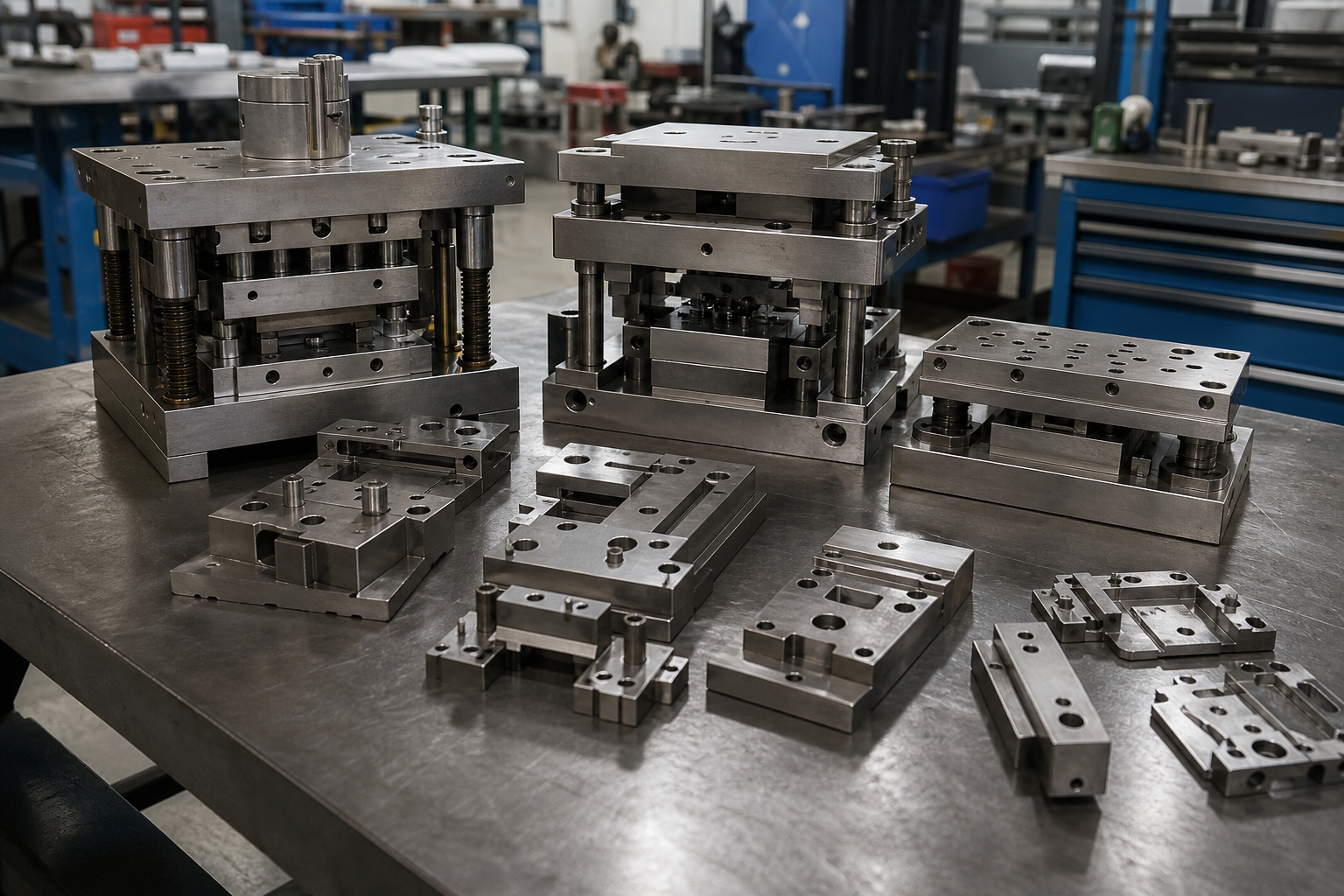
Instead of building a hardened, high-life die for hundreds of thousands or millions of hits, the supplier creates a simplified tool designed for limited output. It may use fewer stations, slower feeds, manual transfer, or lower-cost tool steel. The goal is not maximum efficiency. The goal is to produce real stamped parts with reasonable tooling investment.
Best for:
- Pilot runs
- 100–10,000 pcs, depending on part complexity
- Programs with uncertain long-term demand
- Bridge production before hard tooling is ready
Advantages:
- Closer to production reality than fabricated prototypes
- Lower tooling cost than a full progressive die
- Useful for PPAP samples, trial builds, and low-volume launch
- Can reveal real-world forming, burr, and repeatability issues
Limitations:
- Piece price is higher than mature production stamping
- Tool life is shorter
- Cycle time is slower
- Not ideal for very high annual volume
For the keyword target of this article, this is where short run tooling matters most. It is not just “cheap tooling.” It is a strategic option for programs that need stamped parts before production economics fully justify a hard die.
5. 3D Printing + Secondary Conversion
This route is occasionally used for concept models, checking envelope dimensions, fixture development, or customer presentations.
Best for:
- Non-functional mockups
- Visual design reviews
- Assembly space checks
Advantages:
- Very fast
- Low cost for concept stages
- Easy to revise
Limitations:
- Not a metal stamping process
- Mechanical properties are not representative
- Not appropriate for serious production validation
For real stamped part development, 3D printing is usually a support tool, not the final prototype method.
Which Prototype Method Is Best for Different Part Types?
The correct method depends on what you are trying to learn.
| Development Goal | Best Prototype Route | Why |
|---|---|---|
| Check overall fit in assembly | CNC or laser cut sample | Fast and low setup cost |
| Verify bend sequence and bracket geometry | Laser cut + press brake | Closest low-cost route for simple formed parts |
| Validate pierced holes, burr direction, and formed details | Prototype tooling / short-run stamping | Better replication of stamped behavior |
| Run pilot quantities before launch | Soft tooling | More realistic than fabricated samples |
| Present concept for customer review | 3D print or simple fabricated sample | Fastest visual model |
| Test production economics at low volume | Short run tooling | Bridges engineering and commercial validation |
A common mistake is using one method for every stage. That often wastes money. A better sequence is:
- Fast fabricated sample for early fit check
- Revised prototype for functional testing
- Short-run stamped parts for pilot build
- Full production tooling after design freeze
That staged approach keeps early costs low while still protecting the production launch.

Soft Tooling vs. Hard Tooling: When to Use Each
This is usually the biggest commercial decision in prototype projects.
Soft Tooling
Soft tooling is designed for flexibility and lower initial cost. It may use simpler construction, fewer operations per hit, more manual handling, or lower-grade tooling components. The supplier expects limited lifetime, but enough output for sample runs, pilot lots, or early market demand.
Use soft tooling when:
- The design may still change
- Annual volume is not yet proven
- You need parts within weeks, not months
- The project is in pilot, pre-production, or bridge production stage
- You want real stamped parts without full die investment
Hard Tooling
Hard tooling is the correct choice once the design is frozen and the commercial case is clear. A production die is optimized for repeatability, cycle time, tool life, scrap reduction, and lower unit cost at scale.
Use hard tooling when:
- Annual volume is stable and sufficiently high
- The geometry is finalized
- Production capability and maintenance planning matter more than flexibility
- Unit economics justify the tooling cost
Practical Decision Rule
If your volume forecast is uncertain, start with short-run tooling.
If you are confident the program will run at 100,000+ pcs annually, and the drawing is stable, it usually makes sense to proceed toward production tooling faster.
If the design is still changing every two weeks, full tooling is premature no matter how attractive the projected unit price looks.
Typical Costs for Prototype Stamped Parts
Prototype cost is usually a mix of setup cost, sample fabrication cost, material cost, and any special inspection or finishing.
Below is a realistic comparison range for small to mid-size sheet metal parts. Actual prices vary by size, complexity, tolerance, and region.
| Method | Typical Upfront Cost | Typical Piece Price | Best Quantity Range |
|---|---|---|---|
| CNC machining | $100–$500 setup | $20–$150/pc | 1–20 pcs |
| Laser cut + press brake | $50–$300 setup | $5–$40/pc | 5–100 pcs |
| Wire EDM / simple prototype tool | $800–$3,000 tooling | $2–$15/pc | 20–500 pcs |
| Short run tooling | $1,500–$8,000 tooling | $0.50–$8/pc | 100–10,000 pcs |
| Full production die | $8,000–$60,000+ tooling | Lowest at scale | 10,000+ pcs and recurring |
A few cost realities matter here:
- Simple flat parts prototype cheaply.
- Deep drawn or multi-form parts become expensive quickly.
- Tight tolerances often cost more than the prototype method itself.
- Finishes such as plating, passivation, deburring, or heat treatment can dominate piece price at low quantities.
- Inspection documentation adds cost but may be necessary for engineering approval.
Buyers often ask for the lowest quote without deciding what the prototype is meant to prove. That leads to confusion. If you only need fit verification, do not pay for a short-run die. If you need real process validation, fabricated parts may be a false economy.
Lead Time Expectations: From Drawing to First Parts
Prototype lead time depends less on the material itself and more on how much process development is required.
| Method | Typical Lead Time |
|---|---|
| CNC sample | 3–7 working days |
| Laser cut + brake formed sample | 3–10 working days |
| Prototype tooling | 2–4 weeks |
| Short run tooling | 3–6 weeks |
| Full progressive die | 6–12+ weeks |
These ranges assume the drawing is manufacturable and the supplier has complete information.
Lead time usually increases when the RFQ is missing key inputs such as:
- Material grade and temper
- Final thickness
- Required finish
- Critical tolerances
- 2D and 3D files
- Annual volume estimate
- Sample quantity needed
- Whether the prototype must match future stamping behavior
The cleanest way to speed up prototypes is not “rush production.” It is sending a complete RFQ package the first time.
If your project needs faster conversion from quote to sample, it also helps to flag which dimensions are truly critical and which can remain as-reference during prototype evaluation. That reduces unnecessary over-processing.
What Makes a Prototype Quote Go Wrong?
Most delays and cost surprises do not come from the shop floor. They come from mismatched expectations.
1. Expecting Prototype Parts to Match Production Parts Exactly
A laser-cut bracket is not identical to a progressive die stamped bracket. Burr profile, bend radius, flatness, edge rollover, and hole accuracy relative to formed features may differ.
If you need production-equivalent parts, say so early. Otherwise the supplier may quote the cheapest route, and the samples will be valid only for limited checks.
2. Freezing Tight Tolerances Too Early
Many prototype drawings carry blanket production tolerances that are unnecessary at the validation stage. That increases quote cost and lead time without helping decision-making.
A better approach is to mark only the critical-to-function dimensions tightly during prototyping, then refine the rest after test results.
For guidance on where tight dimensions really matter, see metal stamping tolerances.
3. Ignoring Volume Strategy
The right prototype path for 20 pcs is not the right path for 5,000 pcs. If the pilot order may roll directly into bridge production, short-run tooling often makes more sense than repeated fabricated batches.
4. Treating Surface Finish as an Afterthought
Plating, powder coating, anodizing, passivation, and deburring can affect both schedule and cost. Some buyers approve raw prototypes, then later discover the finish changes fit or appearance. If finish matters, include it in the prototype plan.
How to Transition from Prototype to Production
A good prototype program is not isolated from production. It should reduce uncertainty step by step.
The smoothest transition usually follows this sequence:
Stage 1: Prototype for Design Learning
Use CNC or fabricated samples to verify form, fit, and basic function. The goal is to discover obvious geometry problems fast.
Stage 2: Prototype for Process Learning
Use short run tooling or simplified stamped samples to evaluate forming behavior, burr control, tolerance stability, and inspection requirements.
Stage 3: Pilot Build
Run a small lot under more production-like conditions. This is where many teams confirm packaging, assembly time, defect risks, and supplier communication flow.
Stage 4: Production Tooling Release
Only after geometry, material, finish, and quality requirements are stable should the full production die be released.
The biggest mistake is skipping from CAD approval straight to hard tooling with no intermediate learning loop. That compresses calendar time at the beginning but often expands it later through rework.
Small Batch and Low-Volume Stamping Options
Not every project becomes a high-volume stamping program.
Some parts stay in annual demand ranges of 1,000–20,000 pcs. Others serve replacement parts, regional variants, aftermarket kits, or specialized industrial equipment. In those cases, a supplier offering short-run stamping services can be a better long-term fit than a factory optimized only for massive automotive-style volumes.
Low-volume programs usually need:
- Flexible tooling strategy
- Reasonable MOQ
- Ability to hold inventory or run on demand
- Practical tolerance planning
- Secondary operations in-house or closely managed
- Engineering support when revisions happen
This is where supplier selection matters. A high-volume stamper may quote aggressively on paper but have no interest in supporting small recurring batches efficiently. A supplier with true prototype and bridge-production capability is often more valuable.

What to Send When Requesting Prototype Samples
If you want a useful quote, send more than a PDF and “please quote.”
A strong prototype RFQ should include:
- 2D drawing with dimensions and tolerances
- 3D CAD file if available
- Material grade, temper, and thickness
- Required finish or note that raw samples are acceptable
- Target quantity for the first run
- Annual volume estimate if production may follow
- Application or assembly context
- Critical dimensions or test features
- Whether prototype process must mimic final stamping process
- Required delivery date and shipping destination
If your team is unsure which prototype route makes sense, state the business goal clearly instead: fit check, pilot build, customer sample, design validation, or low-volume production bridge. A capable supplier can recommend the right process based on that.
For projects ready to move, the fastest path is usually to contact the engineering team with drawings, target quantity, and timing requirements.
FAQ
Is CNC machining a valid prototype for a stamped part?
Yes, if the goal is basic dimensional or assembly validation. No, if you need to evaluate true stamped edge condition, forming behavior, or production economics.
What is short run tooling in metal stamping?
Short run tooling is simplified tooling built for limited quantities. It costs less than full production tooling and is commonly used for pilot runs, bridge production, and programs with uncertain demand.
How many parts justify prototype tooling instead of laser cutting?
There is no fixed number, but once quantity increases beyond simple sample counts—or when the part includes features that must be truly stamped—prototype tooling often becomes the better value.
How long does it take to get prototype stamped parts?
Simple fabricated samples may take 3–10 working days. Short-run tooling usually takes 3–6 weeks. Full production tooling often takes 6–12 weeks or more.
Can prototype parts be plated or powder coated?
Yes. Many prototype parts can include finishing, but this adds both cost and lead time. If finish affects fit, corrosion resistance, or appearance, it should be included early.
Should prototype tolerances match final production tolerances?
Only where function requires it. Tightening every dimension too early usually increases cost without improving prototype value.
Final Takeaway
Prototype stamped parts are not about making a part once. They are about making the next decision correctly.
If you only need quick geometry validation, fabricated samples are usually enough. If you need realistic process behavior, short run tooling is often the smarter path. And if the design is stable and volume is proven, production tooling becomes the logical next step.
The best prototype strategy is the one that matches your technical risk, commercial risk, and launch timing—not just the lowest initial quote.
Explore our precision metal stamping services. We deliver metal stamping parts with industry-leading accuracy.
Frequently Asked Questions
What is short run tooling?
Short run tooling is a specialized manufacturing process used to create precise metal components. Our team has over 25 years of experience delivering high-quality results for global clients across automotive, aerospace, electronics, and construction industries.
What tolerances can you achieve for short run tooling?
We achieve standard tolerances of ±0.05mm, with precision tolerances down to ±0.02mm for critical applications. All parts are inspected using CMM equipment with Cpk≥1.33 process capability.
What materials do you work with for short run tooling?
We work with a wide range of materials including aluminum (1100-6061), stainless steel (301-430), carbon steel, copper, brass, phosphor bronze, and specialty alloys. Material thickness ranges from 0.1mm to 12mm.
What is your minimum order quantity for short run tooling?
We accept prototype orders starting from 1 piece. For production runs, we recommend starting at 1,000 pieces for cost efficiency, though we accommodate various volumes based on project requirements.
How do I get a quote for short run tooling?
Submit your drawings (DWG, DXF, STEP, IGES, or PDF) via our contact form or email. We provide DFM feedback and pricing within 24 hours. Our engineering team reviews every inquiry for optimal manufacturability.
What quality certifications do you have for short run tooling?
We maintain ISO 9001:2015 and IATF 16949 certifications with full traceability. Every shipment includes inspection reports, material certificates, and compliance documentation as required.