
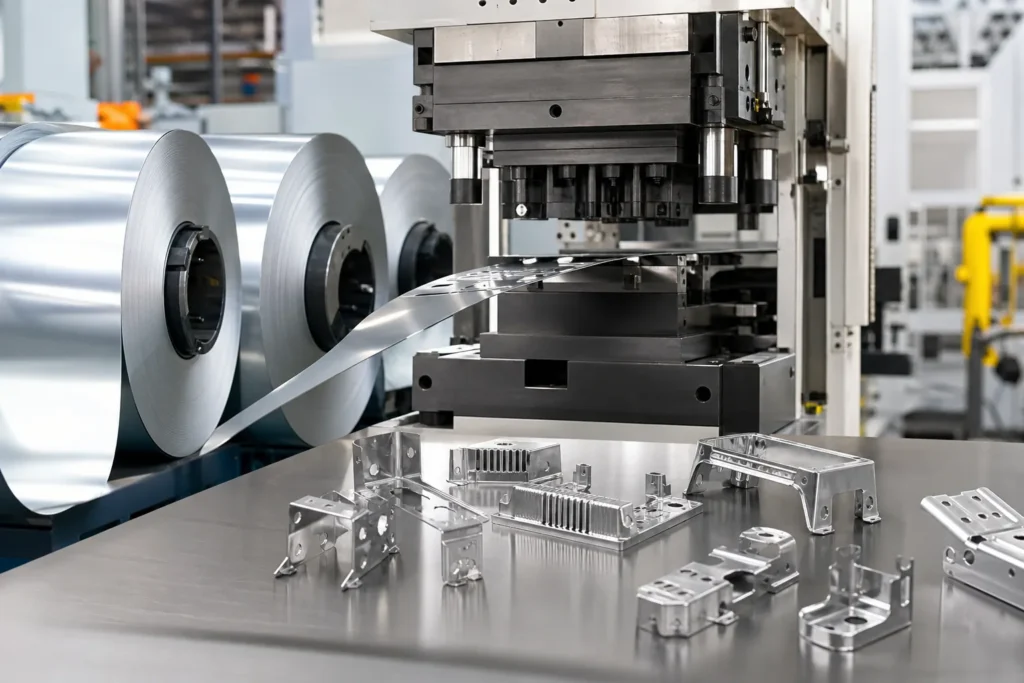
Choosing the best metal stamping parts supplier is not simply about finding the lowest unit price. For procurement teams, engineers, and product managers, the right decision depends on tolerance capability, tooling control, material knowledge, quality systems, lead time reliability, and production capacity. A supplier that looks inexpensive during quotation can become costly if parts fail inspection, tooling changes are slow, or delivery cannot scale beyond prototype volume.
This guide compares common supplier types and practical selection criteria for buyers sourcing stamped brackets, clips, terminals, shields, washers, deep drawn parts, and other precision components. It is written to help you evaluate a metal stamping parts supplier with clear purchasing logic instead of marketing claims.
What Makes the Best Metal Stamping Parts Supplier?
The best supplier is the one whose process capability matches your part risk. A simple flat washer does not require the same supplier profile as a high-volume electrical contact with tight spring geometry. Before comparing quotes, define the application, drawing tolerance, material, annual demand, inspection requirements, and whether the project needs progressive die stamping, deep drawing, bending, tapping, plating, or assembly.
For precision parts, a capable precision metal stamping supplier should be able to discuss tolerance targets such as ±0.01mm where the design and material allow it, while also explaining when a more realistic tolerance improves manufacturability and cost. Good suppliers do not promise every feature at the tightest tolerance; they review the drawing and identify which dimensions are function-critical.
Comparison Table: Supplier Types Compared
| Supplier Type | Best Fit | Strengths | Risks to Check | Typical Buyer Questions |
|---|---|---|---|---|
| China precision stamping factory | Custom parts, medium to high volume, export projects | Tooling, stamping, secondary operations, and cost control in one facility | Verify communication, inspection reports, material traceability, and export experience | Can you support 10,000+ pcs/month and provide dimensional reports? |
| Local job shop | Small batches, urgent repair parts, local engineering support | Fast communication, easy visits, good for prototypes and low volume | May have higher unit cost and limited press range | Do you have the right press tonnage and in-house tooling capacity? |
| Trading company | Simple parts or buyers needing sourcing consolidation | Can compare multiple factories and manage communication | Less direct process control, weaker technical feedback, unclear accountability | Which factory will produce the parts, and who controls quality? |
| Large OEM supplier | Automotive, appliance, or electronics programs with strict systems | Strong quality documentation, automation, and stable mass production | Higher MOQ, slower response for small projects, less flexible pricing | Can you support PPAP, long-term contracts, and engineering changes? |
| General sheet metal fabricator | Large formed panels, enclosures, low-volume structural parts | Flexible fabrication, laser cutting, bending, welding, finishing | Not always optimized for high-speed progressive stamping | Is stamping or fabrication the better process for my annual volume? |
Key Criteria for Evaluating a Metal Stamping Parts Supplier
1. Tolerance and Process Capability
Do not evaluate tolerance only from a website statement. Ask for examples of similar parts, inspection equipment, and how the supplier controls burrs, flatness, hole position, bend angle, and springback. For demanding applications, check whether they can hold critical dimensions near ±0.01mm and whether they use CMM, optical measurement, gauges, or custom fixtures.
A strong custom stamping parts manufacturer should also provide design-for-manufacturing feedback. For example, changing a hole-to-edge distance, bend radius, or material thickness may reduce tool wear and improve production stability without hurting the function of the part.
2. Tooling Design and Maintenance
Tooling is the foundation of stamped part consistency. Progressive dies, compound dies, and deep drawing dies must be designed around material behavior, part geometry, expected volume, and press capacity. Ask whether the supplier builds dies in-house, maintains die records, and supports future engineering changes.
If your project requires repeat orders, tooling ownership should be clear before production starts. Buyers should confirm who owns the die, how it is stored, what happens if the project is transferred, and whether maintenance cost is included after a defined production quantity.
3. Production Capacity and Press Range
Capacity matters when demand increases. A supplier with 5-2,000 ton presses can usually cover a wider range of small precision clips, medium brackets, thick structural stampings, and larger formed components. However, tonnage alone is not enough. You should also check press bed size, feeder systems, die change efficiency, and whether the supplier can support stable monthly volume such as 10,000+ pcs/month.
For buyers comparing overseas suppliers, realistic lead time is another critical factor. A well-managed stamping project may require sample approval, tooling adjustment, surface treatment, packaging, and export logistics. For repeat production, many projects can be planned around 15-20 business days, but new tooling projects usually need a separate timeline.
4. Quality System and Documentation
For industrial and export sourcing, quality documentation reduces risk. Look for suppliers operating under ISO 9001:2015 or equivalent quality management systems. This does not guarantee a perfect part, but it indicates that the supplier should have controlled procedures for incoming material inspection, production checks, nonconformance handling, calibration, and corrective actions.
Ask for first article inspection reports, material certificates, plating reports, salt spray test data if corrosion resistance matters, and packaging standards. A serious supplier will welcome clear inspection criteria because it prevents disputes after shipment.
5. Material and Finishing Knowledge
Metal stamping performance depends heavily on material. Stainless steel, carbon steel, aluminum, brass, copper, phosphor bronze, and spring steel all behave differently during blanking, bending, and forming. A qualified supplier should understand how thickness, hardness, grain direction, and coating affect part performance.
Finishing is also important. Zinc plating, nickel plating, tin plating, passivation, black oxide, anodizing, powder coating, and deburring can change dimensions and surface performance. Buyers should define whether the part needs conductivity, corrosion resistance, cosmetic appearance, solderability, or wear resistance.
Recommended Buying Workflow
Start with a complete RFQ package: 2D drawing, 3D file if available, material grade, thickness, quantity, tolerance requirements, surface finish, application, inspection standard, and expected delivery schedule. If the drawing is incomplete, ask the supplier to identify missing data instead of guessing.
Next, compare quotations in layers. Tooling cost, unit price, sample lead time, mass production lead time, MOQ, payment terms, and shipping method should be reviewed together. A low tooling price may hide weak die life; a low unit price may assume looser inspection or different material.
If you are still defining the part, review process options on custom metal stamping services and compare component examples on metal stamping parts. These pages can help clarify whether your project needs blanking, bending, drawing, progressive stamping, or secondary assembly.
Red Flags When Selecting a Supplier
- The supplier quotes without asking about material, tolerance, annual volume, or finish.
- They promise ±0.01mm on all dimensions without reviewing function and process limits.
- They cannot explain whether parts are made in-house or outsourced.
- No inspection report, material certificate, or quality workflow is available.
- Lead time is vague, especially for tooling, samples, and repeat production.
- The quote does not separate tooling cost, unit cost, finishing, packaging, and freight assumptions.
When a China Precision Stamping Factory Is the Better Choice
A China precision stamping factory can be a strong option when the buyer needs custom tooling, repeatable quality, export packaging, and competitive cost for medium or high-volume programs. This is especially true for brackets, terminals, clips, shielding parts, and formed metal components used in electronics, automotive, appliances, machinery, and hardware.
However, buyers should still qualify the factory carefully. The best result usually comes from a supplier that combines engineering feedback, transparent tooling control, stable production capacity, and clear inspection standards. In other words, the right factory should help you reduce total purchasing risk, not just reduce the first quotation.
FAQ: Best Metal Stamping Parts Supplier
1. How do I choose the best metal stamping parts supplier?
Choose based on part complexity, tolerance capability, tooling experience, quality documentation, material knowledge, capacity, and communication. Do not rely only on unit price. Ask for similar case experience, inspection reports, and a clear production plan.
2. What information should I send for a stamping parts quotation?
Send a 2D drawing, 3D file, material grade, thickness, quantity, tolerance requirements, surface finish, application, inspection standard, and expected delivery schedule. If you need monthly production, state whether the demand is 1,000 pcs/month, 10,000+ pcs/month, or higher.
3. Is ISO 9001:2015 important for a metal stamping supplier?
Yes. ISO 9001:2015 helps show that the supplier has a structured quality management system. Buyers should still verify actual inspection methods, calibration records, and part-specific quality plans.
4. What is a realistic lead time for custom stamped parts?
For repeat production after tooling approval, 15-20 business days may be realistic for many projects. New tooling, complex forming, plating, or special material procurement can require a longer schedule.
5. Should I choose a factory or trading company?
Choose a factory when engineering control, tooling feedback, and direct quality responsibility are important. A trading company may help with simple sourcing or supplier consolidation, but buyers should confirm who actually manufactures and inspects the parts.
Conclusion
The best metal stamping parts supplier is not always the largest company or the lowest bidder. It is the supplier whose equipment, tooling knowledge, inspection system, and production capacity match your part requirements. By comparing supplier types, asking technical questions, and checking measurable data such as tolerance, lead time, certification, press range, and monthly output, buyers can make a sourcing decision that protects both cost and quality.