
Construction and building hardware applications create a consistent demand for metal stamped parts that combine structural reliability, material durability, and dimensional repeatability. Unlike consumer or decorative applications, construction-grade stamped parts must perform under load, environmental exposure, assembly force, and repeated mechanical stress. Design requirements are typically driven by building codes, structural standards, or OEM specification sheets rather than aesthetic preference.
We manufacture stamped metal parts for construction hardware, structural brackets, fastening components, and building system assemblies. Our capabilities cover a range of materials, part geometries, and production volumes that match the procurement patterns of construction OEM programs.
Looking for stamped construction parts? Send your drawing, material spec, and volume requirements to our contact page for a manufacturing review.
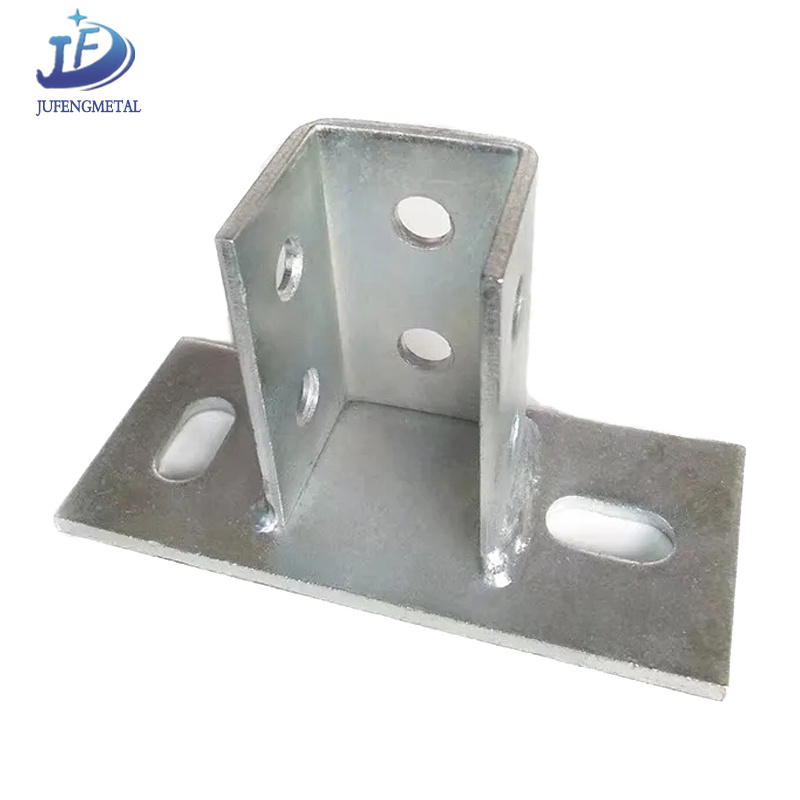
Typical Metal Stamped Parts for Construction
Construction applications use stamped metal parts across a wide range of building system types:
- Structural brackets and angles — framing supports, joist hangers, rafter ties, ridge connectors
- Anchor plates and base plates — column bases, hold-down hardware, anchor channels
- Strap and tie connectors — timber connectors, shear plates, hurricane ties, tension straps
- Clip angles and gussets — steel frame connectors, purlins, secondary framing support
- Seismic and wind-load hardware — shear connectors, tension-rated anchors, moment frame components
- Door and window hardware — hinges, strike plates, frame reinforcements, sill brackets
- Electrical and mechanical enclosures — panel supports, conduit brackets, cable trays
- Formed perforated parts — ventilation panels, grating, load-distribution plates
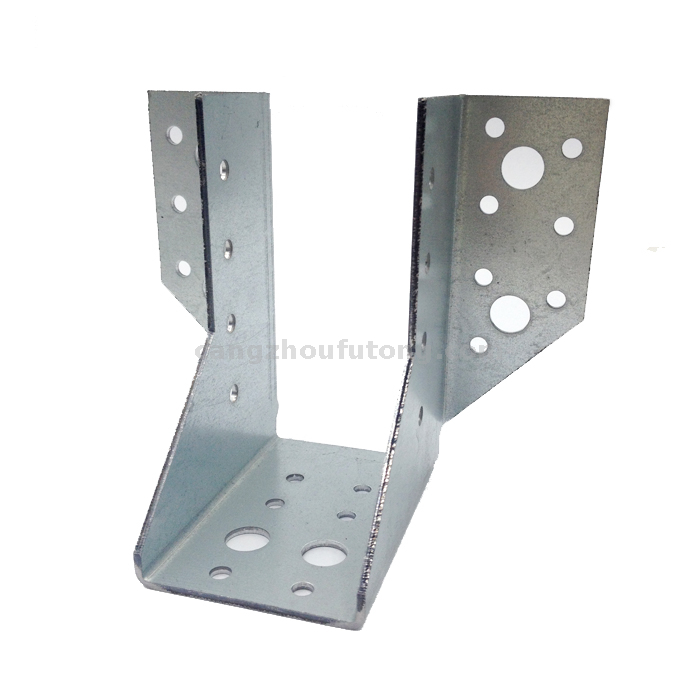
Materials for Construction Stampings
Construction stamped parts must meet environmental exposure and structural requirements over long service periods. Material selection depends on load bearing, corrosion environment, finish compatibility, and cost targets.
| Material | Key Properties | Construction Applications |
|---|---|---|
| Structural carbon steel (Q235, A36) | High strength, weldable, paintable, cost-effective | Load-bearing brackets, framing hardware, structural straps |
| Galvanized steel (SECC, DX51D+Z) | Zinc-coated for corrosion resistance, weldable after cutting | Exterior hardware, roofing connectors, exposed brackets |
| Stainless steel (304, 316) | Corrosion resistant, high strength, durable in wet environments | Coastal hardware, marine-adjacent applications, fasteners |
| Aluminum (6061, 5052) | Lightweight, corrosion resistant, non-magnetic | Curtain wall hardware, window hardware, lightweight brackets |
For construction hardware requiring hot-dip galvanizing, electroplating, or powder coat finishing, we accommodate post-stamping surface treatment as part of the project scope. See: steel stamping, stainless steel stamping, and aluminum stamping.
Stamping Processes for Construction Parts
Construction hardware typically involves thicker gauge material (1.2 mm to 6 mm), higher forming forces, and moderate-to-high production volumes. Common stamping approaches include:
- Progressive die stamping — for smaller hardware pieces, clips, connectors, and brackets with repeating features at high volume. See: progressive die stamping
- Sheet metal stamping — for larger cut-and-form parts such as base plates, angle irons, and cover panels. See: sheet metal stamping
- Compound die stamping — for flat punched parts with holes, slots, and simple forms produced simultaneously in a single stroke
- Metal forming operations — bending, flanging, coining, and embossing integrated into the tooling sequence. See: metal forming
For structural parts, tooling is designed with appropriate clearance and tonnage margins to handle the higher yield strength of structural steel grades.
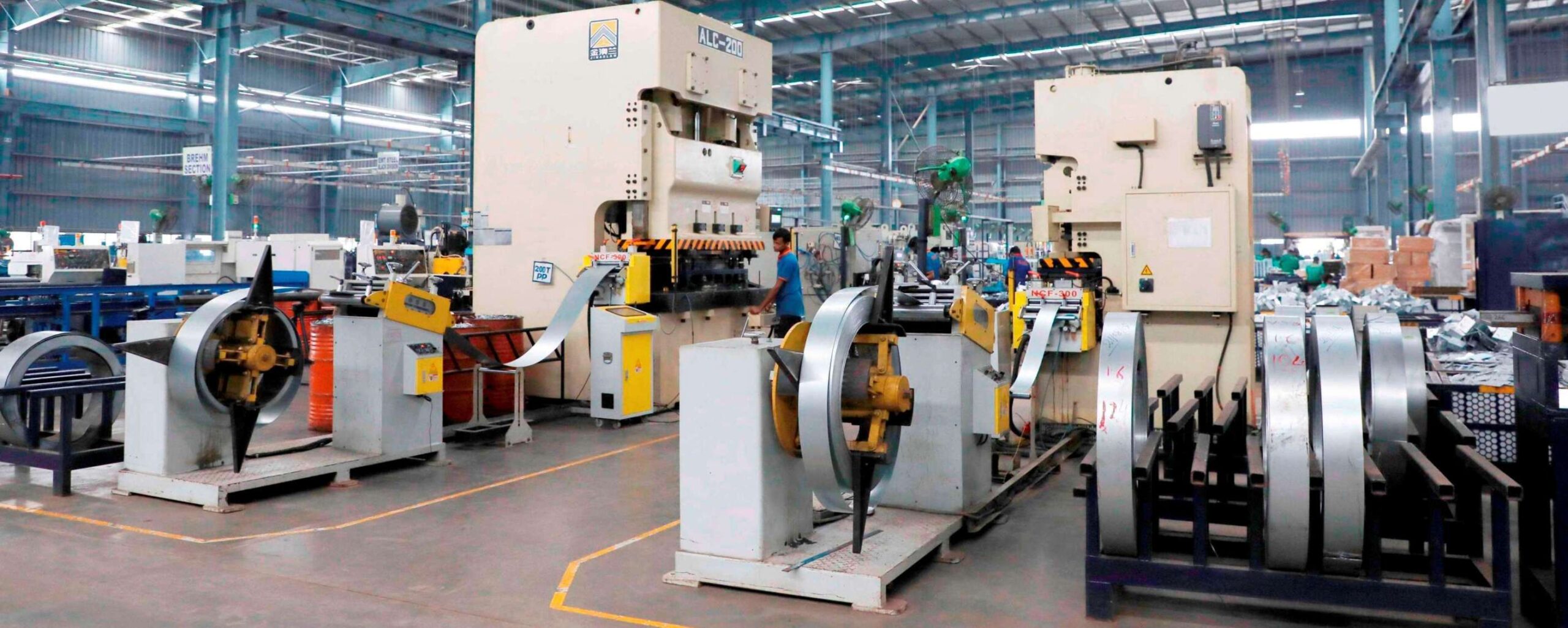
Design Considerations for Construction Stampings
Construction hardware design differs from precision electronics or automotive parts in several key ways:
- Gauge thickness — structural brackets are typically 1.5–5 mm thick, requiring higher press capacity and different tooling materials than thin-gauge precision stamping
- Hole patterns and bolt clearances — punched hole patterns must account for fastener tolerance and structural connection codes
- Surface finish and coating compatibility — many construction parts require hot-dip galvanizing, which means edge burrs, surface pores, and lap joints must be managed in the stamping design
- Batch flexibility — construction projects often use mixed volumes driven by project procurement cycles rather than steady weekly demand
- Load-path geometry — the position of bends, holes, and flanges affects structural performance; DFM review for construction parts includes basic stress-path logic
Industries Adjacent to Construction That We Serve
The skills and tooling used for construction metal stamping overlap with adjacent industries:
- Automotive — structural brackets, underbody supports, high-load formed parts. See: automotive stamping
- Aerospace — structural enclosures, formed panel supports. See: aerospace metal stamping
- Home appliances — structural frames, mounting hardware, motor support brackets. See: home appliance stamping
Why Source Construction Hardware from a Stamping Manufacturer
Construction hardware sourcing differs from precision component sourcing in several practical ways:
- Geometry is typically simpler — angles, straps, plates, and clips have fewer tight-tolerance features but require reliable material strength and consistent dimensions
- Volume and timing flexibility matters — project-driven procurement may need batch variations across seasons or project phases
- Material certification sometimes required — some construction codes require material traceability or mechanical property documentation for structural parts
- Surface treatment integration is common — construction parts often go through galvanizing, powder coat, or passivation before installation
We address all of these factors in the quoting and production planning process for construction metal stamping projects.
FAQ: Construction Metal Stamping
What metal stamped parts are used in construction?
Common construction stampings include structural brackets, anchor plates, strap connectors, joist hangers, clip angles, hurricane ties, door and window hardware, electrical enclosure supports, and perforated panels. Most are produced in carbon steel, galvanized steel, or stainless steel.
What thickness of steel can you stamp for construction parts?
We stamp parts from 0.5 mm up to 6 mm depending on material grade and press capacity. Most structural construction hardware falls in the 1.5–4.5 mm range. Parts above this thickness are typically machined or hot-formed rather than cold stamped.
Can you provide galvanized or pre-coated steel for construction stampings?
Yes. We can work with pre-galvanized coil (SECC, DX51D+Z) as the raw material, or coordinate post-stamp hot-dip galvanizing, powder coat, or zinc plating as part of the supply chain depending on project requirements.
Do you support custom construction hardware designs from drawings?
Yes. We manufacture custom construction hardware from engineering drawings, CAD files, or physical samples. All custom parts go through DFM review before tooling investment. See: custom metal stamped parts.
What is the typical lead time for construction stamping tooling?
For standard compound or progressive dies used in construction hardware, tooling build typically takes 3–6 weeks. First article samples follow. Production lead time after approval depends on order volume and current schedule.
Request a Quote for Construction Metal Stamping
Construction hardware programs benefit from a supplier who understands structural material behavior, batch procurement flexibility, and the tradeoffs between tooling investment and per-part economics at moderate volumes.
Construction Hardware Categories and Applications
Construction and building hardware covers a wide range of stamped metal components, each with specific structural, dimensional, and finish requirements. Understanding the application helps define the manufacturing approach:
- Structural brackets and connectors — L-brackets, T-brackets, joist hangers, and beam connectors transfer load between structural members. These parts typically require 2–5 mm carbon steel or galvanized steel, with hole patterns engineered for specific fastener sizes and load ratings.
- Anchor plates and base plates — used to connect structural steel to concrete foundations. These parts require flatness, hole position accuracy, and sufficient thickness to distribute bolt load without deformation.
- Strap ties and hurricane ties — metal straps that connect rafters, trusses, and studs to resist uplift and lateral forces. These are typically produced from 1–2 mm galvanized steel with multiple nail or screw holes. Volume is high and dimensional consistency is critical for code compliance.
- Clip angles and framing angles — used in steel frame construction for connecting beams, columns, and studs. These parts are usually formed from 1.5–4 mm steel with precise bend angles and hole patterns.
- Door and window hardware — hinges, strikes, keepers, reinforcement plates, and weatherstrip channels. These parts require tighter tolerances and better surface finish than structural hardware, and are often produced from stainless steel or pre-coated steel.
- Electrical enclosure supports and brackets — mounting brackets, panel supports, and cable management clips used in electrical installation. These parts must fit standard enclosure dimensions and support the weight of panels, conduits, and wiring.
Each category has different requirements for material, thickness, tolerance, finish, and volume. Our DFM review evaluates the specific application to recommend the right tooling strategy and process parameters.
Coating and Finish Options for Construction Stampings
Construction hardware is often exposed to moisture, UV, temperature cycling, and mechanical wear. The coating or finish system must match the service environment and the expected service life of the building:
- Pre-galvanized coil (SECC, DX51D+Z) — parts stamped from pre-galvanized coil have zinc protection from the start. This is the most common approach for interior construction hardware and light-duty exterior applications. The zinc layer may crack at tight bend radii, so tool design must minimize coating damage during forming.
- Hot-dip galvanizing (post-stamp) — for exterior and heavy-duty applications, parts are stamped from bare steel and then hot-dip galvanized after forming. This provides a thicker, more uniform zinc coating that is suitable for outdoor exposure and coastal environments.
- Powder coating — electrostatic powder coating provides a durable, decorative finish in a range of colors. Powder coat thickness is typically 60–120 µm and provides both corrosion protection and aesthetic appearance. Common for visible construction hardware and architectural components.
- Zinc plating (electroplating) — provides a thinner zinc layer than hot-dip galvanizing, suitable for interior hardware and applications where dimensional tolerance on plated features is important. Chromate conversion can be added for additional corrosion resistance.
- Black oxide and phosphate coating — provides mild corrosion resistance and a dark appearance. Often used for fasteners and internal hardware where appearance is secondary to function.
Coating selection is part of the DFM and quotation discussion. We coordinate coating processes with qualified suppliers to ensure that the finished part meets both dimensional and finish requirements.
Frequently Asked Questions
What metal stamped parts are used in construction?
Common construction stampings include structural brackets, anchor plates, strap connectors, joist hangers, clip angles, hurricane ties, door and window hardware, electrical enclosure supports, and perforated panels. Most are produced in carbon steel, galvanized steel, or stainless steel.
What thickness of steel can you stamp for construction parts?
We stamp parts from 0.5 mm up to 6 mm depending on material grade and press capacity. Most structural construction hardware falls in the 1.5–4.5 mm range. Parts above this thickness are typically machined or hot-formed rather than cold stamped.
Can you provide galvanized or pre-coated steel for construction stampings?
Yes. We can work with pre-galvanized coil (SECC, DX51D+Z) as the raw material, or coordinate post-stamp hot-dip galvanizing, powder coat, or zinc plating as part of the supply chain depending on project requirements.
Do you support custom construction hardware designs from drawings?
Yes. We manufacture custom construction hardware from engineering drawings, CAD files, or physical samples. All custom parts go through DFM review before tooling investment.
What tolerances can you hold on construction brackets and connectors?
Hole position tolerance is typically ±0.1–0.3 mm. Bend angle tolerance is ±0.5°–2° depending on material thickness and bend length. Flatness tolerance depends on part geometry and material stress relief. Critical dimensions are verified during first article inspection.
What is the typical lead time for construction stamping tooling?
Progressive die tooling for construction hardware typically takes 3–5 weeks. Simpler single-hit or staged tooling can be completed in 2–3 weeks. Lead time depends on tool complexity, number of stations, and current engineering workload.
Contact us to discuss your construction metal stamping requirements — send drawings, material specification, volume estimate, and any finish or certification requirements.