
Custom metal stamped parts are produced from your engineering drawing, CAD file, or physical sample. The part geometry, material specification, dimensional tolerances, surface finish, and packaging requirements are all defined by the customer. The manufacturer’s job is to interpret those requirements accurately and translate them into tooling design, process selection, and production execution that meets them consistently.
We manufacture custom metal stamped parts for OEM programs, product assemblies, and precision component applications. Our process covers the full project arc — from initial design review and tooling strategy through first article sampling and long-run production. We work with a wide range of metals, part geometries, and production volumes, and we do not offer a single tooling approach for every situation.
Have a drawing ready? Send your CAD file, material callout, annual volume, and tolerance requirements to our contact page for a manufacturing review and quote.
What Makes a Stamped Part “Custom”
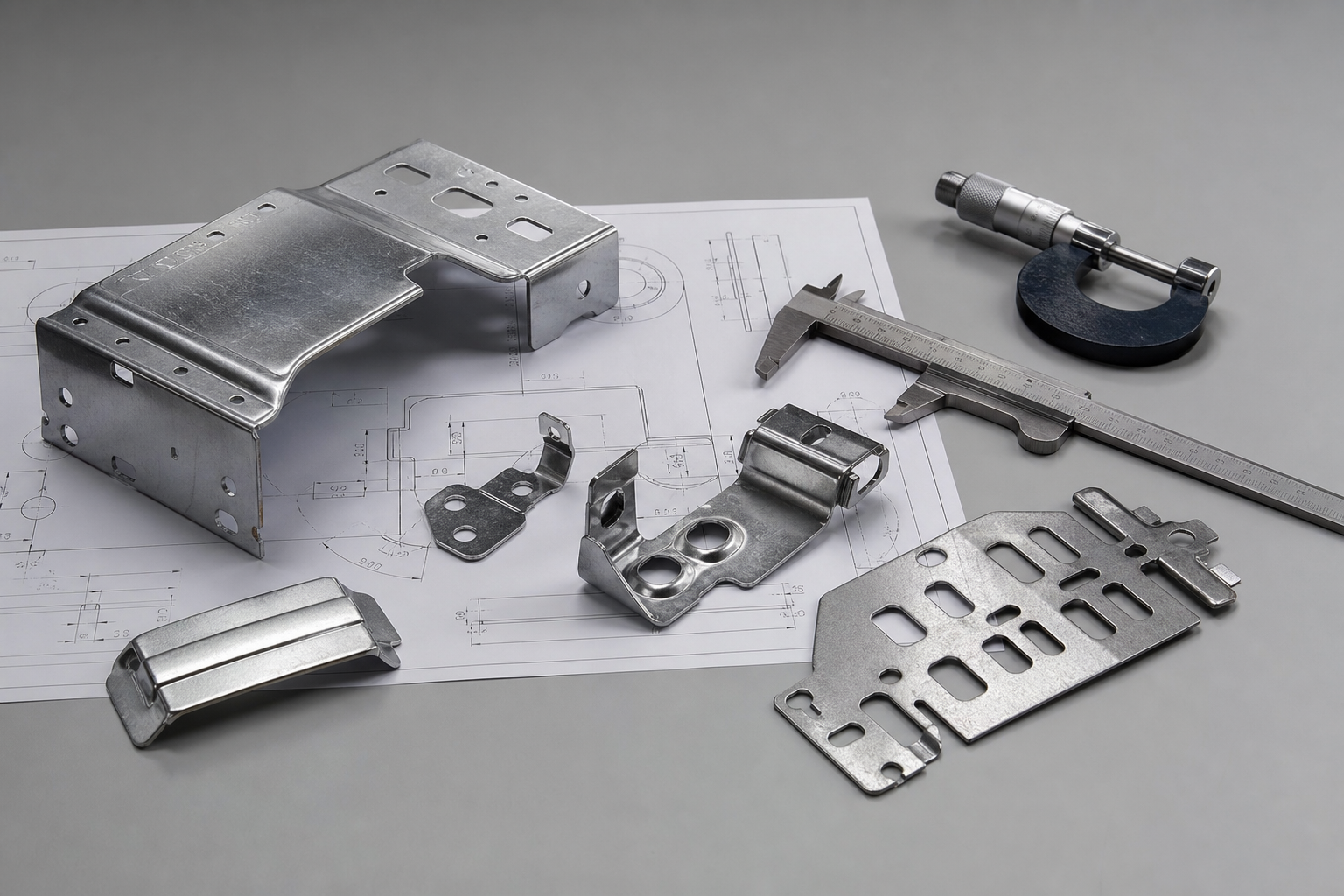
In metal stamping, custom means the tooling is built specifically for your part. Unlike catalog or standard-form parts, custom stamped parts require:
- A drawing or 3D model defining all geometry, tolerances, and feature positions
- Material specification including alloy, grade, temper, and surface condition
- Thickness and coil width requirements for strip layout planning
- Finish requirements such as plating, coating, passivation, or bare metal
- Volume requirements that inform tooling investment decisions
- Assembly or fit requirements that define critical interfaces
The tooling built for your part belongs to your program. It can be maintained, revised, and used for re-orders as long as the part design is stable.
Custom Stamped Parts We Produce
We support a broad range of custom part categories across industries:
- OEM structural brackets — mounting, reinforcement, and load-bearing formed parts
- Electrical terminals and contacts — high-precision connectors, leads, and contact springs
- Enclosure and shielding panels — formed covers, EMI shields, housing components
- Springs, clips, and retention features — snap fits, retention clips, latch components
- Deep draw shells and cups — cylindrical or box-form containers, caps, and housings
- Precision flat parts — washers, shims, gasket substrates, and punched blanks
- Hinges and linkage components — formed pivot parts, latch hardware
- Multi-feature progressive parts — complex parts with punching, forming, bending, and embossing in a single strip
Materials for Custom Stampings
Material choice affects formability, springback behavior, tooling wear, part strength, and downstream performance. We produce custom stamped parts in:
| Material | Common Grades | Why It’s Used |
|---|---|---|
| Carbon steel | SPCC, DC01, Q235, SECC | Structural strength at low cost; weldable, paintable |
| Stainless steel | 304, 316L, 301, 430 | Corrosion resistance, cleanable, durable for long service |
| Aluminum | 5052-H32, 3003, 6061-T6 | Weight reduction, corrosion resistance, machineable |
| Copper | C11000, C10200 | Electrical conductivity; used in terminals and contacts |
| Brass | C26000, C28000 | Formability and corrosion resistance; decorative-functional |
Material-specific detail pages: steel stamping, stainless steel stamping, aluminum stamping, copper stamping, and brass stamping.
Tooling for Custom Stamped Parts
The tooling strategy for a custom stamped part depends on part geometry, material behavior, feature count, and annual volume. Main options include:
- Progressive die — multiple operations in sequence on a continuous strip. Most efficient for high-volume, small-to-medium parts. See: progressive die stamping
- Compound die — simultaneous operations in a single stroke. Used for flat punched parts with low feature count and moderate volume
- Transfer die — parts transferred between stations. Suited for larger or complex parts that cannot run on a progressive strip
- Deep draw tooling — radial forming of shells and cups. See: deep draw stamping
- Single-hit or staged forming — for prototype quantities or low-volume parts where progressive investment is not justified
Tooling selection is determined during DFM review before any investment is made.
DFM Review for Custom Stampings
Before tooling is built, a design-for-manufacturing review should confirm:
- Bend radius vs. material thickness relationship
- Hole size vs. material thickness constraints
- Feature-to-edge and feature-to-feature minimum spacing
- Strip layout efficiency and material yield
- Springback prediction for formed angles
- Burr direction relative to assembly orientation
- Tolerance feasibility vs. process capability
DFM issues caught before tool build avoid costly corrections mid-project. We include DFM feedback as part of the quoting process.
Industries Using Custom Metal Stamped Parts
- Automotive — seat hardware, clip assemblies, mounting brackets, retention parts. See: automotive stamping
- Electronics and electrical — custom terminals, contact springs, connector housings, EMI components. See: electronics stamping
- Medical devices — precision stainless and formed components for device structure and mechanism. See: medical device stamping
- Aerospace — structural support stampings with material traceability requirements. See: aerospace metal stamping
- Home appliances — motor linkage parts, fastening hardware, formed panels. See: home appliance stamping
- Construction and industrial — custom anchors, support plates, formed hardware. See: construction metal stamping
From Drawing to Delivery: Our Custom Stamping Process
Engineering Review for Custom Stamped Parts
Before tooling design begins, every custom stamped part goes through an engineering review that evaluates the drawing from a manufacturing perspective. This DFM (Design for Manufacturability) review covers several areas that directly affect production feasibility and cost:
- Feature accessibility — can all dimensions on the drawing be achieved with stamping operations, or do some features require secondary machining, grinding, or assembly? Identifying this early prevents tooling designs that cannot produce the part as drawn.
- Material formability — does the specified material have enough ductility to achieve the drawn geometry without cracking, wrinkling, or excessive springback? Some combinations of tight radii, deep draws, and high-strength materials exceed the forming limits of cold stamping.
- Tolerance feasibility — are the drawn tolerances achievable with the proposed stamping process, or do some features need tighter control through coining, secondary operations, or process changes? The engineering review flags tolerances that increase cost or risk before they become production problems.
- Tooling strategy — progressive die, transfer die, compound die, or a combination? The choice depends on part geometry, volume, material, and the balance between tooling investment and unit cost. This decision is made during the engineering review, not after tooling design starts.
- Material utilization — strip layout and nesting affect how much material ends up as scrap. Optimizing material utilization during the design phase can reduce unit cost significantly, especially for high-volume programs.
The engineering review is provided as part of our quotation process. It gives you a manufacturing-based assessment of the part before you commit to tooling investment.
Tooling Types for Custom Stamped Parts
The tooling method chosen for a custom stamped part affects unit cost, dimensional capability, production speed, and tooling investment. We work with the following tooling types depending on part requirements:
- Progressive die tooling — the strip advances through multiple stations in a single press stroke. Each station performs one or more operations (piercing, bending, forming, blanking). Best suited for flat or moderately formed parts in medium to high volumes. Material utilization is optimized through strip layout design.
- Transfer die tooling — the part is separated from the strip early and transferred between stations as a discrete blank. Suited for larger parts, parts with complex 3D geometry, or parts that cannot remain on a strip due to size or forming requirements.
- Compound die tooling — multiple cutting operations (blanking and piercing) occur simultaneously in a single press stroke. Produces parts with very tight dimensional relationships between features. Used for flat parts where concentricity or position tolerance is critical.
- Single-hit and staged tooling — for low-volume or prototype runs, individual operations can be performed in separate press hits using simpler tooling. This reduces tooling investment but increases per-part labor and handling time.
Tooling type selection is part of the DFM and quotation process. We recommend the method that balances tooling cost, unit cost, dimensional capability, and delivery schedule for your specific part and volume requirements.
Frequently Asked Questions
What information do I need to get a quote for custom stamped parts?
A complete drawing or CAD file, material specification, thickness, annual volume, tolerance callouts, finish requirements, and any assembly or fit notes. The more complete the package, the more accurate the quote.
How long does tooling take for a custom stamped part?
Progressive and compound die tooling typically takes 3–6 weeks. Transfer dies and larger forming tools may take 5–9 weeks. Actual time depends on tool complexity and engineering workload.
Can I order a small prototype batch before mass production?
Yes. First article samples are produced from production tooling. In some cases, soft tooling or staged methods can be used for early validation before full production tooling investment.
Can you produce low-volume custom stamped parts?
Yes, though tooling investment must be justifiable against the planned volume. For very low quantities, we recommend evaluating whether progressive tooling or a simpler staged-forming approach better fits the economics.
What materials can you use for custom metal stamped parts?
We work with cold-rolled steel, stainless steel (304/316/430), aluminum alloys (5052/6061), copper, brass, phosphor bronze, and pre-coated steels (EG, GA, SECC). Material selection is reviewed during DFM to ensure it suits the part geometry and functional requirements.
Do you provide secondary operations for custom stamped parts?
Yes. We offer tapping, deburring, spot welding, riveting, plating, powder coating, and sub-assembly as integrated or post-stamp secondary operations. These are discussed during the quotation phase to ensure the complete part specification is covered.
Submit your drawing
— CAD file, DXF, PDF, or sample part plus material, volume, and finish requirements- Engineering review — we assess manufacturability, identify risks, and confirm the tooling strategy
- Quotation — tooling investment, unit pricing, lead time, and any recommended design modifications
- Tool build — die design, fabrication, and validation per your part geometry
- First articles — dimensional measurement, fit check, finish review, and approval
- Production — controlled runs with in-process inspection, shipment documentation, and ongoing support
Related pages: custom metal stamping, metal stamping parts, metal stamping manufacturer, precision metal stamping.
FAQ: Custom Metal Stamped Parts
What information do I need to get a quote for custom stamped parts?
A complete drawing or CAD file, material specification, thickness, annual volume, tolerance callouts, finish requirements, and any assembly or fit notes. The more complete the package, the more accurate the quote.
How long does tooling take for a custom stamped part?
Progressive and compound die tooling typically takes 3–6 weeks. Transfer dies and larger forming tools may take 5–9 weeks. Actual time depends on tool complexity and engineering workload.
Can I order a small prototype batch before mass production?
Yes. First article samples are produced from production tooling. In some cases, soft tooling or staged methods can be used for early validation before full production tooling investment.
Who owns the tooling for my custom stamped parts?
Tooling ownership terms depend on the project agreement. In most cases where the customer pays for tooling, they retain the right to transfer it. All terms are confirmed before project start.
Can you produce low-volume custom stamped parts?
Yes, though tooling investment must be justifiable against the planned volume. For very low quantities, we recommend evaluating whether progressive tooling or a simpler staged-forming approach better fits the economics.
Request a Quote for Custom Stamped Parts
We review your part from both a manufacturing and sourcing perspective. That includes tooling strategy, material behavior, process fit, and tolerance feasibility — before committing to a quote that cannot be supported in production.
Submit your drawing and requirements to get started. We respond with a manufacturing review and quotation.