
Your drawing says “brass.” Your supplier quotes three different alloys at three different prices. You pick the cheapest. Six months later, the parts are cracking in the assembly line.
That’s not a bad supplier. That’s a spec problem. Brass covers a family of copper-zinc alloys with properties that diverge sharply above 35% zinc. Picking the wrong one—or letting your supplier pick for you—is how you end up with parts that look right, quote right, and fail in service.
This guide gives you the framework to specify brass correctly the first time.
What Is Brass Stamping?
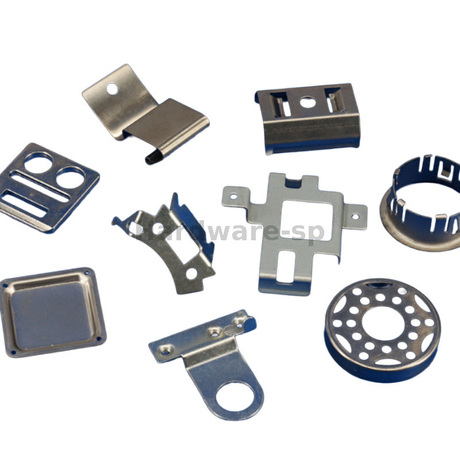
Brass stamping is the cold-forming of brass sheet or strip into precision components using progressive dies, compound dies, or transfer tooling. The process is identical mechanically to steel or aluminum stamping, but brass’s material characteristics—higher ductility, lower work-hardening rate, and excellent surface finish—make it the preferred choice for parts that need to look good, conduct electricity moderately well, and survive thousands of assembly cycles.
The most common brass stamped parts in B2B manufacturing:
- Electrical terminals and connectors — socket contacts, crimp terminals, bus bar clips
- Plumbing and fluid control fittings — valve bodies, compression ring blanks, port inserts
- Decorative hardware — furniture fittings, architectural trim, badge blanks
- Automotive connectors — relay housings, sensor brackets, ground straps
If your application requires full copper conductivity (>70% IACS), brass is the wrong material family. If it requires the strength of stainless steel, brass is also wrong. But for the large middle ground—moderate conductivity, excellent formability, good plating adhesion, and competitive price—brass is hard to beat.
The Two Alloys That Actually Matter: C26000 vs C36000
Ninety percent of brass stamping work uses one of two alloys. Everything else is an edge case.
C26000 — Cartridge Brass (70/30)
Conductivity: 27% IACS
C26000 is 70% copper, 30% zinc. The name “cartridge brass” comes from its original application—ammunition casings—which tells you everything about its formability. It draws deep, bends tight, and springs back predictably.
Key properties:
- Tensile strength (half-hard): 480 MPa
- Yield strength (half-hard): 380 MPa
- Elongation: 8%
- Minimum bend radius (across grain): 0.5t
- Minimum bend radius (with grain): 1.0t
Use it when: complex geometry, multiple bends, tight radii, or high-cycle assembly are involved. C26000 is the default choice for connector housings, terminal brackets, and decorative stampings that will be plated.
Don’t use it when: the part requires machining after stamping (C36000 machines 3× faster), or when dezincification is a concern in marine or hot-water environments.
C36000 — Free-Cutting Brass (61.5/35.5/3)
Conductivity: 26% IACS
C36000 adds 3% lead to the 60/40 brass matrix. That lead content makes it the most machinable metal alloy commercially available—but it significantly reduces formability. Bends that C26000 handles in a single hit require two operations in C36000, and tight radii crack.
Key properties:
- Tensile strength (half-hard): 415 MPa
- Yield strength (half-hard): 310 MPa
- Elongation: 5%
- Minimum bend radius (across grain): 1.5t
- Minimum bend radius (with grain): 2.5t
Use it when: the stamped blank requires significant secondary machining—threading, boring, milling features that can’t be stamped. The machining savings offset the forming penalty.
Don’t use it when: the part has tight bends, thin walls (< 0.5mm), or must meet RoHS compliance (lead is restricted in electrical and electronic equipment sold in the EU and UK).
The One Alloy Most Engineers Overlook: C27200 (65/35)
C27200 sits between C26000 and C36000 in both zinc content and properties. It offers better formability than C36000 with lower cost than C26000. For parts with moderate complexity and cost sensitivity, C27200 is often the right answer—but it rarely appears in standard quotation menus, so you have to ask for it explicitly.
Brass vs. Copper for Stamped Parts
The question comes up constantly: when does copper (C11000) beat brass (C26000)?
| Property | C11000 Copper | C26000 Brass | C36000 Brass |
|---|---|---|---|
| Conductivity (IACS) | 100% | 27% | 26% |
| Tensile Strength (half-hard, MPa) | 260 | 480 | 415 |
| Yield Strength (half-hard, MPa) | 220 | 380 | 310 |
| Formability | Good | Excellent | Moderate |
| Machinability | Poor | Moderate | Excellent |
| Relative Material Cost | High | Medium | Medium-Low |
| Plating Adhesion | Excellent | Excellent | Good |
| RoHS Compliance | Yes | Yes | No (Pb) |
Pick copper (C11000) when current density exceeds 3 A/mm² and cross-section is constrained—busbars, battery tabs, high-current terminals.
Pick C26000 brass when conductivity is secondary and formability, cost, or appearance matters more—connector housings, decorative parts, low-current terminals.
Pick C36000 brass when the part needs significant post-stamp machining and doesn’t ship into RoHS-regulated markets.
Most engineers who switch from C11000 to C26000 for connector housings see 25–35% material cost reduction with no measurable impact on electrical performance.
Mechanical Properties and Formability
Temper Selection
Brass is sold in tempers that reflect cold-work level. The right temper depends on your forming operations:
- Annealed (O60): Maximum formability, lowest strength. Use for deep draws, severe bends, or multi-stage forming.
- Quarter-hard (H01): Light forming, moderate strength. Most common for flat blanks with simple bends.
- Half-hard (H02): Good strength, limited forming. Use for parts that need spring-back control or final hardness.
- Full-hard (H04): Maximum strength, minimal formability. Use for spring contacts or clip designs where elastic return matters.
Work Hardening
Brass work-hardens with each forming operation. C26000 has a moderate work-hardening rate—harder than pure copper, softer than phosphor bronze. For parts with more than 3–4 forming stations, plan for intermediate annealing or design forming steps to keep strain below 30% per stage.
Springback
All brass tempers spring back after forming. Half-hard C26000 typically requires 2–3° overbend compensation on 90° bends. Full-hard tempers require 5–8°. Phosphor bronze (C51000) is far worse for springback—if you’re specifying brass for a spring application, make sure it’s actually a spring application, not just a part that needs to flex once or twice.
Surface Finishes for Brass Stampings
Bare brass oxidizes—not as fast as copper, but faster than most engineers expect. Unprotected brass turns from gold to brown within weeks at room humidity, and green in wet environments. In most applications, some surface treatment is required.
Tin Plating (Most Common for Electrical)
2–8 µm electrodeposited tin over brass. Protects against oxidation, improves solderability, and reduces insertion force in connector applications. Compatible with standard wave and reflow soldering profiles up to 232°C.
Cost: Low. The default choice for electrical terminals.
One caveat: tin whiskers. In RoHS-compliant bright tin plating, whisker growth can cause shorts in densely populated electronics. For high-reliability applications, specify matte tin or tin-copper alloy plating.
Nickel Plating
3–10 µm nickel over brass (usually with a copper strike for adhesion). Higher hardness than tin, better wear resistance, and more stable contact resistance over temperature cycling. Use for connectors with high mating cycles (>500 insertions) or elevated operating temperatures.
Gold Plating (Selective)
0.1–1.0 µm hard gold over nickel undercoat. Used for low-resistance, high-reliability signal contacts. Selective plating (only on contact areas) keeps cost manageable. Specify gold thickness based on mating cycles—0.2 µm is sufficient for 25 cycles, 0.5 µm for 200 cycles, 1.0 µm for 500+ cycles.
Lacquering and Clear Coating
For decorative brass stampings (furniture hardware, architectural trim, badge blanks), clear lacquer or electrophoretic clear coating preserves the gold appearance without changing dimensions. Lacquer is not suitable for electrical contact surfaces.
Passivation / Chromate Conversion
Chemical treatment creating a thin oxide barrier. Adequate for indoor storage protection and non-contact surfaces. Adds minimal cost and no significant dimension change.
Polishing
For high-end decorative applications, mechanical polishing to a mirror finish before lacquering. Adds significant cost (typically 3–5× the base stamping cost for the polishing operation alone) and is rarely justified in functional B2B parts.
Industries and Applications
Electrical and Electronics
Brass’s combination of moderate conductivity, excellent plating adhesion, and formability makes it the dominant material for:
- Crimp terminals: C26000 half-hard, tin-plated
- PCB edge connectors: C26000 annealed, selective gold
- Relay housings and brackets: C26000 quarter-hard, nickel-plated
- Grounding clips: C26000 or C27200, zinc-plated
Plumbing and Fluid Systems
C36000’s machinability makes it standard for fittings that require threading or precision bores after stamping. Compression ring blanks, valve seats, and port inserts are typically C36000. Note: for potable water applications in California and Vermont, low-lead brass (< 0.25% Pb) is required by law—C36000 doesn't qualify.
Automotive Connectors
Connector housings and terminal brackets in automotive applications see temperature cycling from -40°C to +125°C. C26000 half-hard with nickel plating handles this range reliably. For under-hood applications above 150°C, consider phosphor bronze or beryllium copper instead.
Decorative Hardware
Furniture fittings, door hardware, and architectural trim use C26000 annealed for complex forming, then polished and lacquered or plated to the final appearance specification. Lead times for decorative stampings are typically longer due to the multi-step finishing process.
Design Guidelines for Brass Stampings
Follow these rules to prevent the most common rework requests:
Minimum hole diameter: ≥ 1.2× material thickness. Smaller punches wear faster and produce rough hole edges in brass, which can cause plating adhesion problems.
Minimum inside corner radius: ≥ 0.3mm for C26000, ≥ 0.5mm for C36000. Sharp inside corners crack in harder tempers and create stress concentration points under vibration loading.
Bend radius by temper:
- Annealed: 0.5t minimum (across grain)
- Quarter-hard: 1.0t minimum (across grain)
- Half-hard: 1.5t minimum (across grain)
- Full-hard: 2.5t minimum (across grain)
Always specify bends across the rolling direction (perpendicular to the strip feed direction) where possible. Bends parallel to rolling direction require 2× the radius.
Emboss depth: Limit to ≤ 25% of material thickness in a single hit. Deeper embosses need a restrike operation.
Carrier strip width: For progressive die work on material < 0.3mm thick, maintain ≥ 1.8mm carrier strips. Narrower carriers cause strip buckling and feed errors.
Flatness: Brass parts tend to warp during multi-stage forming due to internal stress release. If flatness tighter than 0.1mm/100mm is required, add a coin (sizing) operation at the final station.
Tolerances (standard production, 10,000–500,000 pcs):
| Feature | Standard | Tight |
|---|---|---|
| Blank dimension | ±0.05mm | ±0.02mm |
| Hole diameter | ±0.03mm | ±0.01mm |
| Bend angle | ±1.0° | ±0.5° |
| Flatness | 0.1mm/100mm | 0.05mm/100mm |
Frequently Asked Questions
What is the difference between brass stamping and copper stamping?
The main differences are alloy composition, conductivity, and cost. Copper (C11000) offers 100% IACS conductivity but is softer and more expensive. Brass (C26000) offers 27% IACS conductivity with better formability and lower cost. For electrical terminals where conductivity is critical, use copper. For connector housings, decorative parts, or applications where moderate conductivity is acceptable, brass is typically the better choice. See our Copper Stamping Guide for a full comparison.
Is C36000 brass RoHS compliant?
No. C36000 contains approximately 3% lead, which exceeds the RoHS limit of 0.1% by weight in homogeneous materials for electrical and electronic equipment sold in the EU, UK, and increasingly California. If your parts ship into regulated markets, specify C26000 or another lead-free brass. If your parts are outside RoHS scope (plumbing fittings, automotive non-electrical components), C36000 remains acceptable.
What’s the minimum order quantity for custom brass stampings?
It depends on whether tooling is already made. For new tooling, most suppliers require 5,000–10,000 pieces per order to amortize progressive die costs (typically $3,000–$15,000 USD depending on complexity). For prototype quantities of 100–500 pieces, ask about soft tooling (aluminum dies) as an interim solution. Once production tooling exists, minimum orders of 1,000–2,000 pieces are common.
How long does brass stamping tooling take?
For a standard progressive die (4–8 stations): 3–5 weeks. Simple blanking or forming dies: 1–2 weeks. Complex dies with tight tolerances or thin material (< 0.2mm): 6–8 weeks. Always confirm lead time at the quoting stage—tooling lead time is the most common schedule risk for new programs.
Get a Quote for Your Brass Stamping Project
Whether you need C26000 cartridge brass connector terminals, C36000 plumbing fittings, or decorative hardware stampings with custom plating—bring us your drawing and we’ll quote alloy, tooling, and per-piece price at your volume.
Request a Free Quote — We respond within 24 hours with a detailed breakdown.
Related resources: Copper Stamping Guide · Metal Stamping Services · What Is Metal Stamping?
Our precision metal stamping capabilities ensure superior part quality. Get a quote for custom metal stamped parts.
Frequently Asked Questions
What is custom brass stamp?
Custom brass stamp is a specialized manufacturing process used to create precise metal components. Our team has over 25 years of experience delivering high-quality results for global clients across automotive, aerospace, electronics, and construction industries.
What tolerances can you achieve for custom brass stamp?
We achieve standard tolerances of ±0.05mm, with precision tolerances down to ±0.02mm for critical applications. All parts are inspected using CMM equipment with Cpk≥1.33 process capability.
What materials do you work with for custom brass stamp?
We work with a wide range of materials including aluminum (1100-6061), stainless steel (301-430), carbon steel, copper, brass, phosphor bronze, and specialty alloys. Material thickness ranges from 0.1mm to 12mm.
What is your minimum order quantity for custom brass stamp?
We accept prototype orders starting from 1 piece. For production runs, we recommend starting at 1,000 pieces for cost efficiency, though we accommodate various volumes based on project requirements.
How do I get a quote for custom brass stamp?
Submit your drawings (DWG, DXF, STEP, IGES, or PDF) via our contact form or email. We provide DFM feedback and pricing within 24 hours. Our engineering team reviews every inquiry for optimal manufacturability.
What quality certifications do you have for custom brass stamp?
We maintain ISO 9001:2015 and IATF 16949 certifications with full traceability. Every shipment includes inspection reports, material certificates, and compliance documentation as required.