
By Liu Zhou | Updated May 2026
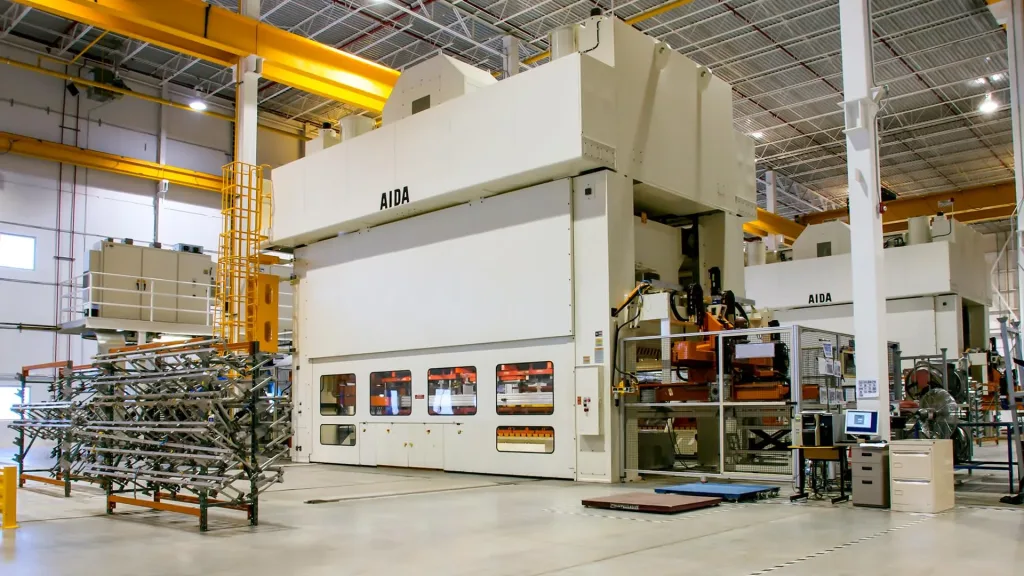
When selecting a stamping method for high-volume metal parts, the choice between progressive die stamping and compound die stamping directly impacts tooling cost, throughput, part quality, and production flexibility. Progressive dies carry a continuous strip through multiple stations, performing one operation per station per press stroke. Compound dies perform multiple operations — blanking and forming, or punching and blanking — simultaneously in a single station during one press stroke. Both are proven production methods, but they solve fundamentally different manufacturing problems.
This guide compares progressive and compound die stamping in depth, explains when each is the better choice, and provides a practical decision framework for tooling engineers and manufacturing process planners.
How Progressive Die Stamping Works
Progressive die stamping feeds a continuous metal strip or coil through a sequence of stations inside a single die set mounted in a mechanical or servo press. The strip advances one pitch per stroke, and each station performs a distinct operation — piercing, forming, bending, drawing, coining, or cutting — until the finished part is separated from the carrier strip at the final station.
A typical progressive die may include:
- Pilot piercing stations — Establish registration holes early in the strip to maintain alignment across all subsequent stations.
- Pre-forming stations — Create preliminary features such as extrusions, louvers, ribs, or embossments before the main forming operations.
- Bending and forming stations — Fold tabs, flanges, brackets, or shallow drawn features to specified angles and depths.
- Coining and sizing stations — Add precision thickness variations, lettering, or tight-tolerance features.
- Cut-off / separation station — The finished part is punched free from the carrier strip and ejected from the die.
The strip itself acts as the workpiece carrier, maintaining positional registration between stations via pilot pins and alignment notches. This means every stroke of the press produces a finished part, making progressive dies exceptionally efficient at high volumes.
Progressive Die Advantages
- Extremely high throughput — 200 to 1,500+ parts per minute depending on part size and complexity.
- Exceptional repeatability — Dimensional consistency across millions of parts with minimal operator intervention.
- Lowest per-part cost at scale — Every stroke produces a finished part; tooling amortization is spread across enormous volumes.
- Reduced labor — One operator, one press, fully automated strip feed and part takeaway.
- Multi-operation integration — Combine blanking, piercing, forming, bending, and coining in a single die.
Progressive Die Limitations
- High tooling investment — A complete progressive die costs $50,000–$500,000+ depending on complexity.
- Longer lead time — 8–16 weeks for design, machining, wire EDM, and tryout.
- Material waste from carrier strip — The carrier skeleton (scrap web) reduces material utilization to 60–85% for many geometries.
- Not ideal for very deep draws — Deep drawing stations in progressive dies are limited to shallow depth-to-diameter ratios.
How Compound Die Stamping Works
Compound die stamping performs multiple cutting or forming operations simultaneously at a single station during one press stroke. The most common compound die configuration blanks and pierces (or blanks and forms) a part in a single hit. Unlike progressive dies, there is no strip advance between operations — all operations happen at the same instant.
A compound die typically consists of:
- A single punch-and-die station — The punch descends and the blanking punch cuts the outer profile while the piercing punch creates internal features (holes, slots, or cutouts) in the same stroke.
- Integrated forming elements — In compound blank-and-form dies, a forming punch or die section creates flanges, cups, or shallow drawn features simultaneously with the blanking operation.
- Stripper plate — Separates the finished part from the punch on the upstroke and holds the strip flat.
- Die block and bolster — The lower die assembly that supports all cutting and forming elements in precise alignment.
Because all operations occur at once, compound dies produce parts with exceptional positional accuracy between features — the blank profile and internal features are created in the same stroke, eliminating cumulative tolerance stack-up from multiple stations.
Compound Die Advantages
- Superior feature-to-feature accuracy — All features are cut or formed simultaneously, so positional tolerances between the blank outline and internal features are limited only by die manufacturing precision (±0.01–0.025 mm is achievable).
- Simpler die construction — Fewer stations, no strip advancement mechanism, no carrier strip — the die is often smaller and less complex than a progressive die.
- Higher material utilization — No carrier strip or skeleton; blanking layouts can achieve 80–95% material utilization depending on geometry.
- Lower tooling cost — A compound die typically costs $15,000–$80,000 — significantly less than a progressive die of comparable part complexity.
- Shorter lead time — 4–8 weeks for design, build, and tryout.
Compound Die Limitations
- Lower throughput — Each stroke produces only one part (or a small array of parts), compared to progressive dies that may run at 10–50× the speed.
- Part complexity ceiling — Compound dies are best for parts that can be completed in a single hit. Parts requiring multiple forming stages or sequential bends cannot be produced in a single compound operation.
- Manual or semi-automated handling — Parts must be removed from the die and strip manually or with simple automation, increasing labor per part.
- Press tonnage requirements — Because all operations happen simultaneously, the instantaneous force requirement is higher, often requiring a larger press than a progressive die making the same part at lower per-stroke force.
Progressive Die vs Compound Die: Head-to-Head Comparison
| Factor | Progressive Die Stamping | Compound Die Stamping |
|---|---|---|
| Number of Stations | 5–40+ stations in sequence | 1 station (all operations simultaneous) |
| Throughput (parts/min) | 200–1,500+ | 15–120 (depends on part size and press speed) |
| Part Complexity | High — sequential operations allow complex geometry, multi-step bends, shallow draws | Moderate — limited to what can be accomplished in a single stroke |
| Feature-to-Feature Accuracy | Good (±0.05–0.10 mm) but subject to cumulative station-to-station error | Excellent (±0.01–0.025 mm) since all features are cut simultaneously |
| Material Utilization | 60–85% (carrier strip waste) | 80–95% (no carrier strip) |
| Tooling Cost | $50,000–$500,000+ | $15,000–$80,000 |
| Maintenance | Higher — more stations, more wear points, pilot pin alignment critical | Lower — fewer components, simpler alignment |
| Best For | High-volume, multi-feature flat or lightly formed parts (connectors, brackets, clips, EMI shields) | Medium-volume, high-precision flat parts requiring tight feature-to-feature tolerances (precision washers, gaskets, laminations) |
When Compound Dies Are the Better Choice
Despite the popularity of progressive dies in high-volume manufacturing, compound dies are often the superior choice under specific conditions:
1. Tight Positional Tolerances Are Critical
When the tolerance between the outer blank profile and internal features (holes, slots, cutouts) must be held to ±0.01–0.025 mm, compound dies have a clear advantage. Because all features are cut in the same stroke, there is no station-to-station alignment error. This makes compound dies the preferred method for:
- Electrical laminations — Motor and transformer cores require exact alignment of slot patterns relative to the outer lamination profile.
- Precision washers and gaskets — Bolt hole patterns must be concentric with the outer diameter within tight tolerances.
- Sealing components — Any part where hole-to-edge distance directly affects sealing performance.
2. Material Utilization Is a Priority
The carrier strip in progressive dies can waste 15–40% of raw material. For expensive materials — beryllium copper, Monel, Inconel, titanium, or thick stainless steel — this waste translates directly into cost. Compound dies blank directly from the sheet or strip with no skeleton, achieving 80–95% material utilization. On a $40/kg material, the savings from a 15% improvement in utilization can be substantial over a production run.
3. Volume Is Moderate (10,000–500,000 Parts/Year)
At moderate volumes, the tooling cost of a progressive die may never be fully amortized. A compound die costing $30,000–$50,000 produces parts at acceptable speeds for annual volumes in the tens to hundreds of thousands, while a $200,000 progressive die would remain underutilized.
4. The Part Geometry Fits a Single-Hit Operation
Parts that are essentially flat profiles with internal features — no sequential bends, no multi-step forming — are natural candidates for compound dies. Examples include:
- Flat brackets with multiple hole patterns
- Electrical contact washers
- Shim plates and spacer discs
- Flat gaskets with complex outer profiles
5. Shorter Tooling Lead Time Is Needed
A compound die can be designed, built, and proven in 4–8 weeks — roughly half the lead time of a progressive die. For projects with aggressive launch timelines or where production must begin before a progressive die is ready, a compound die can serve as the initial production tool.
Cost-Speed Crossover Analysis
Understanding the economic crossover between progressive and compound die stamping is essential for making the right tooling investment.
The Trade-Off in Numbers
Consider a flat washer with a complex outer profile and three internal holes:
- Compound die: Tooling = $35,000; cycle time = 60 parts/min; labor = $0.05/part.
- Progressive die: Tooling = $150,000; cycle time = 400 parts/min; labor = $0.01/part.
At 25,000 parts, compound die per-part cost (tooling amortized) = $1.45/part vs progressive die = $6.01/part. Compound die is clearly more economical.
At 100,000 parts, compound die = $0.40/part vs progressive = $1.51/part. Compound die still wins.
At 500,000 parts, compound = $0.12/part vs progressive = $0.31/part. The gap narrows but compound die remains cheaper in this example.
At 2,000,000 parts, compound = $0.07/part vs progressive = $0.085/part. The crossover is approaching — and at even higher volumes, progressive die speed advantage dominates.
The crossover typically occurs between 1,000,000 and 5,000,000 parts for simple flat geometries that can be made in either die type. For more complex parts requiring multiple operations in a progressive die, the crossover point shifts lower (250,000–1,000,000 parts) because the progressive die’s multi-station advantage becomes more significant.
Beyond Direct Cost
The crossover analysis must also consider:
- Scrap material cost — Progressive die scrap (carrier strip) is continuous; compound die scrap is per-blank. At expensive material prices, the compound die’s higher utilization may shift the crossover further right.
- Quality cost — If the application demands very tight feature-to-feature tolerances, the compound die’s superior accuracy may eliminate secondary operations or inspection costs that a progressive die cannot avoid.
- Inventory and scheduling — A progressive die running at 400 ppm can build inventory quickly, but a compound die at 60 ppm provides more scheduling flexibility for low-volume, high-mix production.
Die Design Considerations
Progressive Die Design
Designing a progressive die requires expertise in strip layout, station sequencing, and carrier strip engineering:
- Strip layout optimization — The orientation of parts on the strip, the number of parts per strip width, and the carrier strip geometry all affect material utilization and die reliability.
- Station sequencing — Operations must be sequenced to manage material flow, prevent distortion, and maintain strip rigidity. Forming stations are typically placed after piercing stations; bending directions must account for strip flatness.
- Carrier strip engineering — The carrier (bridge or skeleton) must be strong enough to transport the strip through all stations without stretching, bending, or breaking. Carrier width and pilot hole placement are critical.
- Die material selection — Progressive dies stamp millions of parts; tool steel grades such as D2, M2, carbide inserts, or powder metallurgy steels (CPM-10V, CPM-15V) are specified for wear resistance.
- Simulation and tryout — Finite element analysis (FEA) of material flow, springback, and stress distribution is standard practice before committing to die steel cutting.
Compound Die Design
Compound die design focuses on achieving simultaneous operations with precision:
- Clearance control — Because blanking and piercing happen simultaneously, punch-to-die clearances must be precisely controlled for both the outer profile and all internal features. Different material thicknesses may require different clearances in the same die.
- Timing and synchronization — All cutting elements must contact the material at the same instant. A difference of even 0.05 mm in punch height can cause uneven loading, premature wear, and dimensional variation.
- Stripping force — Compound dies generate high stripping forces because multiple punches retract simultaneously. The stripper plate design must handle these forces without deflecting.
- Press selection — Because instantaneous tonnage is high (all operations in one hit), the press must have sufficient force capacity at the bottom of the stroke. Mechanical presses with high tonnage at bottom dead center are preferred.
- Die material — Because compound dies run at lower volumes, tool steel selection can be less aggressive — D2, A2, or even S7 for shock-prone operations may be adequate.
Real-World Examples
Example 1: Electrical Motor Lamination (Compound Die)
A manufacturer of small DC motors produces stator laminations from 0.35 mm silicon steel. The lamination has a circular outer profile with 12 precisely positioned stator slots. The tolerance between each slot and the outer diameter is ±0.02 mm. A compound die blanks the outer profile and punches all 12 slots in one stroke, achieving the required positional accuracy. A progressive die could also produce this part, but the station-to-station cumulative error would exceed the ±0.02 mm specification. Annual volume: 200,000 units. Tooling cost: $45,000. The compound die is the clear choice.
Example 2: Automotive Connector Terminal (Progressive Die)
An automotive Tier 1 supplier produces a copper alloy connector terminal with 8 piercing operations, 3 forming bends, and a coining step. Annual volume: 15 million parts. A 16-station progressive die runs at 600 ppm on a high-speed press with coil feed automation. Tooling cost: $280,000. At 15 million parts, per-part tooling amortization is under $0.02. The complexity and volume make progressive die stamping the only viable option — a compound die cannot perform the sequential forming operations required.
Example 3: Precision Stainless Steel Gasket (Compound Die)
A medical device manufacturer requires a 316L stainless steel gasket with a complex outer profile and 6 bolt holes. Tolerances are tight: ±0.015 mm on hole-to-edge distances. Annual volume: 50,000 units. Material cost is high ($28/kg for 316L sheet). A compound die achieves 92% material utilization and meets all tolerance requirements. Tooling cost: $28,000. A progressive die would cost $120,000, waste 25% more material, and the volume does not justify the investment. Compound die is the right choice.
Example 4: EMI Shield Bracket (Progressive Die)
A consumer electronics company needs a nickel-silver EMI shield bracket with 5 piercing operations, 2 bends at different angles, and a flanging operation. Annual volume: 8 million parts. A 10-station progressive die produces 350 ppm with integrated forming and bending. Tooling cost: $180,000. The sequential bends and multi-operation complexity make a compound die impossible — progressive die is the only viable stamping method.
Example 5: Shim Plate (Compound Die → Progressive Die Transition)
A heavy equipment manufacturer initially needs 20,000 shim plates per year from 2 mm hardened steel. A compound die ($22,000) produces the parts economically at 40 ppm. Three years later, demand grows to 500,000 units/year. At that volume, a progressive die ($95,000) running at 250 ppm becomes more cost-effective. The manufacturer transitions from compound to progressive die stamping, reducing per-part cost by 40%. This staged approach — compound first, progressive later — is a common and effective strategy.
Frequently Asked Questions
What is the main difference between a progressive die and a compound die?
The main difference is the number of stations and how operations are performed. A progressive die has multiple stations arranged in sequence, with the strip advancing one pitch per stroke — each station performs one operation per stroke. A compound die has a single station where multiple operations (blanking, piercing, forming) happen simultaneously during one press stroke. Progressive dies are built for high-volume, multi-step parts; compound dies excel at high-precision, single-hit parts.
When should I choose a compound die over a progressive die?
Choose a compound die when your part requires very tight feature-to-feature tolerances (±0.01–0.025 mm), when material utilization is critical (especially with expensive alloys), when annual volume is moderate (10,000–500,000 parts), when the part geometry can be completed in a single hit, or when tooling lead time and budget are limited. Compound dies are also preferred for electrical laminations, precision washers, gaskets, and flat brackets with tight hole patterns.
Can a progressive die replace a compound die for all applications?
No. While a progressive die can often produce the same parts as a compound die, there are cases where compound dies are superior. Parts requiring extreme positional accuracy between features benefit from compound dies because all features are cut simultaneously — there is no cumulative station-to-station error. Additionally, for moderate volumes, the lower tooling cost of a compound die makes it more economical. Progressive dies also waste more material due to the carrier strip skeleton, which matters when stamping expensive materials.
How does material utilization compare between progressive and compound dies?
Compound dies typically achieve 80–95% material utilization because they blank parts directly from the sheet or strip with no carrier strip waste. Progressive dies typically achieve 60–85% utilization because the carrier strip (skeleton web) that transports parts between stations consumes material. For a $30/kg material at 80% vs 65% utilization, the material cost difference over a 1,000,000-part run can exceed $100,000 — often enough to justify the compound die approach even at higher volumes.
What is the typical cost crossover volume between progressive and compound die stamping?
The cost crossover depends on part complexity, material cost, and the specific tooling quotes. For simple flat parts that can be made in either die type, the crossover typically occurs between 1,000,000 and 5,000,000 parts. For more complex parts requiring multiple operations, the crossover may occur as low as 250,000 parts because the progressive die’s multi-station capability delivers a larger per-part cost reduction. Always calculate tooling amortization, per-part cycle time cost, labor, and material waste to determine the exact crossover for your specific application.
Conclusion
The progressive die vs compound die stamping decision is not about which method is “better” in absolute terms — it is about matching the die type to the part geometry, tolerance requirements, production volume, and cost constraints.
Choose progressive die stamping when your part requires multiple sequential operations (piercing, forming, bending, coining), when annual volume exceeds 500,000–1,000,000 parts, and when per-part cost at scale is the primary driver.
Choose compound die stamping when your part can be completed in a single hit, when feature-to-feature tolerance is critical (±0.01–0.025 mm), when material utilization must be maximized, when volume is moderate (10,000–500,000 parts/year), or when tooling budget and lead time are constrained.
Many manufacturers start with compound dies for initial production and transition to progressive dies as volume grows — a staged approach that minimizes upfront tooling investment while maintaining the ability to scale.
For tooling engineers and process planners, the key is to evaluate each part individually: sketch the strip layout for a progressive die, estimate the compound die station count, calculate the cost crossover volume, and compare material utilization. The right answer is always application-specific.
Need help selecting the right die type for your next stamped part? Contact our tooling engineering team for a free feasibility review and cost analysis.
Published on metalstampingparts.ltd — Your source for precision metal stamping expertise.