
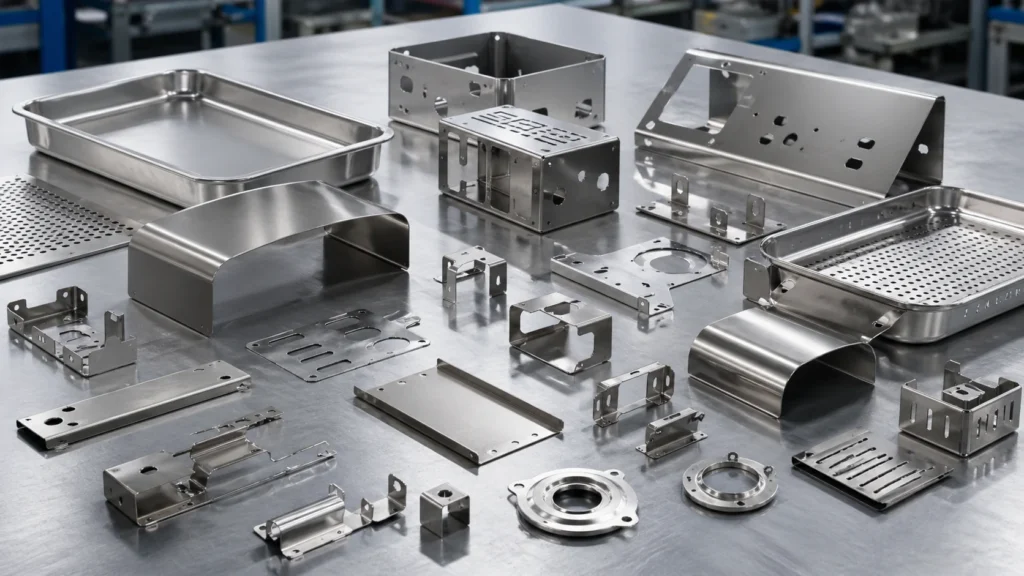
Stainless Steel Stamping Services
Stainless steel stamping produces durable, corrosion-resistant components for the most demanding applications in medical, food processing, marine, automotive, aerospace, chemical processing, and industrial environments. As specialists in stainless steel metal stamping, we understand the unique challenges of forming this material — higher forming forces, work hardening behavior, and springback compensation — and deliver defect-free parts that meet your exact specifications.
Our stainless steel stamping capabilities include progressive die stamping, deep drawing, blanking, piercing, bending, forming, and coining in austenitic, ferritic, martensitic, and precipitation-hardened stainless steel grades from 0.004 inches to 0.250 inches thick.
Stainless Steel Grades We Stamp
| Grade | Type | Key Properties | Common Applications |
|---|---|---|---|
| 301 | Austenitic | High work-hardening rate, good springiness | Springs, clips, retainers, structural parts |
| 302/304 | Austenitic | Excellent corrosion resistance, most common grade | Medical, food equipment, kitchen, architecture |
| 316 | Austenitic | Superior corrosion resistance (Mo added) | Marine, chemical processing, pharmaceutical |
| 409 | Ferritic | Good heat resistance, lower cost | Automotive exhaust, heat exchangers |
| 410 | Martensitic | Hardenable, moderate corrosion resistance | Cutlery, valve parts, fasteners |
| 430 | Ferritic | Magnetic, good formability, decorative | Appliance trim, automotive trim, kitchenware |
| 17-4 PH | Precipitation Hardened | Very high strength after heat treatment | Aerospace, medical implants, high-load parts |
Challenges of Stamping Stainless Steel
Stainless steel is more challenging to stamp than carbon steel or aluminum due to several material characteristics:
- Higher forming forces — stainless steel requires 50-70% more tonnage than equivalent carbon steel, demanding heavier presses and more robust tooling
- Work hardening — austenitic grades (301, 304, 316) harden rapidly during forming, requiring careful process planning to avoid cracking
- Springback — stainless steel springs back more than carbon steel after bending, requiring over-bend compensation in die design
- Galling — stainless has a tendency to gall (cold weld) against tooling surfaces, requiring specialized die coatings and lubricants
- Surface sensitivity — scratches and die marks are more visible on stainless steel’s bright surface, demanding polished tooling and careful handling
Our experience with stainless steel stamping means we engineer solutions for all these challenges, delivering parts that meet dimensional requirements without surface defects.
Applications
- Medical and surgical — instrument components, implant parts, device housings, surgical tray brackets, and sterilization equipment
- Food processing — equipment housings, conveyor components, mixer parts, and sanitary fittings
- Marine hardware — deck fittings, rigging hardware, fasteners, and structural brackets
- Automotive — exhaust system components, trim pieces, fuel system parts, and under-hood brackets
- Chemical processing — reactor components, valve parts, gaskets, and equipment brackets
- Architecture — decorative panels, facade brackets, handrail fittings, and elevator components
Surface Finishing
- Passivation — chemical treatment per ASTM A967 to restore the protective oxide layer after stamping
- Electropolishing — electrochemical polishing for ultra-smooth, hygienic surfaces (medical, pharmaceutical)
- Mechanical polishing — mirror, satin, or brushed finishes for decorative applications
- PVD coating — titanium nitride or similar coatings for wear resistance and decorative color
Request a Quote
Contact us at duoshaomali@gmail.com or call +86 152-5047-1868.