
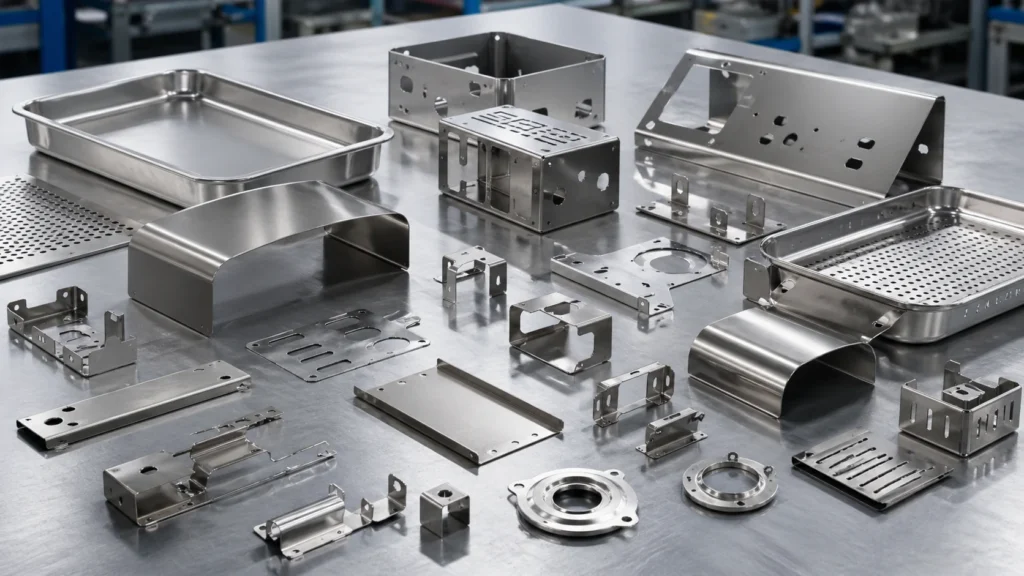
Stainless steel штампкунӣ produces durable, corrosion-resistant components for the most demanding applications in medical, food processing, marine, автомобилӣ, aerospace, chemical processing, and industrial environments. As spestainless steel штампкунии металлtal штампкунӣ, we understand the unique challenges of forming this material — higher forming forces, work hardening behavior, and springback compensation — and deliver defect-free parts that meet your exact specifications.
Мо stainless steel штампкунӣ capabilities include қолаби прогрессивӣ штампкунӣ, deep drawing, blanking, piercing,stainless steel grades coining in austenitic, ferritic, martensitic, and precipitation-hardened stainless steel grades from 0.004 inches to 0.250 inches thick.
Stainless Steel Grades We Stamp
| Grade | Type | Key Properties | Умумӣ Applications |
|---|---|---|---|
| 301 | Austenitic | High work-hardening rate, good springiness | Springs, clips, retainers, structural parts |
| 302/304 | Austenitic | Excellent corrosion resistance, most common grade | Medical, food equipment, kitchen, architecture |
| 316 | Austenitic | Superior corrosion resistance (Mo added) | Marine, chemical processing, pharmaceutical |
| 409 | Ferritic | Good heat resistance, lower cost | автомобилӣ exhaust, heat exchangers |
| 410 | Martensitic | Hardenable, moderate corrosion resistance | Cutlery, valve parts, fasteners |
| 430 | Ferritic | Magnetic, good formability, decorative | Appliance trim, автомобилӣ trim, kitchenware |
| 17-4 PH | Precipitation Hardened | Very high strength after heat treatment | Aerospace, medical implants, high-load parts |
304, 316 and 316L Stainless Steel штампкунӣ Selection
304 stainless steel штампкунӣ is the common choice for general corrosion resistance, food equipment, appliance parts, and medical components. 316 stainless steel adds molybdenum for better chloride and marine-environment resistance. 316L stainless steel uses lower carbon content to reduce carbide precipitation after welding, making it suitable for welded housings, medical assemblies, and corrosion-sensitive қисмҳои штампшуда.
Challenges of штампкунӣ Stainless Steel
Stainless steel is more challenging to stamp than carbon steel or aluminum due to several material characteristics:
- Higher forming forces — stainless steel requires 50-70% more tonnage than equivalent carbon steel, demanding heavier presses and more robust tooling
- Work hardening — austenitic grades (301, 304, 316) harden rapidly during forming, requiring careful process planning to avoid cracking
- Springback — stainless steel springs back more than carbon steel after bending, requiring over-bend compensation in die design
- Galling — stainless has a tendency to gall (cold weld) against tooling surfaces, requiring specialized die coatings and lubricants
- Surface sensitivity — scratches and die marks are more visible on stainless steel’s bright surface, demanding polished tooling and careful handling
Мо experience with stainless steel штампкунӣ means we engineer solutions for all these challenges, delivering parts that meet dimensional requirements without surface defects.
Applications
- Medical and surgical — instrument components, implant parts, device housings, surgical tray кронштейнҳо, and sterilization equipment
- Food processing — equipment housings, conveyor components, mixer parts, and sanitary fittings
- Marine hardware — deck fittings, rigging hardware, fasteners, and structural кронштейнҳо
- автомобилӣ — exhaust system components, trim pieces, fuel system parts, and under-hood кронштейнҳо
- Chemical processing — reactor components, valve parts, gaskets, and equipment кронштейнҳо
- Architecture — decorative panels, facade кронштейнҳо, handrail fittings, and elevator components
Surface Finishing
- Passivation — chemical treatment per ASTM A967 to restore the protective oxide layer after штампкунӣ
- Electropolishing — electrochemical polishing for ultra-smooth, hygienic surfaces (medical, pharmaceutical)
- Mechanical polishing — mirror, satin, or brushed finishes for decorative applications
- PVD coating — titanium nitride or similar coatings for wear resistance and decorative color
Stainless Steel штампкунӣ Specifications
Use this capability table to match stainless steel grades, material thickness, tolerance considerations, finishing requirements, and production needs to your stamped part project.
| Specification | Stainless Steel штампкунӣ Имконият |
|---|---|
| Stainless grades | 301, 302/304, 316, 409, 410, 430, 17-4 PH and other austenitic, ferritic, martensitic, and precipitation-hardened grades. | 0.004 in to 0.250 in, depending on grade, hardness, geometry, burr limits, and forming requirements. |
| Typical tolerances | Tight tolerances are available for critical features; springback, work hardening, grain direction, and burr control should be reviewed during DFM. |
| штампкунӣ processes | қолаби прогрессивӣ штампкунӣ, deep drawing, blanking, piercing, bending, forming, and coining. |
| Production volume | Prototype, pilot run, and production quantities; progressive dies are recommended for repeat high-volume stainless steel қисмҳои штампшуда. |
| Suitable parts | Medical components, food equipment parts, springs, clips, retainers, shields, кронштейнҳо, kitchen hardware, and marine hardware. |
| Surface finishes | Mill finish, brushing, polishing, passivation, electropolishing, bead blasting, deburring, and cleaning. |
| Industries | Medical, food processing, marine, автомобилӣ, aerospace, chemical processing, and industrial equipment. |
| RFQ path | Provide drawings, stainless grade, thickness, finish/passivation needs, tolerance class, annual volume, and corrosion or cleanliness requirements through the тамос/quote page. |
Нархро дархост кунед
бо мо тамос гиред at [email protected] or call +86 152-5047-1868.