
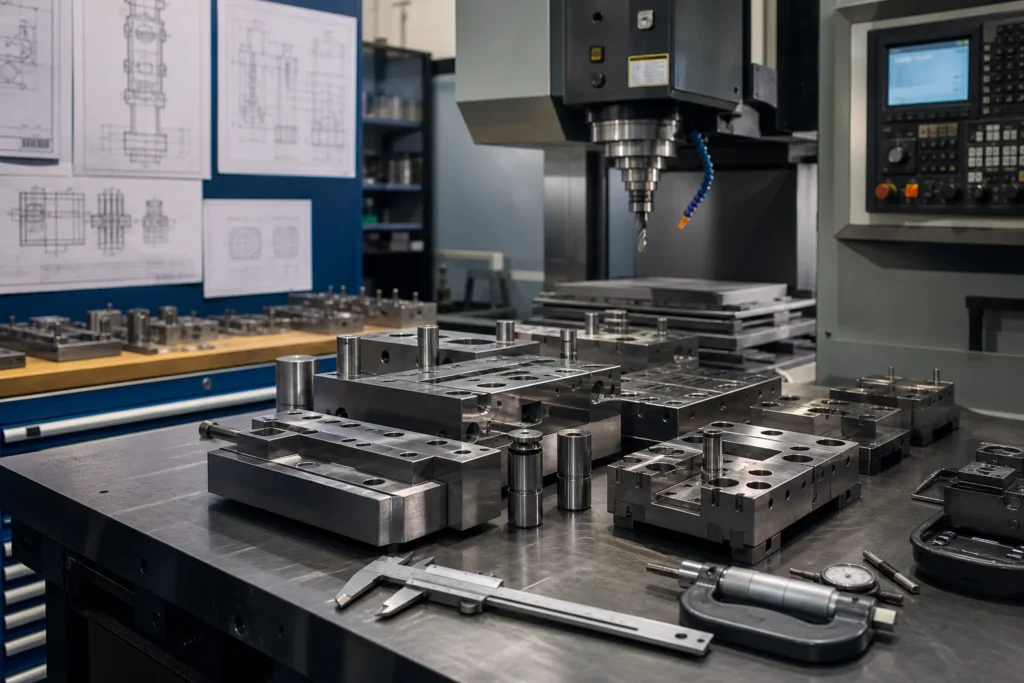
Short answer: Choose between a full duplicate tā die, critical spare inserts, and a transfer-ready backup according to outage cost, tool failure modes, program life, and recovery time. Do not assume a copied die or insert will be interchangeable. Freeze the design basis, document press and material conditions, then require new tryout samples and production approval for the selected route.
A second-source tooling RFQ should answer one narrow question: what physical and technical backup is justified if the production die becomes unavailable? This is different from qualifying another kaiwhakarato. The decision is about how much tooling to duplicate, what must remain replaceable, and how quickly controlled production can be restored.
Compare the three backup routes
| Route | Pai fit | Main RFQ risk |
|---|---|---|
| Full duplicate die | A long outage would threaten critical demand, the program has enough remaining life, and another press location must be able to produce independently. | The new die may copy outdated geometry or produce different results despite similar drawings. |
| Critical spare inserts | Known wear or breakage is concentrated in replaceable punches, inserts, pilots, springs, sensors, or other service items. | Wāhanga labeled as spares may not fit, align, or perform without fitting and revalidation. |
| Transfer-ready backup | The existing die can move, and recovery can rely on a controlled data package, reserved press route, bridge tool, or temporary operation. | Transport, setup, missing interfaces, and approval time may make the recovery slower than the plan suggests. |
Compare tool investment with the likely interruption, inventory coverage, remaining demand, and cost of reapproval. The taputapu tā cost guide can frame commercial inputs, while die modification versus new tooling helps when the current die already needs substantial correction.
When a full duplicate die is worth considering
A complete second die is easier to justify when a single tool failure could stop an important assembly, repair would require unavailable steel or components, moving the original is impractical, or two geographically separate production routes are required. It is harder to justify when remaining volume is low, failures are limited to serviceable inserts, or the second tool would sit untested for years.
Ask the quote to separate tool build, tryout, inspection, samples, spares, storage preparation, and future maintenance. A duplicate die is an independent production asset, not merely an insurance copy.
Should the second die copy the original tool?
Copy the released functional basis, not every historical compromise. The RFQ should identify the controlling part drawing, 3D model, strip layout, station drawings, tool bill of materials, insert drawings, sensor logic, setup sheet, approved engineering changes, and known deviations. Use the drawing package checklist and mate ahu whakamua design checklist to expose missing inputs.
If the original die has recurring burr, feed, springback, scrap, or maintenance problems, state whether the second tool must reproduce the released design or incorporate an approved correction. Any correction needs revision control so future repairs do not mix two tool designs under one tool number.
Interchangeability cannot be assumed
Define what “interchangeable” means. It may refer to replacement inserts fitting both dies, common sensors and purchased components, the same setup fixtures, or finished parts working in the same assembly. These are separate claims. Specify datums, fits, hardness or coating where controlled, identification, fitting allowance, and the inspection method for each common component.
Even a dimensionally matching insert may change clearance, burr, alignment, or forming load after installation. Require a documented fitting check and the appropriate sample release. The die repair and reapproval checklist provides a useful boundary for replacement work.
Record press, material, and lubrication conditions
A duplicate tool may run in a different press, feeder, straightener, scrap system, or control platform. Tukuna the proposed press data with the RFQ, including shut height, bolster interface, feed direction and height, stroke and speed assumptions, tonnage through the working stroke, utilities, sensors, and die protection. Arotake the press compatibility checklist; nameplate tonnage or a matching footprint is not approval.
Also define material grade, thickness, temper, coating, kaiwhakarato restrictions, grain direction where relevant, and the production lubricant. Different coil behavior or lubrication can change feed stability, forming load, galling, springback, cleaning, and downstream finishing. Tryout material should be relevant to the intended production condition.
Samples do not transfer approval automatically
Last-known-good parts, station samples, golden samples, reject examples, and dimensional history are valuable comparison evidence. They do not prove the new die, spare insert, bridge process, or new press condition is approved. Use the golden and limit sample guide to control references.
Define the tryout source, sample quantity, drawing revision, material lot, press setup, inspection report, functional checks, open deviations, and signoff owner before cutting steel. Production release should follow recorded evidence, as outlined in the tooling tryout guide and production approval sample guide.
Control ownership, spares, maintenance, and storage
The RFQ should state who owns the second die, design data, common inserts, bridge tooling, gauges, removed components, and future modifications. Clarify asset tags, access rights, transfer rights, and disposition at program end with the tool ownership transfer guide.
For each route, request a recommended spare list, replenishment data, maintenance tasks, inspection intervals, preservation method, storage location, periodic cycling or condition checks, and responsibility for corrosion or storage damage. A dormant duplicate die still needs controlled storage and records. Use the die maintenance and tool-life guide to structure that plan.
RFQ inputs for a backup tooling decision
- Wāhanga drawing, 3D model, revision history, critical functions, and annual demand.
- Current die drawings, strip layout, BOM, setup data, condition, repairs, and recurring failures.
- Required recovery time, inventory coverage, outage consequence, and remaining program life.
- Route to quote: full duplicate, named spare inserts, transfer-ready package, bridge tool, or priced alternatives.
- Target press and feed data, material and lubricant requirements, sample evidence, and production approval scope.
- Interchangeability definition, ownership terms, spare quantities, maintenance, preservation, storage, and transfer expectations.
Tukuna the controlled files and desired recovery scenario through the whakapā page. Use the RFQ form to request separate assumptions and validation steps for the full duplicate, spare-insert, and transfer-ready options.
FAQ
When is a full duplicate tā die worth the cost?
It is worth considering when a long tool outage would threaten critical demand, repair or transfer would be too slow, and remaining program value supports an independently approved production asset.
Can a second die be assumed interchangeable with the original?
No. Tikanga inserts, setup interfaces, and finished-part output each need defined requirements, inspection, fitting checks where applicable, tryout, and approval.
Are spare inserts enough for backup tooling?
They may be enough when failure risk is concentrated in known replaceable items and the main die remains available, maintainable, documented, and capable of returning to production.
Does a duplicate die need new production approval?
Yes. Existing samples are references, but the new tool, press, material, lubrication, inspection evidence, and any design differences must pass the agreed release process.