
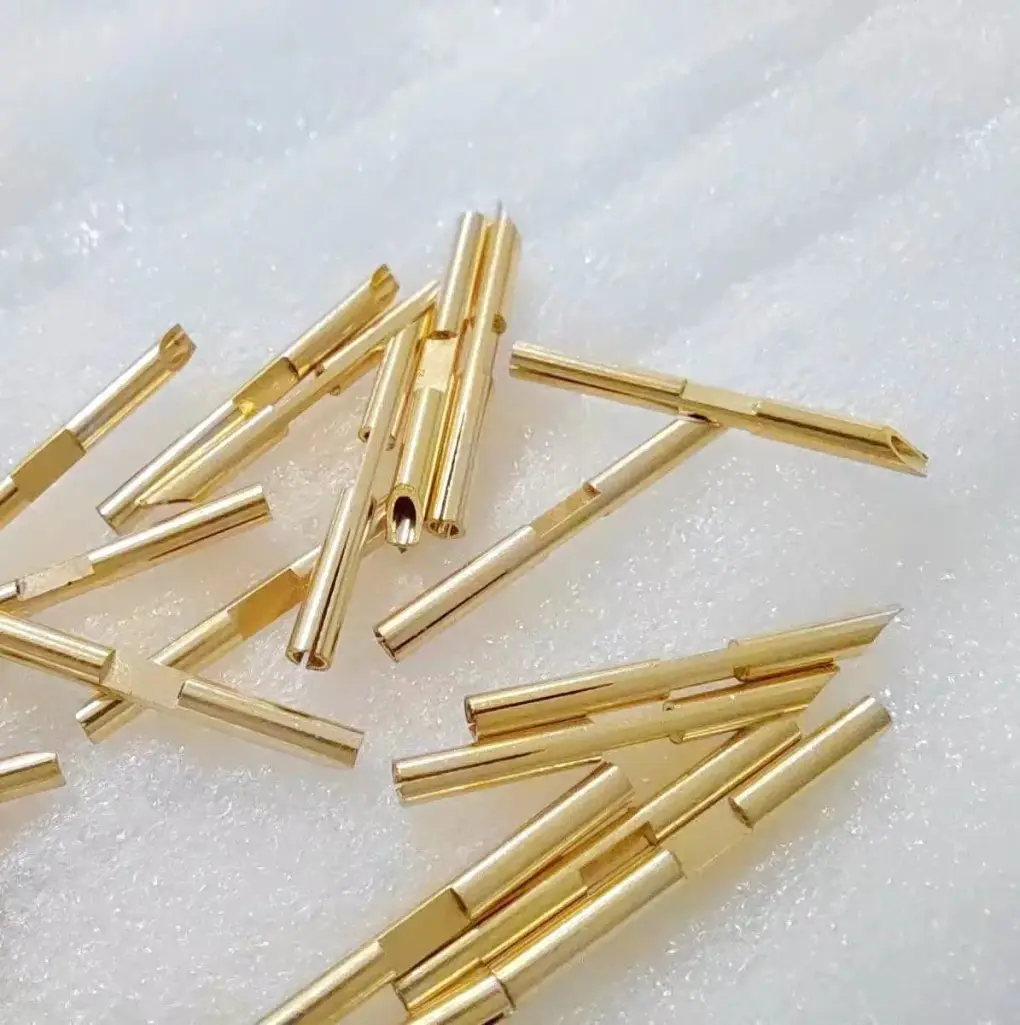
Short answer: wire harness stamped terminals are precision metal contacts supplied loose or on carrier reels for cable and connector assemblies. A useful RFQ should define terminal geometry, coil material, thickness, temper, plating, burr direction, crimp wing layout, insertion and retention force targets, packaging format, inspection needs, and expected annual volume.
This guide is for wire harness engineers, connector teams, and sourcing managers buying custom stamped terminals for automotive, EV, appliance, industrial control, and electronic assemblies. A terminal has to fit the connector cavity, grip the wire, carry current, and feed through crimping equipment without creating line stops.
For a quote, send drawings and wire details through the RFQ form. Useful companion pages include the terminal and contact stamping design guide and reel-to-reel stamping.
Functional zones on a stamped terminal
A terminal drawing should identify the mating contact area, locking lance, conductor crimp wings, insulation support wings, carrier attachment point, cut-off tab, and any surfaces that must be protected from burrs or plating damage. If those zones are not marked, quotation becomes slower because the ຜູ້ສະໜອງ must guess which dimensions control function.
Common terminal forms include box terminals, blade terminals, fork terminals, ring terminals, spring contacts, battery contacts, and small signal contacts. Each has different risk points. Contact beams need spring control. Crimp wings need forming symmetry. Locking lances need stable free height and retention force.
Coil stock, material, and temper
Wire harness terminals are commonly stamped from conductive strip supplied in coil form. Brass is widely used for general terminals. Phosphor bronze is often selected where spring recovery and fatigue resistance matter. Copper alloys may be used where conductivity is the first priority. Beryllium copper may fit compact spring contacts, while stainless steel is usually limited to non-current spring or retention features unless plating and circuit design allow it.
Material grade and temper affect bend radius, spring force, crimp behavior, and fatigue life. If current rating, temperature rise, or contact resistance is critical, include those requirements in the RFQ rather than only specifying the base alloy.
Crimp wings and wire range
The crimp area is one of the most common sources of production issues. Conductor wings must wrap the wire strands without cutting them. Insulation wings must support the cable without crushing it. The drawing should state wire size range, insulation outside diameter, strip length, crimp height target, and pull-force requirement when known.
Small changes in wing length, roll form, and burr direction can affect crimp quality. A burr inside the crimp barrel may damage strands. A burr on the outside may affect insertion into a connector housing. Mark the burr side and functional crimp surfaces when the requirement is known.
Insertion force, retention force, and connector fit
The terminal must enter the housing without scraping, folding, or deforming. It must then lock in place with enough retention force. A lance that is too weak may back out. A lance that is too aggressive can raise insertion force or damage the plastic housing.
If the customer has a connector specification, include it with the RFQ. It helps the stamping review connect the flat drawing to the assembled condition. Critical features usually include lance height, mating tab thickness, contact beam height, width across formed features, and cut-off tab length.
Plating and contact surface control
Plating affects conductivity, corrosion resistance, solderability, wear, and mating cycles. Tin plating is common for many harness terminals. Nickel underplate, silver, or gold may be used for higher reliability, low signal levels, higher temperature, or repeated mating. Selective plating can reduce precious metal cost when only the contact zone needs coverage.
The production route should define whether the part uses pre-plated strip, post-plating, or reel-to-reel plating. Pre-plated strip can be efficient, but cut edges may expose base metal. Post-plating can cover cut edges better, but formed terminals must be nested and handled carefully. See the plating and passivation RFQ guide for finish inputs.
Reel-to-reel stamping and packaging
High-volume harness terminals are often supplied on carrier strips. The carrier maintains orientation through stamping, forming, plating, inspection, and packaging. It also supports automatic feeding at the harness assembly plant.
Carrier design should define pitch, feed holes, cut-off point, reel direction, splice requirements, leader length, tail length, and quantity per reel. Loose terminals may work for prototypes or manual assembly, but reels are usually better for automatic crimping machines. Bent carrier strips, tangled parts, or unclear reel orientation can stop a line even when the terminal itself is dimensionally correct.
Inspection and documentation
Inspection should focus on functional dimensions. Typical checks include material certificate, plating thickness, visual surface inspection, burr review, pitch measurement, formed height, critical width, crimp wing symmetry, flatness, and go/no-go gauges. For automotive, EV, appliance, and industrial programs, buyers may request PPAP-like documents, first article inspection, control plan, process flow, and capability data for critical dimensions.
For broader quality planning, see ການປັ໊ມໂລຫະ quality standards and the first article inspection checklist.
RFQ information to send
- 2D drawing with revision, critical dimensions, and burr side.
- 3D model or physical sample if available.
- Material grade, thickness, temper, and conductivity requirement.
- Plating type, thickness, contact zone, and corrosion requirement.
- Wire size range, insulation OD, crimp height, pull-force target, and connector specification.
- Packaging format: loose, strip, reel, tray, or customer-specified reel.
- Prototype quantity, annual volume, inspection package, and target ເວລານໍາສົ່ງ.
Send your terminal drawings through the RFQ form. If force targets or connector housing details are not final, include the current assumptions so manufacturability can be reviewed before tooling.