
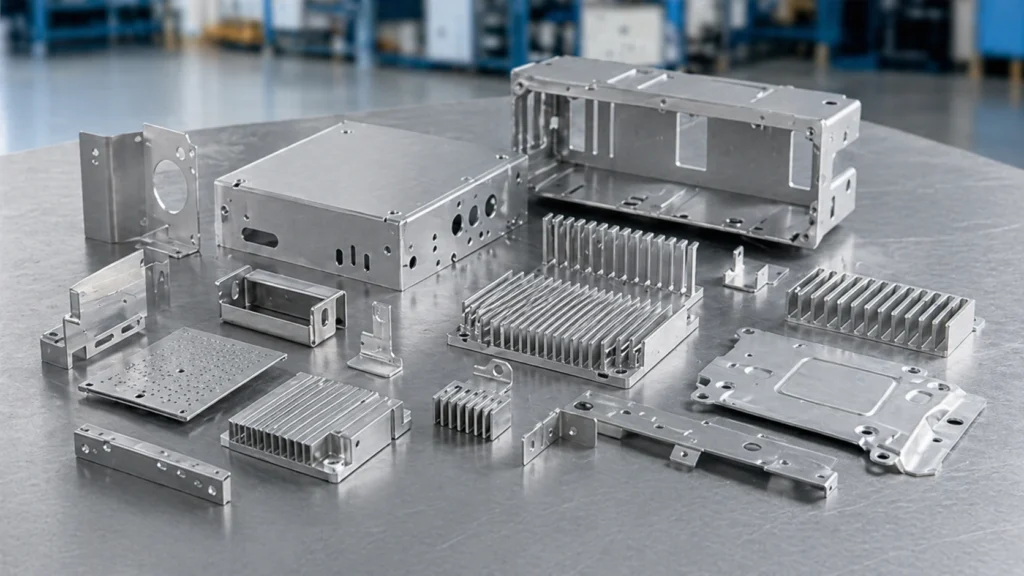
Short answer: stamped heat sinks and thermal management parts should be quoted with material, thickness, thermal contact area, flatness, spring force, finish, burr direction, cleanliness, and assembly method. The stamped part may work as a heat spreader, shield, clip, bracket, cover, or thermal contact rather than a traditional machined heat sink.
This guide is for electronics, power, telecom, LED, EV, and industrial buyers sourcing stamped thermal parts. Stamping can be useful when the part needs repeatable thin metal geometry, volume production, spring contact, shielding, or a formed bracket that also supports heat transfer.
If you already have a drawing, send material, thickness, finish, thermal interface notes, annual volume, and assembly requirements through the RFQ form. For a broader quote package, start with the ಮೆಟಲ್ ಸ್ಟ್ಯಾಂಪಿಂಗ್ RFQ checklist.
What counts as a stamped thermal part?
Stamped thermal parts are not always finned heat sinks. They may be flat heat spreaders, aluminum or copper covers, spring clips, battery thermal tabs, LED brackets, shielding covers, busbar-related heat spreaders, power module retainers, or formed metal pieces that press a thermal pad into place.
| Part type | Thermal role | RFQ concern |
|---|---|---|
| Heat spreader | Moves heat from a source to a larger surface. | Flatness, material, contact area, surface finish. |
| Spring thermal clip | Maintains pressure on a pad, module, or cover. | Spring force, fatigue, bend radius, burr direction. |
| Stamped cover or shield | Combines protection, grounding, shielding, and heat spreading. | Wall height, grounding points, finish, packaging. |
| LED or power bracket | Supports a device while conducting heat to a housing. | Hole position, flatness, coating, assembly stack. |
| Battery or busbar thermal tab | Supports current path, mounting, or thermal connection. | Conductivity, plating, insulation clearance, traceability. |
Material selection for thermal stamping
Aluminum and copper alloys are common when thermal conductivity matters, but the best material depends on strength, corrosion, plating, forming, thickness, cost, and assembly. Stainless steel may be used for spring clips or retainers where force matters more than heat spreading. Copper or aluminum may be used for heat spreaders, tabs, or covers.
Do not specify only “metal heat sink” on the RFQ. State the heat path, contact area, assembly pressure, corrosion environment, finish, and whether electrical conductivity is allowed or must be insulated. Use the material selection guide when comparing alloys.
Flatness and contact pressure
Thermal performance often depends on contact. A stamped heat spreader that is warped may not contact the thermal pad evenly. A clip that loses spring force may not hold a module against the interface. A bracket that twists during forming may create an air gap.
Define flatness and spring-force requirements where they matter. If the part presses against a thermal pad, graphite sheet, paste, module, LED board, or housing, tell the ಸರಬರಾಜುದಾರ the mating surface, compression range, and assembly method.
Burrs, finish, and cleanliness
Burrs can cut thermal pads, scratch insulation, damage wires, or interfere with assembly. Surface finish can affect contact, corrosion, solderability, appearance, or cleanliness. Oil residue may be unacceptable near thermal interface materials or electronics assemblies.
Review the burr control guide and plating/passivation RFQ guide if the part has edge safety, coating, passivation, plating, or cleaning requirements. Mark the side that contacts the thermal interface.
Stamping versus machining or extrusion
Stamping is not the right process for every heat sink. Extrusions and machining are better for some finned geometries. Stamping can be a strong fit when the part is thin, formed, high-volume, spring-like, combined with shielding, or integrated into a bracket or cover.
For cost comparison, consider tooling, unit cost, material scrap, secondary operations, finishing, inspection, and assembly. A stamped design may reduce part count if it combines mounting, shielding, grounding, and thermal contact in one component.
RFQ checklist for stamped thermal parts
- 2D drawing and 3D model with revision.
- Material grade, temper, thickness, and allowed substitutes.
- Thermal function: heat spreader, clip, shield, bracket, tab, or cover.
- Thermal contact area, flatness, pressure, and mating surface details.
- Electrical function: conductive, grounded, insulated, soldered, or isolated.
- Burr direction, edge break, cleaning, oil residue, and surface finish requirements.
- Assembly method: screws, rivets, clips, solder, adhesive, thermal pad, or press fit.
- Prototype, annual volume, inspection records, and packaging requirements.
Inspection points
Inspection may include material certificate, thickness, flatness, bend angle, hole position, spring height, plating appearance, burr check, cleanliness, and packaging condition. For spring clips, consider functional force checks. For heat spreaders, define the surfaces that must remain flat and protected.
Use the FAI checklist when launching new thermal ಸ್ಟ್ಯಾಂಪ್ ಮಾಡಿದ ಭಾಗಗಳು. For automotive, EV, or high-reliability programs, decide whether PPAP/APQP-style documentation is required.
For a practical RFQ review, send the drawing, mating part details, thermal interface notes, finish requirements, and target volume through the RFQ form. If the part must hold pressure against a pad, module, board, or housing, include that assembly condition with the quote request.
Packaging for thermal parts
Thin heat spreaders, covers, and clips can be damaged after production if they rub, bend, or trap moisture. Flat surfaces and thermal contact areas may need interleaving, trays, or separated packing. Clips may need orientation control so spring arms are not compressed during shipment.
For export packaging, combine the RFQ with the packaging and shipping guide. State label, lot traceability, carton strength, moisture protection, and part separation needs.
FAQ: stamped heat sinks and thermal parts
Can heat sinks be made by ಮೆಟಲ್ ಸ್ಟ್ಯಾಂಪಿಂಗ್?
Some thermal parts can be stamped, especially thin heat spreaders, clips, covers, shields, tabs, and brackets. Finned heat sinks may need extrusion or machining.
Which materials are common?
Aluminum and copper alloys are common for thermal conductivity. Stainless steel or spring materials may be used when force or retention matters.
Why is flatness important?
Thermal transfer depends on contact. Poor flatness can create air gaps or uneven pressure against pads, modules, boards, or housings.
Does surface finish affect thermal parts?
Yes. Finish can affect corrosion, contact, solderability, cleanliness, appearance, and whether the part can safely touch pads or electronics.
What should be inspected?
Common checks include material, thickness, flatness, hole position, bend angle, spring height, burrs, finish, cleanliness, and packaging.
What should I send for a stamped thermal part quote?
Send drawings, material, thickness, thermal contact details, mating parts, finish, assembly method, annual volume, inspection needs, and packaging requirements.