
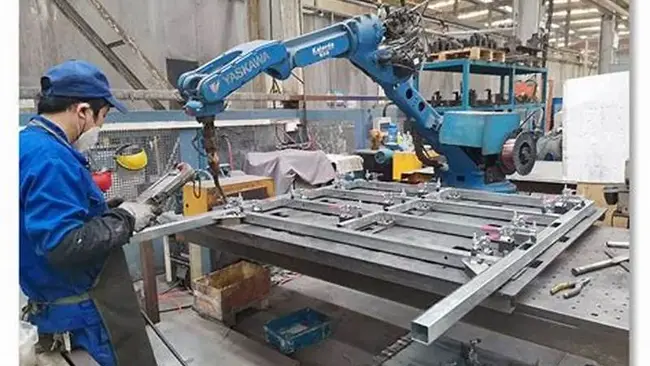
Short answer: sassan da aka buga often need welding, riveting, clinching, or threaded fasteners as secondary operations to become finished assemblies. gama gari stamped-part welding methods include resistance projection welding, laser welding, MIG/TIG, and stud welding. Joint design, material compatibility, plating, and heat-affected zone control determine the right method.
This guide is for design engineers and sourcing teams who buy sassan da aka buga that will be welded into assemblies. Understanding how bugawa geometry, material, and surface finish affect weld quality helps avoid costly rework and strength failures.
Aika your assembly drawing and weld specifications through the RFQ form. For related assembly topics, see stamped metal assemblies and secondary operations and bugun karfe plating and passivation guide.
Resistance projection welding
The most common method for stamped assemblies. A projection (embossed dimple, ridge, or ring) is coined into one stamped part. Current passes through the projection, which collapses under pressure, creating a fused nugget. Amfanin:
- No filler material needed
- Fast cycle time (0.5-3 seconds per weld)
- Consistent nugget size when projection geometry is controlled
- Can weld multiple points simultaneously
- Suitable for low-carbon steel, stainless, galvanized, and aluminum with proper electrode tuning
Design recommendations for weldable sassan da aka buga
- Projection geometry: dimple diameter 2-4 mm, height 0.3-0.8 mm for 1-2 mm material
- Material thickness ratio: ideally 1:1 to 3:1 between joined parts
- Plating: zinc plating above 8-12 microns can cause weld expulsion; consider selective plating or weld-before-plating sequence
- Edge distance: projection center should be at least 2x material thickness from any edge
- Material compatibility: weld low-carbon to low-carbon, stainless to stainless; avoid welding stainless to galvanized steel
- Burr direction: parts should be stacked with burr facing inward to avoid interference with weld interface
Laser welding for precision stamped assemblies
Laser welding is used for hermetic seals, small components, and assemblies where minimal heat input is critical. Typical applications:
- Battery tuntuɓa plates and busbar assemblies
- Medical device stamped components requiring clean welds
- Sensor housings and electronic shields
- Thin foil or shim stacks (0.1-0.5 mm per layer)
Fastener insertion for stamped assemblies
Many sassan da aka buga receive self-clinching fasteners (PEM nuts, studs, standoffs) or threaded inserts for bolted connections:
- Clinching nut installation: requires hole size within 0.05 mm of spec, material hardness below HRB 80
- Weld nuts: projection or spot weld types for thicker material or post-plating assembly
- Helical inserts: for aluminum or soft sassan da aka buga needing reusable threads
- Stake and rivet: samarwa cikin sanyi or orbital riveting for permanent joints
Design checks before welding or assembly
Assembly problems often start in the bugawa print. A flange that is too narrow, a hole placed too close to a bend, or a coating specified before welding can make a good stamped part difficult to join. Bita the assembly sequence while the die design is still flexible, especially when the stamped part will be plated, passivated, powder coated, or packed as a ready-to-install subassembly.
- Weld access: leave room for electrodes, clamps, shielding gas, or laser path access. Tight return flanges may need fixture pockets.
- Flatness and coplanarity: welded brackets and shields need tuntuɓa surfaces controlled before joining; see the coplanarity guide.
- Burr direction: keep burrs away from weld interfaces, sealing faces, and fastener seating surfaces.
- Finish sequence: decide whether the part is weld-before-plate, plate-before-assembly, passivate-after-weld, or locally masked.
- Fixture datums: define the surfaces used to locate the assembly during welding so dimensional inspection matches the build process.
What to include in an assembly RFQ
Aika the stamped part drawings, the finished assembly drawing, material grades, thicknesses, weld callouts, finish requirements, annual volume, inspection expectations, and packaging needs. If the assembly has failed in production before, include the failure mode, such as weld pull-out, distortion, cosmetic burn marks, nut torque-out, or thread damage.
Useful companion pages include clinching and self-clinching fasteners, hardware insertion for sassan da aka buga, stamped metal assemblies, and packaging and shipping for sassan da aka buga.
FAQ
Can sassan da aka buga be welded after zinc plating?
What is the minimum flange width for projection welding?
How does burr affect stamped part welding?
Submit your assembly RFQ
Aika your assembly drawing, weld specifications, plating requirements, and annual volume through the RFQ form. Include the material grades, thicknesses, and plating of each component in the assembly.