
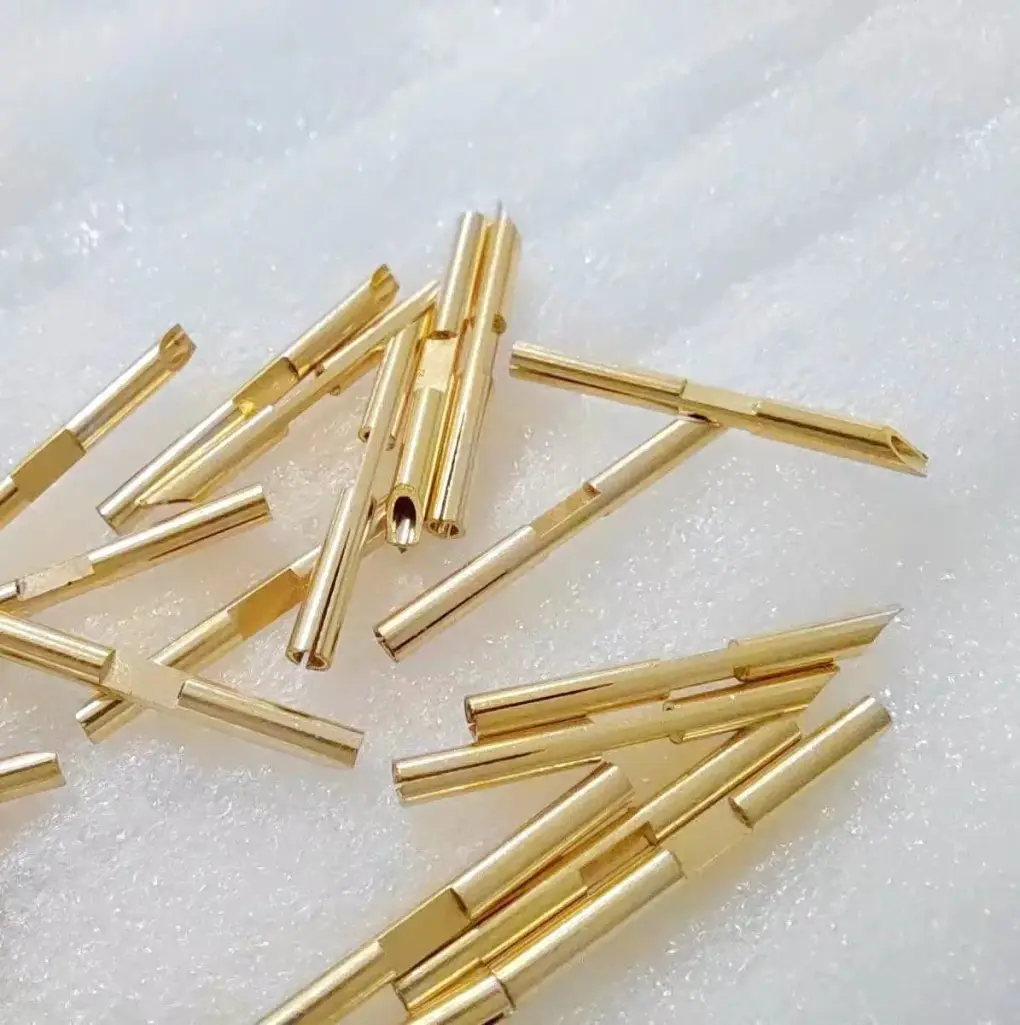
Short answer: beryllium copper spring contacts are used when a stamped tuntuɓa must carry current, recover after repeated deflection, and hold stable force in a compact space. The main engineering decisions are alloy temper, forming radius, heat treatment, burr direction, plating, and fatigue testing. Aika drawings, thickness, deflection, tuntuɓa force, plating, volume, and application environment for a useful RFQ.
This page focuses on beryllium copper spring tuntuɓa bugawa for connector contacts, battery springs, grounding clips, EMI fingers, charging terminals, and small conductive spring parts. It is intentionally narrower than a general copper bugawa page: the core issue is spring behavior after forming and repeated compression.
For quote review, send drawings through the RFQ form. If you are comparing alloys, start with phosphor bronze vs beryllium copper tuntuɓa bugawa and the terminal and tuntuɓa bugawa design guide.
Why BeCu is specified for stamped contacts
Beryllium copper is chosen when a tuntuɓa needs both conductivity and elastic recovery. In many small assemblies, the part must bend during assembly and return close to its designed position. If it takes a permanent set, tuntuɓa resistance may rise, vibration may break continuity, or a connector may fail retention checks.
BeCu can be formed before age hardening or stamped from a harder strip depending on design, bend severity, and production route. That sequence should be discussed before tooling because it affects spring force, cracking risk, dimensional stability, and cost. The drawing should define the dimensions that apply after final processing, not only in the blank state.
When phosphor bronze or stainless may be better
BeCu is not automatically the right answer. Phosphor bronze is often a practical choice for moderate spring force, good formability, and lower material cost. Stainless steel can work where corrosion resistance and mechanical spring action matter more than conductivity. Brass may fit low-cost contacts with mild spring requirements.
If a tuntuɓa is losing force, BeCu may be worth reviewing. If the part is over-specified and does not need high fatigue life or recovery, phosphor bronze may reduce cost. The mai samarwa should ask about current, tuntuɓa resistance, mating cycles, temperature, corrosion exposure, and assembly force before recommending a material.
Design details that affect tuntuɓa life
The first checks are bend radius, grain direction, working deflection, tuntuɓa beam length, and edge condition. A sharp inside radius may save space but can concentrate stress. A longer beam lowers stress but needs more package room. Narrow slots, lances, coined points, and holes near bends can change stiffness and fatigue behavior.
Burr direction is especially important on spring contacts. A burr can scrape a mating pad, cut plating, increase insertion force, or start cracks near a bend. Functional surfaces should be marked on the drawing so the burr side and rollover side can be planned in the die layout.
Heat treatment and forming sequence
Heat treatment may be central to BeCu performance. Some designs are blanked and formed in a softer condition, then age hardened. Other designs use pre-tempered material when bends are mild enough. The wrong sequence can lead to cracks, weak spring force, or dimension changes after final processing.
During DFM review, confirm which dimensions are measured before and after heat treatment, whether the part can be fixtured during aging, and whether flatness or height must be corrected afterward. For higher-volume parts, progressive tooling can support repeatable blanking, forming, and cutoff when the material route is clear. See Custom bugun karfe for broader tooling context.
Plating for electrical tuntuɓa surfaces
Plating is selected for tuntuɓa resistance, corrosion protection, solderability, and wear. Nickel is often used as a barrier layer. Tin may fit cost-sensitive terminals and solderable areas. Gold is used when low tuntuɓa resistance, signal reliability, or corrosion resistance matters on small tuntuɓa points.
Selective plating can reduce cost when only the mating zone needs gold or tin. For formed contacts, confirm whether plating is applied before or after forming and whether bending could damage the plated surface. For more finish planning, review the plating and passivation RFQ guide.
Fatigue testing and inspection
A spring tuntuɓa should be evaluated by how it behaves at working height. Useful checks include free height, working height, tuntuɓa force, permanent set after cycling, resistance measurement, plating thickness, burr inspection, and visual review of bends under magnification.
For motoci, telecom, battery, medical, or high-reliability electronics programs, buyers may request sample reports, material certificates, plating certificates, process flow, control plan, and PPAP-like documentation. The exact package should match risk and volume. For mai samarwa document review, see the mai samarwa quality audit checklist.
What to send for a BeCu tuntuɓa RFQ
- 2D drawing and 3D model with revision level.
- Alloy, temper, strip thickness, and acceptable substitute materials.
- Free height, working height, deflection, and target tuntuɓa force.
- Plating stack, tuntuɓa surface, burr direction, and edge requirements.
- Cycle life, operating temperature, tuntuɓa resistance target, and mating surface if known.
- Prototype quantity, annual volume, inspection documents, packaging, and lokacin isarwa.
Use the RFQ form to send drawings and notes. If the current issue is force loss, cracked bends, burr damage, plating wear, or unstable resistance, explain it directly so the review can focus on the real failure mode.