
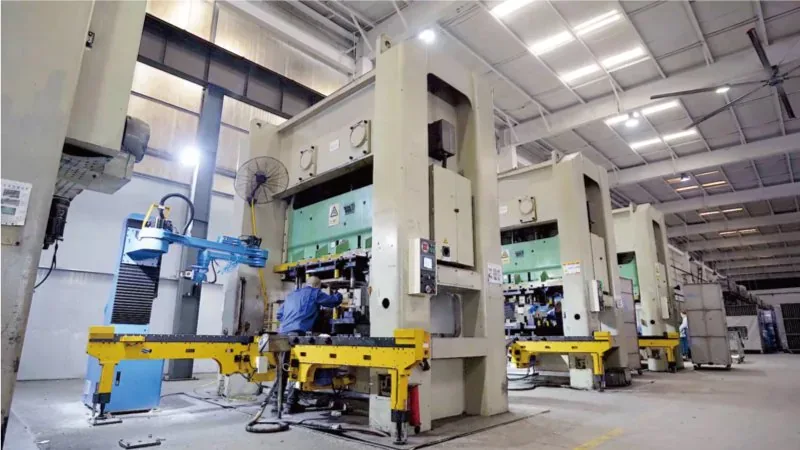
Short answer: stamped metal assemblies should be quoted with the stamped part drawing, secondary operations, hardware, joining method, finish sequence, inspection requirements, packaging, and assembly function. Tapping, staking, riveting, welding, PEM hardware, cleaning, and kitting can reduce buyer handling, but only if the scope is defined before tooling and production.
This guide is for OEM buyers who want more than loose қисмҳои штампшуда. It explains how to specify stamped assemblies and secondary operations so the quote reflects real production work, quality checks, and packaging needs.
If you need assembled қисмҳои штампшуда, send drawings, BOM, hardware specs, joining requirements, finish, annual volume, and inspection needs through the RFQ form. For quote preparation, start with the штампкунии металл RFQ checklist.
What are stamped metal assemblies?
A stamped assembly combines one or more қисмҳои штампшуда with secondary work such as tapping, staking, riveting, spot welding, projection welding, hardware insertion, clinching, bending after plating, cleaning, labeling, or packaging as a kit. The goal is often to reduce таъминкунанда count, simplify receiving, or move parts closer to final assembly.
The scope must be clear. A quote for a stamped blank is different from a quote for a cleaned, plated, tapped, welded, inspected, and packed assembly.
Умумӣ secondary operations
| Operation | Why buyers request it | RFQ concern |
|---|---|---|
| Tapping or thread forming | Adds threaded mounting points after штампкунӣ. | Thread size, gauge check, burrs, plating sequence. |
| Riveting or staking | Joins layers, кронштейнҳо, contacts, or reinforcement parts. | Joint strength, fixture location, inspection method. |
| Welding | Combines қисмҳои штампшуда into a bracket or housing assembly. | Weld type, distortion, cosmetic side, coating sequence. |
| Hardware insertion | Adds PEM nuts, studs, bushings, pins, or fasteners. | Hardware spec, pull-out force, installation direction. |
| Cleaning and packing | Prepares parts for assembly or export shipment. | Oil residue, corrosion protection, labels, tray or kit packing. |
Design for assembly before tooling
Secondary operations can change the штампкунӣ design. Holes for hardware may need different clearance. Tabs for staking need material and geometry control. Welded areas may need flatness and coating planning. Threaded features may need enough material around the hole. If the assembly step is defined after tooling, the die may not support it well.
Use the punched holes and slots guide and tolerances guide when deciding hole size, edge distance, and alignment features. Ask for DFM review before freezing the tooling layout.
Finish sequence matters
Plating, passivation, powder coating, cleaning, welding, and hardware insertion must be sequenced correctly. Welding after plating may damage finish. Tapping before plating may change thread fit after coating. Hardware insertion after coating may crack finish. Cleaning may be needed before assembly or before final packing.
Use the plating and passivation RFQ guide when finish affects assembly. Tell the таъминкунанда which surfaces are cosmetic, conductive, threaded, welded, or corrosion-sensitive.
Assembly fixtures and inspection
Stamped assemblies often need fixtures to hold parts during welding, staking, riveting, or hardware insertion. Inspection may need go/no-go gauges, torque checks, pull-out tests, weld appearance checks, thread gauges, CMM checks, or functional fit tests. Define what makes the assembly acceptable, not only each loose component.
For launch, use the first article inspection checklist. For controlled programs, decide early whether PPAP/APQP-style documentation is required.
таъминкунанда consolidation without losing control
Buying a stamped assembly can reduce receiving work and таъминкунанда coordination, but the buyer still needs clear specifications. Define which таъминкунанда owns hardware sourcing, plating coordination, inspection records, packaging, and nonconformance response. If the assembly includes buyer-supplied hardware, state how shortages and substitutions will be handled.
When comparing suppliers, use the quote дастури муқоиса and таъминкунанда quality audit checklist. A low assembly price is not useful if inspection scope, hardware, or packaging is missing.
RFQ checklist for stamped assemblies
- Stamped part drawings, assembly drawing, BOM, and current revision.
- Secondary operations: tapping, staking, riveting, welding, hardware insertion, cleaning, labeling, kitting.
- Hardware specifications, approved brands, material, finish, and substitution rules.
- Finish sequence: before or after assembly, masking, cosmetic areas, corrosion protection.
- Critical dimensions after assembly, functional fit, pull-out force, torque, weld, or thread requirements.
- Inspection records, FAI, PPAP, material certificates, plating reports, or assembly test data.
- Packaging method, labels, lot traceability, kit quantity, and export requirements.
- Annual volume, release schedule, target муҳлати таҳвил, and current таъминкунанда issue if any.
Packaging and logistics for assemblies
Assemblies can be more fragile than loose қисмҳои штампшуда. Hardware can scratch surfaces, welded parts can bend, and finished assemblies may need trays, dividers, or kit boxes. Labels should identify part number, revision, lot, quantity, inspection status, and hardware if applicable.
Use the packaging and shipping guide before quoting assemblies that are plated, cosmetic, fragile, or exported. Ирсол кунед packaging photos if your receiving team already has an approved standard.
For an assembly quote, send the stamped part drawing, assembly drawing, BOM, hardware details, finish requirements, inspection points, packaging standard, and target муҳлати таҳвил through the тамос page. Clear scope helps separate штампкунӣ cost from secondary operation cost and avoids late changes after tooling starts.
Саволҳо: stamped metal assemblies
What secondary operations can be added to қисмҳои штампшуда?
Умумӣ operations include tapping, thread forming, staking, riveting, spot welding, hardware insertion, cleaning, labeling, and packaging.
Should secondary operations be quoted before tooling?
Yes. Assembly operations can affect hole size, flatness, tabs, fixtures, finish sequence, and inspection requirements.
Can a штампкунӣ таъминкунанда coordinate plating and assembly?
Often yes, but the RFQ should define responsibility for outside processes, records, inspection, packaging, and nonconformance handling.
What inspection is needed for stamped assemblies?
Inspection may include dimensional checks after assembly, thread gauges, pull-out force, torque, weld checks, fit tests, and visual inspection.
Does assembly affect packaging?
Yes. Assemblies may need trays, dividers, orientation control, or kitting to prevent bending, scratches, hardware damage, or mixed parts.
What should be included in an assembly RFQ?
Ирсол кунед part drawings, assembly drawing, BOM, hardware specs, secondary operations, finish sequence, inspection needs, packaging, and volume.