
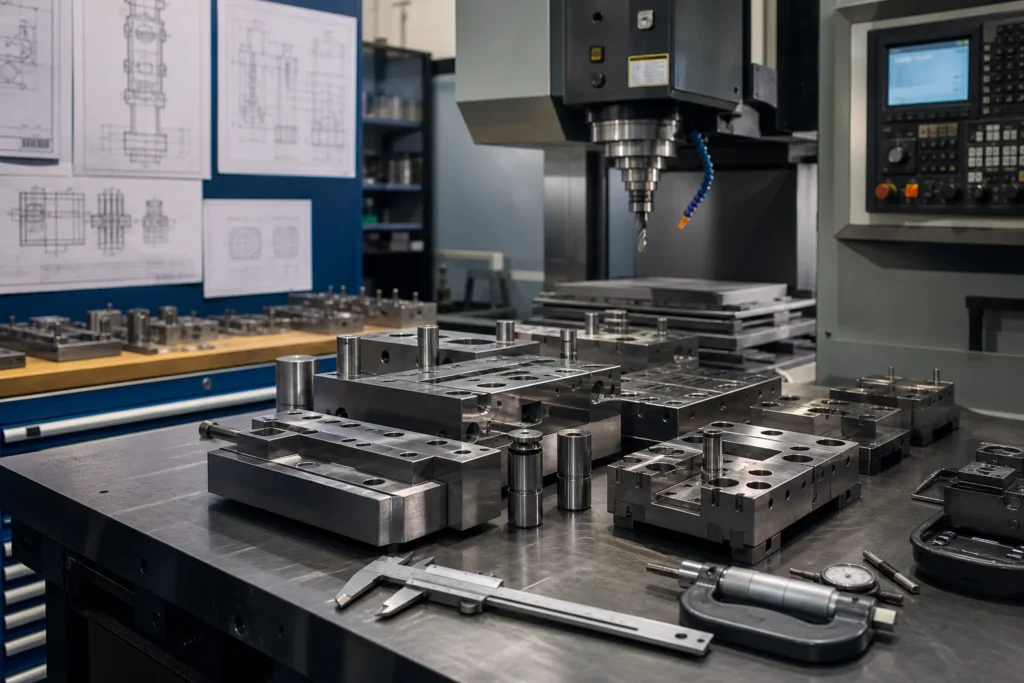
Short answer: Metal alat nyitak cost depends on part complexity, material thickness, tolerance requirements, die type, expected production volume, inspection needs, and whether the part needs secondary operations. A simple prototype or single-operation die can be quoted very differently from a paeh progresif built for high-volume production. The best way to control tooling cost is to send a clear drawing package and ask for DFM feedback before the die design is frozen.
This guide is written for buyers and engineers comparing nyitak logam quotes. It explains why tooling prices vary, what a panyadia is usually estimating, and which RFQ details help prevent surprise charges after design review.
If you already have a drawing package, send it through the quote request form. If you are still planning the project, use the sections below to understand which design and commercial choices affect the tooling budget.
What is included in metal alat nyitak cost?
Tooling cost is not just the steel block used to make a die. A practical tooling quote may include die design, strip layout, die components, machining, heat treatment, fitting, trial runs, sample inspection, engineering changes, and sometimes fixtures or gauges. Different suppliers separate these items in different ways, so the total should be reviewed with the scope clearly stated.
| Cost area | What it covers | Buyer question to ask |
|---|---|---|
| Die design | Prosés planning, strip layout, forming sequence, clearance, carrier design, and DFM review. | Is DFM included before final tool build? |
| Die components | Die shoe, punches, inserts, springs, guides, pilots, lifters, strippers, sensors, and wear parts. | Are standard components or custom inserts used? |
| Machining and fitting | CNC, EDM, grinding, wire cutting, assembly, fitting, and tryout adjustment. | How many trial loops are expected before sample approval? |
| Sampling | First samples, dimensional checks, forming adjustments, and material trial usage. | How many sample pieces are included? |
| Inspection support | FAI report, CMM checks, simple gauges, or customer-specific documentation. | Which quality documents are included in the tooling quote? |
Main factors that change tooling price
The biggest tooling cost drivers are usually geometry, tolerance, production volume, and process sequence. A flat washer-like part may need blanking only. A bracket with several bends, pierced holes, lances, embosses, tight hole locations, and plating requirements needs more die stations and more engineering time.
- Bagian complexity: More bends, forms, holes, tabs, and features usually mean more die stations or secondary operations.
- Bahan thickness: Thicker material changes tonnage, clearance, punch strength, die wear, and press selection.
- Bahan type: Stainless steel, high-strength steel, spring materials, copper alloys, and aluminum each affect forming and wear differently.
- Tight tolerances: Critical hole positions, flatness, bend height, and kontak areas may need better guiding, pilots, secondary sizing, or additional inspection.
- Annual volume: High volume often justifies progressive tooling; low volume may fit simpler tooling or short-run methods.
- Finish and burr control: Plating, passivation, deburring, or burr direction requirements can change die clearance and process planning.
Tooling type and when each option makes sense
There is no single correct die type for every stamped part. The tooling choice should match the geometry, production volume, and tolerance risk.
| Tooling option | Typical use | Cost behavior |
|---|---|---|
| Prototype or soft tooling | Early samples, design validation, low quantity trials. | Lower initial tooling cost, slower production, limited life. |
| Single-stage die | Simple blanking, piercing, bending, or forming in separate operations. | Moderate tooling cost, more handling if multiple operations are needed. |
| paeh gabungan | Flat parts where blanking and piercing can happen in one press stroke. | Higher than a simple die, efficient for suitable flat geometry. |
| paeh progresif | High-volume parts with repeated piercing, bending, forming, and cutoff stations. | Higher initial tool cost, lower production cost at volume. |
| paeh mindahkeun | Larger or deeper formed parts moved between stations. | Higher engineering and setup cost, useful for complex formed parts. |
For high-volume programs, review paeh progresif nyitak. For simple or early-stage parts, prototype nyitak logam or short run nyitak logam may be more practical.
Why the same part can receive different tooling quotes
Two suppliers may quote different tooling prices because they are not quoting the same scope. One quote may include DFM, sensors, spare inserts, sample inspection, and fixture checks. Another may include only a basic tool build with limited sample support. The lower number is not always the lower project cost if revisions or quality controls are missing.
When comparing quotes, ask whether these items are included:
- Die design and strip layout review.
- Bahan for tool trial and sample run.
- First article inspection report.
- Spare punches, inserts, or wear parts.
- Sensor, misfeed protection, or slug detection when needed.
- Engineering change cost after drawing revision.
- Tool ownership, storage, and maintenance responsibility.
How production volume affects the tooling decision
Tooling should be evaluated with unit price, not as an isolated line item. A higher-cost paeh progresif may reduce part price, labor, scrap, and variation over a high-volume production run. For low volume, the same die may take too long to pay back.
Share these quantity details in the RFQ:
- Prototype or sample quantity.
- First production order quantity.
- Expected annual volume.
- Batch frequency and delivery schedule.
- Expected project life.
If the annual volume is uncertain, ask for two options. A panyadia can quote a lower-entry tooling route and a production tooling route so you can compare total cost at different volume levels.
DFM changes that can reduce tooling cost
Design-for-manufacturing review is one of the most useful steps before tooling. Some changes are small on the drawing but important in the die.
- Increase bend radius where material cracking or high forming force is likely.
- Move holes away from bends or edges when the design allows it.
- Relax non-critical tolerances and mark only functional dimensions as critical.
- Add bend relief or corner relief to reduce tearing.
- Tinjauan burr direction based on assembly and safety needs.
- Choose a material grade that balances forming, strength, corrosion, and cost.
- Reduce unnecessary cosmetic requirements on hidden features.
Related design help: nyitak logam part design guide and nyitak logam RFQ checklist.
Tooling cost RFQ checklist
To receive a useful tooling quote, send:
- 2D drawing and 3D file with revision level.
- Kelas Bahan, temper, and sheet thickness.
- Critical dimensions, tolerances, datum scheme, and burr requirements.
- Prototype quantity, first order quantity, annual volume, and project life.
- Surface finish, deburring, plating, cleaning, and packaging requirements.
- Inspection documents such as FAI, dimensional report, CMM report, or material certificate.
- Target sample date and production launch date.
- Whether the quote should include tool ownership, maintenance, spare inserts, or gauges.
FAQ
Why is metal alat nyitak expensive?
alat nyitak requires engineering, die design, precision machining, fitting, trial runs, and inspection. The tool must control material movement under press force, so cost depends on complexity, tolerance, volume, and tool life expectations.
Is a paeh progresif always the best option?
No. Progressive dies are useful for high-volume parts with repeated operations, but they can be too expensive for early prototypes or low-volume orders. The right choice depends on total cost across tooling and production.
Can tooling cost be reduced after the quote?
Sometimes. DFM changes such as relaxing non-critical tolerances, adjusting bend radius, changing hole location, or simplifying finish requirements can reduce tooling risk and cost before the die is built.
Should kapamilikan perkakas be written in the purchase order?
Yes. Tool ownership, storage, maintenance, transfer rights, and replacement of wear parts should be clear before payment. This prevents confusion if the project is transferred or re-sourced later.
What information helps quote tooling faster?
A complete drawing package, material grade, thickness, critical tolerances, annual volume, finish, inspection needs, and launch schedule help the panyadia choose the right die type and estimate tooling work accurately.
Can I get a tooling quote without final drawings?
You can get a planning estimate, but not a firm production tooling quote. Early sketches and target requirements are useful for DFM feedback, while final drawings are needed before the tool scope is fixed.
Request a tooling review
If you are comparing tooling options for stamped brackets, terminals, busbars, shields, clips, housings, or custom lambaran logam parts, send your drawings through the RFQ form. Include material, thickness, quantity, finish, critical tolerances, and launch timing. We can review the part and explain which tooling route is practical for your volume and cost target.