
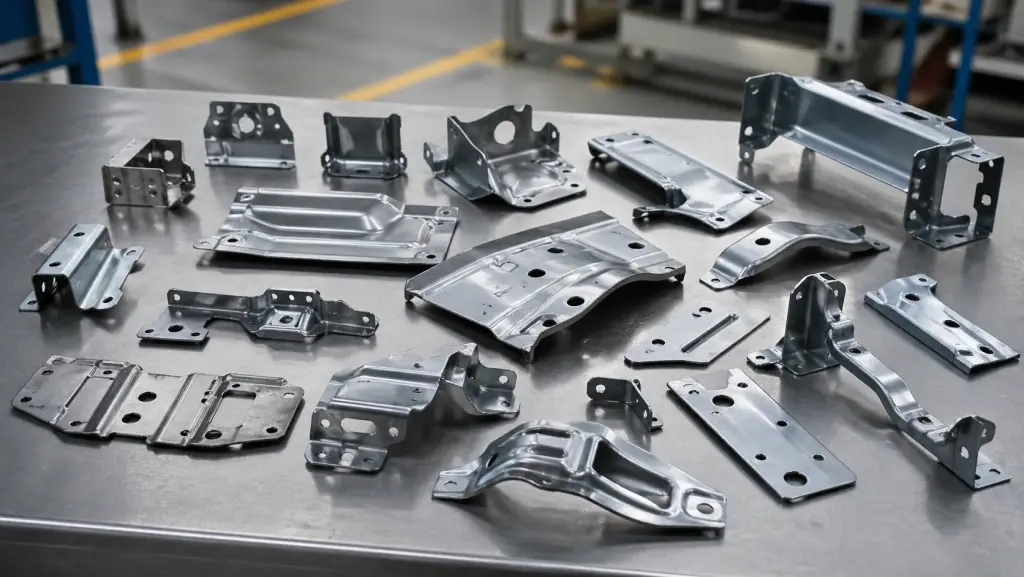
Short answer: Stamped part datums should match how the part is located in the final assembly, not only what is easiest to measure on a bench. Thin, formed, or spring-like parts may need a functional gage, restrained check, or clear free-state requirement so buyer and සැපයුම්කරු measure the same condition.
මුද්රා තැබූ කොටස් can be flexible, curved, burred, plated, or slightly warped in free state. A CMM report may look different from a fixture check if the datum scheme is unclear. This creates arguments even when the part functions correctly in assembly. A good RFQ explains how the part is located, constrained, and accepted.
Use this page with the critical dimensions inspection plan, Gage R&R and MSA guide, FAI checklist, and tolerances guide.
Datum and gage decisions
| Decision | Risk if unclear | RFQ detail |
|---|---|---|
| Primary datum | සැපයුම්කරු may measure from a surface that does not control assembly fit. | State the functional locating surface, hole, edge, or formed feature. |
| Free-state or restrained | Flexible parts can pass one method and fail another. | Define whether the part is clamped, nested, or measured without force. |
| Functional gage | CMM data may not reflect actual assembly condition. | Ask whether a go/no-go or checking fixture is needed. |
| Correlation | Buyer and සැපයුම්කරු may not agree on measurement method. | Define master samples, gage calibration, and report format. |
Choose datums from function
The best datum scheme usually starts with the assembly. Holes that locate on pins, tabs that seat against a bracket, or formed faces that contact a mating part may deserve datum priority. A long sheared edge may be easy to probe, but it may not control the part in the real product.
For thin පත්ර ලෝහ, a datum surface can be affected by flatness, coating, burr direction, or forming stress. If the part is measured in free state, the drawing should say so. If the customer assembly restrains the part, the inspection method should describe the restraint.
When a functional gage helps
A functional gage is useful when the buyer cares about fit more than isolated coordinate data. It can check whether mounting holes align, tabs seat, clips engage, or a bracket clears a mating component. The gage does not replace all dimensional inspection, but it can prevent a shipment of parts that measure acceptably and still fail assembly.
The quote should state whether gage cost is included, who owns the gage, how it is calibrated, and whether the buyer wants gage correlation samples. For measurement variation, connect the gage plan with the inspection equipment guide and coplanarity guide.
RFQ details to include
- 2D drawing, 3D model, assembly drawing, and mating part information if available.
- Functional datums, CTQ dimensions, hole patterns, bend heights, tabs, clips, and locating features.
- Free-state or restrained measurement rule, clamp points, and allowed measurement force.
- Whether a functional gage, CMM report, optical inspection, or go/no-go check is expected.
- Gauge ownership, calibration interval, master sample, report format, and approval sample count.
- Finish thickness, burr direction, and surface requirements that affect seating or probing.
How to avoid measurement disputes
Before production, ask the සැපයුම්කරු to mark the drawing with the planned inspection method for each CTQ. If the buyer uses a fixture and the සැපයුම්කරු uses CMM free-state measurement, agree how differences will be resolved. A small fixture investment can be cheaper than repeated sorting, rework, or shipment holds.
Send the drawing, assembly need, and inspection expectation through the contact page. If the datum scheme is still being developed, use the RFQ form to request DFM feedback before the drawing is frozen. The most useful සැපයුම්කරු response will point out which datums are practical and which may create inspection noise.
For high-volume parts, decide whether the functional gage is only for launch approval or also for routine production checks. A launch-only gage may prove the design. A production gage must survive daily use, have clear wear limits, and be easy for operators to use without forcing the part into a false pass condition.
FAQ
Should stamped part datums follow the drawing or the assembly?
They should follow the controlled drawing, but the drawing should be based on how the part locates and functions in the assembly.
When is a functional gage needed?
A functional gage is useful when fit, hole alignment, clip engagement, or restrained position matters more than isolated free-state measurements.
Can CMM inspection replace a fixture?
Sometimes, but CMM data may not represent flexible or restrained parts. Buyer and සැපයුම්කරු should agree on the accepted measurement condition.
Who should pay for the checking fixture?
That is a commercial decision. The RFQ should state whether gage cost is included, amortized, or quoted separately.