
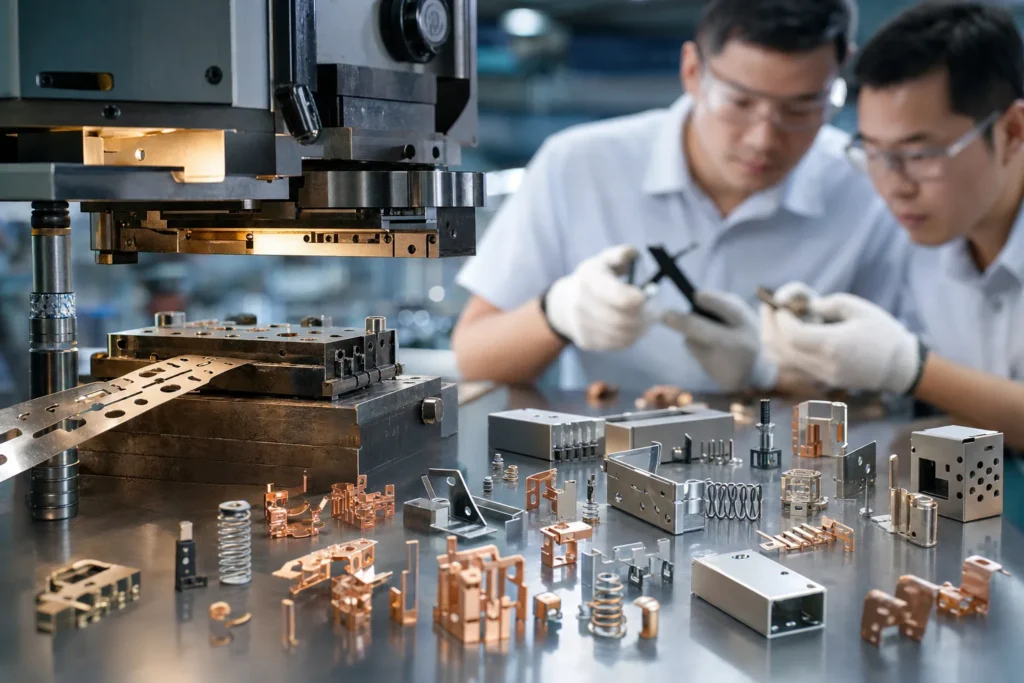
Short answer: Golden samples and limit samples help stamped part buyers define acceptance when a drawing note is not enough. The RFQ should state what the sample controls, who approves it, how it is labeled, how long it is retained, which defects are covered, and whether the sample supports production release, receiving inspection, or temporary containment.
Many stamped part disputes start with words that sound clear until parts arrive: slight scratch, normal tool mark, acceptable burr, light stain, or good fit. A golden sample shows the approved target. A limit sample shows the edge of acceptance. They are useful when visual, functional, or packaging conditions cannot be explained well by dimensions alone.
Use this page with the tooling tryout and sample approval guide, first article inspection checklist, surface finish inspection guide, and plating defect acceptance guide.
Sample approval details before quoting
| Sample type | What it controls | RFQ evidence |
|---|---|---|
| Golden sample | Shows the approved target condition or reference build. | Part number, revision, lot ID, approval date, photos, and storage rule. |
| Limit sample | Shows the maximum acceptable defect or variation. | Defect location, acceptance reason, viewing method, and expiry rule. |
| Reject sample | Shows a condition that must not ship. | Marked defect, measurement or photo, defect class, and reaction plan. |
| Retained sample | Keeps a record for future comparison. | Retention time, storage condition, label, and replacement rule. |
Define what the sample does not control
A sample is not a replacement for the drawing. It should support a controlled drawing, finish specification, inspection plan, or quality agreement. If a dimension is critical, it still needs a tolerance and measurement method. If a plated cyswllt must meet resistance, the sample should not replace the test limit.
State whether the sample controls appearance, burr direction, bend witness marks, plating color, edge corrosion, packaging rub marks, functional fit, or only general workmanship. This keeps the sample from being used too broadly later. For camera checks, connect the sample set to the vision inspection criteria guide so the visual standard can be translated into production checks.
Keep samples tied to revision and lot history
A good sample folder includes the part number, drawing revision, material, finish, production route, tool number, lot ID, approval date, approver, photos, and storage location. If a tool is repaired, finish cyflenwr changes, material changes, or a drawing revision is released, the old sample may no longer represent the accepted condition. Keep the approval rule connected to the control plan checklist so production checks do not drift away from the approved sample.
For cyflenwr transfer, the buyer should decide whether current production samples, historical limit samples, and reject samples travel with the quote package. Samples can show burr side, forming marks, finish tone, packing risk, and real variation that may not be visible in the drawing. They also help receiving inspection avoid rejecting harmless variation while still catching functional risk.
RFQ details to include
- Drawing, revision, material, finish, tolerance notes, cosmetic zones, functional zones, burr limits, and packaging requirement.
- Sample purpose: golden reference, limit sample, reject sample, retained sample, launch approval, receiving check, or containment support.
- Defects covered: scratches, stains, tool marks, plating color, burrs, dents, edge condition, bend marks, flatness, fit, or packaging damage.
- Viewing or measurement rule, lighting, distance, microscope or camera method, fixture, and who can approve sample updates.
- Labeling, storage, retention time, photo record, replacement rule, and whether samples are returned or kept by both sides.
- Prototype quantity, pilot run, annual volume, launch timing, and report format needed with samples.
How to compare cyflenwr answers
A useful answer separates sample-based judgment from measured requirements. It should explain which conditions need a sample, which need a gage or test, and how sample approval will be controlled after revisions. A weak answer only says samples will be approved.
Ask whether the sample set will be used for production operators, final inspection, receiving inspection, or customer approval. Each use may need different photos, labels, and handling. If the part is plated, spring loaded, or fragile, sample storage can affect the reference condition.
Anfon drawings, defect photos, acceptance examples, and sample needs through the cyswllt page. Use the RFQ form to ask for a sample approval plan when the accepted condition cannot be captured by tolerance notes alone.
FAQ
What is a golden sample for rhannau wedi'u stampio?
It is an approved reference part that shows the target appearance, fit, or workmanship condition for a controlled drawing and revision.
How is a limit sample different from a golden sample?
A golden sample shows the preferred target. A limit sample shows the edge of acceptance for a defined defect or variation.
Can a limit sample replace a drawing tolerance?
No. Critical dimensions, force, resistance, hardness, and finish thickness still need written limits and measurement methods.
What should be sent for sample approval?
Anfon drawings, revision, defect photos, sample purpose, inspection method, approval responsibility, retention rule, quantity, and production timing.