
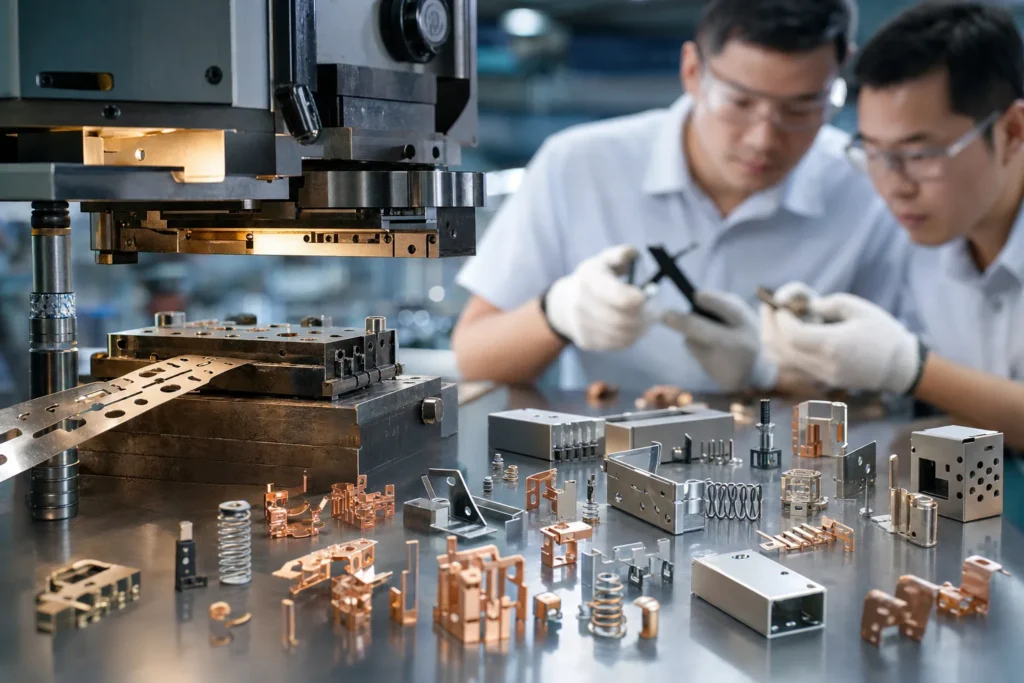
Short answer: Stamped spring clips should be quoted with permanent set and stress relaxation requirements when whakapā force matters over time. The RFQ should define free height, working height, overtravel, material temper, heat exposure, plating, cycling, storage compression, force measurement points, sample stage, and whether force is checked before and after aging or repeated assembly.
A spring clip can look correct at first article and still lose force after compression, heat, vibration, or repeated assembly. For grounding clips, battery contacts, EMI fingers, and latch springs, the important question is not only initial height. It is whether the clip still works after the condition it will actually see.
Use this page with the spring whakapā force test guide, stamped spring clips guide, beryllium copper spring whakapā guide, and vibration fatigue validation guide.
Spring clip set and relaxation details
| Detail | Why it matters | RFQ evidence |
|---|---|---|
| Working height | Free height alone does not prove installed force. | Installed height, overtravel, whakapā point, and test direction. |
| Permanent set | A clip can stay bent after compression and lose whakapā pressure. | Allowed height loss or force loss after compression. |
| Heat exposure | Copper alloys, stainless, and plated clips relax differently under heat. | Temperature, time, sample state, and force after aging. |
| Surface condition | Plating cracks or wear can change resistance while force still looks acceptable. | Plating stack, whakapā zone, visual limit, and resistance check. |
Define force over time, not only shape
Many drawings show free height, material thickness, and a few bend dimensions. That is a useful start, but it does not define long-term function. If the clip is compressed in the final product, ask how force will be measured at working height and what happens after the clip stays compressed, sees heat, or is cycled several times.
Rawa choice should be tied to the condition. Phosphor bronze, beryllium copper, stainless steel, brass, and plated steel do not behave the same after forming and heat exposure. If the buyer has a required force window, the RFQ should state whether the kaiwhakarato is responsible for choosing material temper or only making to a supplied drawing.
Separate compression set from fatigue failure
Permanent set and fatigue are related but not identical. A clip can lose height without cracking, or it can crack after repeated travel while still looking fine in a short compression check. The sample plan should match the field risk: storage compression, repeated mating, vibration, heat aging, or one-time assembly overtravel.
For plated clips, define whether force loss, plating cracks, whakapā wear, and resistance drift are checked together. A clip that keeps force but develops unstable whakapā resistance can still fail. For electrical surfaces, connect the plan to the whakapā resistance guide and the fretting corrosion guide.
RFQ details to include
- Drawing with free height, working height, whakapā point, overtravel, bend radii, grain direction if relevant, and no-touch surfaces.
- Koeke rauemi, thickness, temper, heat treatment, plating stack, underplate, and approved material alternatives.
- Initial force range, force after compression, heat aging, cycling, vibration, or storage condition with sample size and report format.
- Permanent set limit, height recovery rule, visual crack limit, plating crack limit, and whakapā resistance if the clip carries current.
- Packaging rule, whether clips are shipped loose, in trays, on strip, or compressed in a fixture, and shelf-life expectation.
- Prototype quantity, annual volume, current field issue if any, and target launch date.
How to compare kaiwhakarato answers
A useful answer discusses material temper, forming strain, test height, aging condition, and what evidence can be included with samples. A weak answer only says the clip has spring properties. Ask whether the proposed material and process have margin for the required travel.
If the design is still open, request a staged sample plan. Early samples can compare material and force curves, while production samples should prove the actual tooling, plating, and packaging condition.
Tukuna drawings, force limits, working height, aging or cycling conditions, plating needs, and sample quantity through the whakapā page. Use the RFQ form to ask for a force-after-aging report when long-term whakapā pressure is the real risk.
FAQ
What is permanent set in a stamped spring clip?
It is the remaining deformation after the clip has been compressed or loaded, often seen as reduced free height or reduced force at the working height.
How is stress relaxation different from fatigue?
Stress relaxation is force loss under load over time, often with heat involved. Fatigue is crack or failure risk from repeated cycling.
Should spring clip force be tested after plating?
Yes when plating, heat, cleaning, or handling can affect bend behavior, whakapā surface condition, or electrical resistance.
What should be sent for a spring clip relaxation RFQ?
Tukuna drawings, material, thickness, force range, working height, overtravel, heat or cycling condition, plating, sample quantity, packaging, and report needs.